
How to use Studocu AI mock exams to build confidence for your finals


Finals week is coming up, and that nervous exam feeling can show up fast.
You might have notes in five places, a highlighted textbook, and a study guide, and still not know if you’re truly ready. You aren't alone; approximately 30-40% of students globally experience moderate to high levels of test anxiety during exams, according to research published by Library Progress International. A lot of students aren’t only asking, “Did I study enough?” They’re asking, “Can I actually do this under pressure?”
That’s where mock exams can really help, as Studocu AI Mock Exams can turn your course materials into exam-style practice, so you can spot gaps, practice under a timer, and walk into finals feeling more prepared.
Understanding AI Mock Exams
AI mock exams are practice tests made from your own study materials. Instead of using random questions, they use your notes and slides to create exam-style practice. That means the questions feel closer to what you’ve been learning, not a generic worksheet.
With Studocu AI Mock Exams, you upload materials like lecture slides, notes, or textbook chapters. Then the tool creates a practice exam with different question types, plus a timer and scoring. If you’re missing something for a topic, you can also add course documents from Studocu’s library to support your prep.
Why Mock Exams Build Confidence
Mock exams build confidence because they remove the “unknown.” You get used to the kinds of questions, the timing, and the pressure, before it actually counts. According to a study by McKinsey, personalized AI learning can help students do better by up to 30%, demonstrating their effectiveness in exam preparation. When you practice with a timer (even sometimes), you learn how to pace yourself. That makes exam day feel more familiar, and that familiarity can make nerves feel more manageable.
Getting Started with Studocu AI Mock Exams
Preparing Your Study Materials
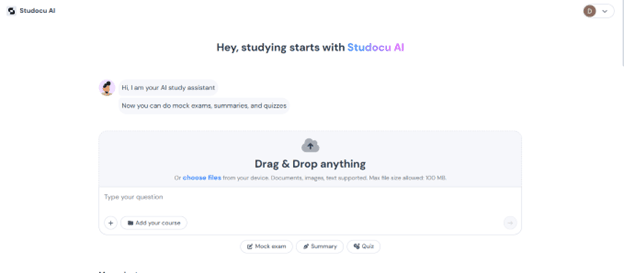
Start by pulling your course materials into one place, which can include lecture slides (like PDFs), typed notes, and even class recordings you saved. The more complete your materials are, the more helpful your practice exam can be.
If you’re missing notes for a topic, you can check the Studocu Library of over 50 million documents shared by students in your course or school. That can help you fill small gaps without starting from zero.
Creating Your First Mock Exam
After you upload your materials, choose the “Mock Exam” option. Studocu AI uses your documents to build a practice exam with a mix of question types, like multiple choice, short answers, and longer responses. For example, in Microeconomics, you might see questions on consumer choices, elasticity, and market equilibrium.
To make your practice more useful, be intentional about what you include. You can start with one lecture or one chapter if you want a smaller practice set. Then you can add more documents later for a full exam-style run. Each new mock exam can give you fresh questions, so you can practice the ideas, not just the answers.

Using Mock Exams Strategically
Building a Practice Schedule
Add mock exams to your study plan in a simple way and start small early on, like shorter practice runs, and work up to full-length mock exams closer to finals. Spacing your studying (instead of cramming) can help you remember more and feel less stressed. A study published on the National Library of Medicine found that "spaced learning" resulted in retention gains much higher than standard cramming.
Try focused study blocks with short breaks, and when you take a mock exam, do it at a time when you’re usually sharp, so it feels closer to a real exam day routine.
Analyzing Your Performance
After each mock exam, don’t just look at the score and move on. Take a few minutes to review what you missed and understand why it was wrong. Studocu shows results and feedback after you submit, so you can connect mistakes back to the right topic.
Also, look for patterns: are you missing the same kind of question again and again? That’s your study “to-do list.” Then make your next mock exam using the materials that cover those weak areas, so your practice stays targeted and useful.
Building Confidence Through Repetition
Simulating Real Exam Conditions
Studocu AI Mock Exams include a timer and scoring, so your practice feels more like a real exam. That matters because finals aren’t only about knowing the content. They’re also about staying steady when the clock is running.
To make it feel even more real, try a simple setup: sit at a desk, remove distractions, and write answers within the time limit. The more “real” your practice feels, the less shocking the real exam will feel.
Tracking Progress Over Time
Save your mock exams and look back at your past attempts. When you can see your scores improving over time, it’s easier to trust your study plan. That kind of progress check can also lower anxiety, because you’re not guessing anymore, you have proof you’re getting better.
Mock exams also build test skills as you practice reading questions carefully, pacing yourself, and choosing what to do first. You also learn when it’s smart to skip a hard question and come back later. Those strategies can lift your score even when the content feels tough.
Reducing Exam Anxiety with AI Support
Exam anxiety is common, even when you’ve studied a lot. It often comes from not knowing what to expect, worrying about your score, or remembering a past exam that went badly. Mock exams help because they turn that fear into something you can practice. The results are real: a January 2026 report by Tutorful highlights that students who practice testing outperform those who just restudy by an average of 15%. You’re not walking in cold anymore.
Mock exams also work like a “mental rehearsal.” Each time you practice, you teach your brain, “I can handle this.” And because it’s practice, the stakes are lower. You can learn from mistakes without the panic.
Mock exams help most when you pair them with basic self-care. Sleep, breaks, water, and a short reset walk can make your study time more effective and your exam day calmer.
Maximizing Your Mock Exam Results
Mock exams push you to do active recall, which means you have to pull answers from memory instead of just rereading notes. This kind of practice is powerful because it helps you remember information longer than passive review.
Studocu also has a big student community, so you can learn from materials that other students have shared. Sometimes a topic finally clicks when you see it explained a different way. Combined with mock exams and feedback, this helps you focus on what you actually need to study, instead of spending time on things you already know well.
Conclusion
Exam confidence usually isn’t about studying more hours. It’s about studying in a way that shows you what you know, what you don’t know yet, and what to do next. Studocu AI Mock Exams help by giving you realistic practice and clear feedback, so you can stop guessing and start improving.
If you’ve already practiced under exam-like conditions a few times, finals won’t feel like a surprise. You’ll know how the timing feels, you’ll recognize your weak spots, and you’ll have a plan. That shift, from “I hope I’m ready” to “I’ve practiced this”, can change everything.