
Australia find fleeting distraction from Sandpapergate with victory over England
TO describe the circumstances surrounding England's white-ball tour of Australia as distracting would be a bit like describing Yorkshire as the greatest county in the whole of Christendom. A statement of the bleedin’ obvious, in other words, as Sandpapergate continues to dominate.

The build-up to Saturday’s first of five T20 internationals in Melbourne was no different, as Josh Hazlewood, Darren Lehmann and Todd Greenberg had their say. Hazlewood threatened to quit international cricket if Pat Cummins was removed as Australia’s Test captain, Lehmann reiterated that he did not know that sandpaper was being used to alter the condition of the ball during the 2018 tour of South Africa, and Greenberg publicly backed Cummins in his capacity as Cricket Australia’s chief executive. Where it will end is anyone's guess, although a satisfactory resolution seems unlikely, given that there are more versions of the truth than you could shake a sheet of sandpaper at.
That everyone involved would just like the whole thing to go away as quickly as possible is clear; if only wishes were horses, as the old saying goes. The one-day international series that has just ended felt like a sideshow amid all the controversy, and this quintet of T20s is doomed to be of similarly secondary importance. At least Australia had something to cheer about with a much-needed win, prevailing by three wickets with one ball remaining in a high-scoring encounter at the MCG.
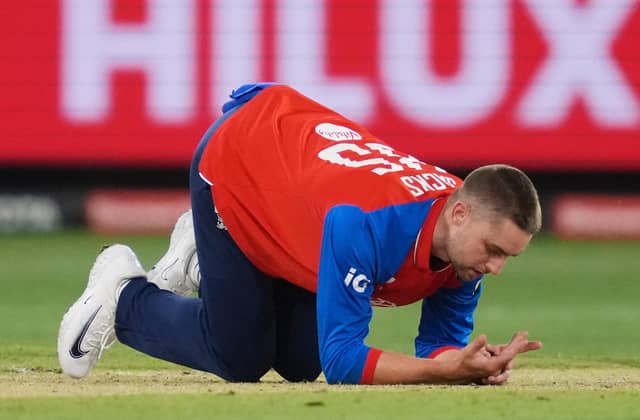
After England posted the highest T20 international total at the ground, 187-9, Australia immediately surpassed it. Nikhil Chaudhary, the 30-year-old all-rounder, followed up the best bowling figures of the match (2-21 from four overs) with the highest individual score (66 from 38 balls) to deservedly claim the player-of-the-match award. Chaudhary was part of a much-changed Australia side as the big guns were rested ahead of the New Zealand Test series, with Sam Harper and Lachlan Shaw handed their debuts. Henry Crocombe made his first T20 international appearance for England, who are also without a number of players who took part in the 2-1 ODI series win, as they look ahead to the forthcoming Test series in South Africa.
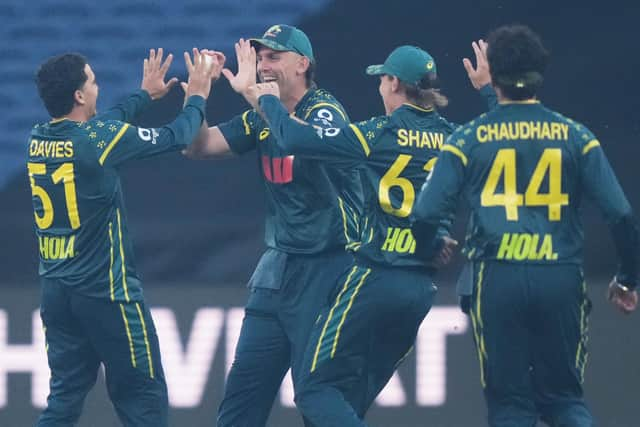
The quality of cricket was invariably diluted, not least by Australia’s terrible catching. After sending England in, they grassed four chances in the first five overs, and six overall. They gave two lives to Harry Brook, who made them pay with England’s highest score, 65 from 28 balls, with six sixes and four fours. His blistering innings was ended by that man Chaudhary, who had him caught behind as he tried to glide the ball past the wicketkeeper.
Phil Salt had fallen to the first ball of the match, picking out Mitchell Marsh at mid-off, and Aneurin Donald’s scratchy innings ended with a hoick to the same man in the same position. Helped by the butter-fingered fielders, Brook and Banton - who was also dropped twice - added 97 for the third wicket off 41 balls, the highest stand of the contest. When Brook was the one to fall at the end of the ninth over, England had 110 on the board and the platform was there for a total well over 200. That platform was wasted.
Banton clipped Ben Dwarshuis to deep mid-wicket, where the debutant Shaw incongruously pulled off an absolute screamer, diving full-length on the run. After Banton fell for 39 off 22, England slipped to 123-5 when leg-spinner Adam Zampa pinned Will Jacks lbw. Chaudhary got his second when Sam Curran skied to Shaw at deep point, then Jordan Cox was taken at deep mid-wicket for 27 off 30. Jamie Overton was bowled by a fine slower ball from Jack Edwards, and Liam Dawson was run out off the final delivery.
Australia also lost a wicket in their first over, Dawson bowling the advancing Jake Fraser-McGurk. Marsh and Harper added 50 in five overs before Harper’s 32 from 15 was ended by Crocombe, who had him spooning a catch to point. Marsh thought he had been run out by a direct hit from Overton at mid-on as he tried to pinch a single and was halfway off the field before replays showed he had just made his ground. He had made 37 from 32 when he was finally sent packing, well caught by Dawson at short fine leg off Curran to leave Australia 95-3 in the 11th over.
The lesser-spotted Adil Rashid had Tim David lofting to long-on, then Jacks had Shaw caught in the covers and Joel Davies at mid-wicket (156-6). But Jacks’s night ended painfully with blood pouring from his bowling hand after he tried to take a fierce return chance off Dwarshuis, with Crocombe called on to complete the over. All the time, Chaudhary was playing a splendid hand, hitting cleanly all around the ground. Overton eventually had him caught at deep backward square, but Edwards kept his cool to see his team home. With 11 runs wanted off the last over, he hit Curran’s first ball for six and his penultimate one to the backward point boundary, the Sandpapergate saga temporarily forgotten.