
Brian Close: Remembering Yorkshire CCC 's daring, defiant and daft hero
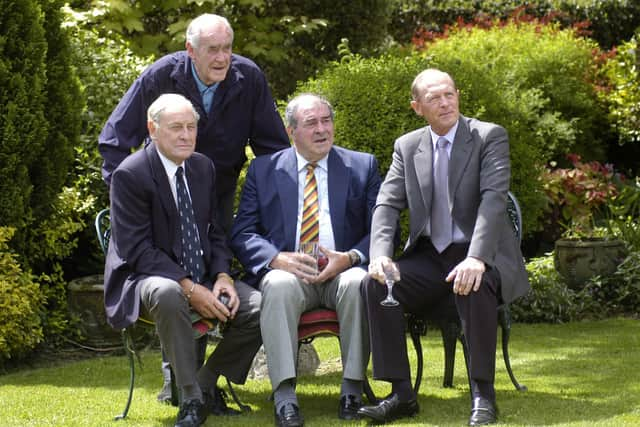
OF the so-called Four Greatest Living Yorkshiremen (Fred Trueman, Brian Close, Raymond Illingworth and Geoffrey Boycott), only one of whom (Boycott) is actually still living, I always found Close the most challenging to deal with.
Requests for comment on a cricketing matter invariably drew a reply along the lines of “I’m busy at the minute, ring me tomorrow.”
Although this was never said impolitely, it could be frustrating in a world of impending deadlines and impatient sports editors.
When I did manage to get Close’s ear, sometimes in person at his local golf club, one never quite knew when he might suddenly break off to take an important call from his bookmaker and/or consult a copy of the Racing Post.
Sometimes, conversations would end abruptly… “Right, I’ve got to go.”
“Brian, I was just going to ask as well…”
“Ring me tomorrow.”
It was with a sense of ambivalence, therefore, as opposed to what might be called reverence, that I approached a new book about Close by Stephen Chalke, one of the game’s finest and most prolific authors.


Chalke, who has also written biographies/collaborated with famous Yorkshire figures such as Bob Appleyard and Geoff Cope, perhaps fits into the category with which some reading this might themselves identify – that of regarding Close as something of a boyhood hero.
That does not affect Chalke’s objectivity in One Hell of a Life, and of course there is no law that says that a boyhood hero should dance to the tune of the local press either.
Close would not be the first to enjoy – as I always suspected he did – toying with the media and, I would go further, being purposely awkward, an extension, no doubt, of his obstinate personality.
It was not long into this excellent book, one which paints an evocative picture of a truly singular man, that I appreciated that Close had not always had the easiest of rides from the Fourth Estate in years gone by, which maybe explained a little of his attitude.

He got on well with some journalists, no doubt, writers who championed his cause as a player and captain.
But what a rough ride he had at times too, during a career in which he suffered more than his share of brickbats and criticism, so much of it undeserved.
Although there was truth in the fact that he did not always help himself, something that can be deduced by the book’s subtitle, which describes him as “daring, defiant and daft”, Close – a bit like the equally colourful Trueman – was often a scapegoat and a focal point for snobbery, not least from the infamous MCC types after the war.
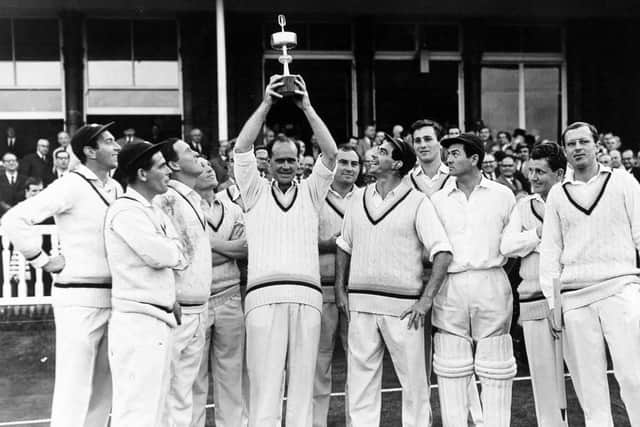
The pattern was set on his first England tour to Australia in 1950-51.
Having become England’s youngest Test debutant in 1949, aged 18 years and 149 days, a record that survived until Rehan Ahmed shaved 23 days off it two years ago, Close had a disastrous experience Down Under, fulfilling the warnings of many sage observers who predicted that he was too young and that selection could damage his development.
He was “naive and unworldly”, he later conceded, his relationship with his team-mates breaking down.
They considered him difficult to understand and swollen-headed; conversely, they appeared to be rather better cricketers than empathetic colleagues.
Criticism of Close – in particular for a shot just before lunch on day two of the second Test in Melbourne, with the match at a critical stage – took him by surprise and hung over him for years.
He attempted a sweep (not the done thing in those days, old boy) against the spinner Jack Iverson and lobbed up a catch, returning to the deathly silence of the dressing room.
“Let the blighter stew,” roared Freddie Brown, the England captain, when told by one of the Australian players that Close seemed “a bit down” and “needs a little help”.
If that could perhaps be excused as a skipper wishing to teach his young charge a lesson, the press tore into the teenager in brutal style, laughably so from this distance and the anything-goes era of Bazball.
Jack Fingleton, the former Australian batsman-turned writer, fumed that Close “should be made to work his passage home on a cargo ship” after a “sickly, anaemic hit” that was “nightmarish” (tell us what you really think, Jack).
Jim Swanton, the haughty yet influential Daily Telegraph correspondent, described the shot as “inexplicable in any cricketer, irrespective of age”, and later blustered that he had never seen “a worse stroke played in a Test by a reputable batsman at such a moment”.
For that miscued sweep, Close spent four-and-a-half years in the wilderness and, from a possible 244 Tests that England played between his first and last appearances, featured in just 22 of them across 11 series, figures that did scant justice to a man who scored just under 35,000 first-class runs and took almost 1,200 wickets.
Close’s only other Ashes Test, at Old Trafford in 1961, was marred by comparable controversy when he fell cheaply after sweeping and swiping at Richie Benaud bowling round the wicket, John Woodcock whining in The Times that the innings was “best talked about in whispers”, and that Close batted “as if he was out of his cricketing senses”.
If not quite out of his senses (Close insisted that his strategy was all about trying to win the game), the phrase nevertheless seems apposite to his life overall, one in which words such as “crackers” and “nuts” were often aimed in his direction, albeit affectionately.
He was an habitual risk-taker to the point where, after reading this book, which suggests no obvious explanation for the formation of a character trait that also revealed itself in an abnormally fearless physical courage, one was left to wonder, in fact, whether Close perhaps suffered from some sort of undiagnosed medical disorder; certainly that would explain a lot about him and his complete blindness to, and utter disregard for, any type of hazard.
This was someone who “ran towards the danger” long before Brendon McCullum, the England head coach, thought of the term – or, to be more exact, drove towards it at terrifying speeds, his life full of car accidents and mishaps.
Stories abound of Close driving around like a maniac, a copy of the Racing Post on the steering wheel, maybe pouring himself a coffee in the outside lane, to the extent that - funny as they are, because they are thankfully bereft of tragedy - Close was quite obviously a danger to society as well as to himself, someone who should have had his keys taken off him when he was sober.
One Hell of a Life - beautifully written, as are all books by Stephen Chalke, pacy and well-structured - deals well with Close’s loss of the England and then Yorkshire captaincy, the former rooted in yet more snobbery after he had won six and drawn one of his seven Tests in charge, setbacks that hurt and haunted him to the end.
One gets a sense of what made him such a great and successful captain, a terrific tactical brain fusing with a relentlessly attacking approach and that peculiar physical courage that would have inspired the weakest of men, all wrapped in a healthy and very useful – for leadership purposes – veneer of “you mess with this guy at your peril”.
As with the stories concerning his driving, there are numerous tales here of Close fielding suicidally near to the bat, never asking anyone to do what he wouldn’t do himself, another mark of great leadership, and taking numerous blows about the body.
Sometimes, chances would rebound to team-mates off his dome-like forehead, his only concern, as they rushed to his aid, “did you catch the bloody thing?”
The enduring public images of this colossal figure, one who could be as generous and funny as he was competitive and malice-free, a man who led Yorkshire to four County Championships and two Gillette Cups, are of his poor body beaten black-and-blue after facing Wes Hall at Lord’s in 1963, and then batting for dear life against Michael Holding at Old Trafford in 1976, when, at the age of 45, he was recalled by England for one last hurrah.
Watching Close swaying out of the way at the last second, as Holding aims at his helmetless head in footage easily found on YouTube, is genuinely terrifying; Holding could easily have left Manchester that day with blood on his hands and a lifetime of remorse.
Would Close have wanted it any other way? I doubt it.
As with Jaws, the indestructible figure of cinema, Close somehow survived it all until lung cancer finally claimed him in 2015 at the age of 84; it almost goes without saying that the inveterate risk-taker was still smoking 40 cigarettes a day while undergoing radiotherapy, damned if he was going to forgo “my only pleasure in life”.
I last spoke to him, I think, in that year of his death.
We were doing our annual Yorkshire CCC pre-season pull-out, a part of which featured the predictions of former players as to how they thought the side might fare.
I rang Close a day before I needed him, anticipating the reply.
“I’m busy at the minute, ring me tomorrow.”
When I did, he kindly gave me his opinions before I asked, as I had to ask everyone, for a “player to watch”.
The line went silent.
“I’m watching them all,” he eventually croaked.
What a response. What a character. What a man.
One Hell of a Life - Brian Close: Daring, Defiant and Daft, by Stephen Chalke, is published by Fairfield Books, priced £20.