
Cricket fixtures: 2026 offers a better spread but concerns remain - Chris Waters
THE Impossible Job, they say of managing the England football team and, it would seem, now the BBC too.
Both of those roles are child’s play, though, compared to that of devising the county cricket fixture list, a task so thankless that it might be easier to find a cure for the common cold.
With four domestic men’s and women’s competitions, including The Hundred, the fixture planners are on a hiding to nothing.
Of course, it’s what happens when you try to fit a quart into a pint pot, to borrow the idiom, an inevitable consequence of competing priorities, sporting and commercial.
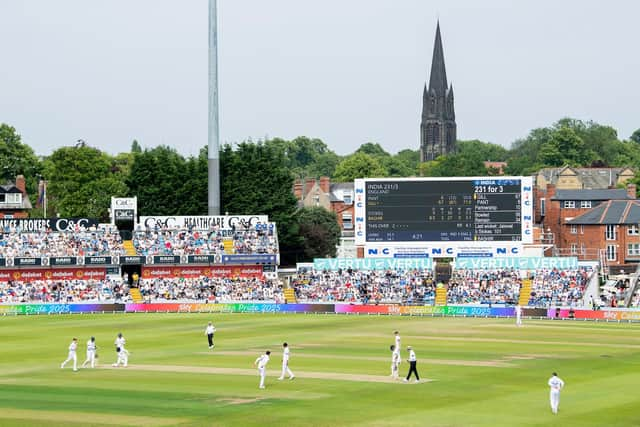

On the face of it, given the various challenges and complexities therein, next summer’s fixture list (the bulk of which was announced on Thursday, following that of the T20 schedule on Tuesday) makes, in this view, the best of a bad job.
It’s a bit cleaner than last year, with the 14 County Championship rounds split into an early-season block of six, a midsummer block of two (during the T20) and another block of six to finish the campaign, although there is precious little wriggle-room in that last sextet.
The T20 is now done and dusted quickly, with the men’s and women’s Finals Days taking place less than a week after the respective group stages finish. Last season, the men’s Finals Day was held around two months after those group stages, an unacceptable amount of time for teams and supporters to wait, in which the narrative of the competition naturally waned.
Even the Professional Cricketers’ Association (PCA) is pleased with the changes, an organisation which likes to whinge about player workload as often as possible without ever connecting it to the advent of The Hundred, and so losing credibility. The PCA also welcomed the significant reduction in back-to-back T20 matches and reduced travel by returning to regionalised groups.
Such a satisfyingly condensed narrative is not quite there in the One-Day Cup, which runs alongside The Hundred and sees a gap of just over one calendar month in the men’s competition from the end of the group stages to the final, if only a one-week gap in the women’s event.
There are some who would like to see the One-Day Cup played much earlier in the season, perhaps affording opportunities to pick stronger teams, although it does have advantages in its current location, giving chances to younger players and also to supporters to watch more games at outgrounds.
The Championship schedule, of course, remains a hot topic, with no change to the 14-match format despite endless discussion.
Various proposals were mooted in the recent domestic review - including a reduction to 12 or even 13 games - but the status quo has stayed, leading to a top division of 10 teams (including Yorkshire) and a second tier of eight.
This remains an imperfect solution, with Yorkshire playing five of their opponents home and away, and the other four only once. This is calculated, by the way, on a complex seeding and pairing system which explains, for instance, why Yorkshire have only one game next summer against Nottinghamshire, the champions.
In a nutshell, the counties are seeded from one-to-10 based on where they finished last season, with Nottinghamshire thus seeded first and Glamorgan (who took the second and final promotion place) seeded 10th.
The teams are then split into five pairs based on those finishing/seeding positions - Nottinghamshire (1st) and Surrey (2nd); Somerset (3rd) and Sussex (4th); Warwickshire (5th) and Essex (6th); Yorkshire (7th) and Hampshire (8th); Leicestershire (9th) and Glamorgan (10th).
Each county plays home and away against the other county in its pair (hence, Yorkshire play Hampshire twice), then twice against one county from each of the other pairs, and once against the other team.
This explains why, if you go through the pairs, Yorkshire play Nottinghamshire once and Surrey twice; Somerset twice and Sussex once; Warwickshire twice and Essex once; and Leicestershire twice and Glamorgan once. Understanding how these games are decided, however, is predictably confusing.
Essentially, they are worked out based on an aggregate seeding number (usually around 27) to ensure as much equivalence as possible when it comes to the teams each county plays twice.
For example, by playing twice against Surrey (seeded 2), Somerset (3), Warwickshire (5), Hampshire (8) and Leicestershire (9), that adds up to 27 exactly in Yorkshire’s case, and explains why they then face Nottinghamshire, Sussex, Essex and Glamorgan only once.
If you have managed to even remotely grasp all of that and keep up with me to this point, then pour yourself a glass of something nice and refreshing. They say that cricket’s a complicated game, but some of us don’t believe ‘em.