
Dickie Bird: My last encounter with cricket legend emphasised his extraordinary appeal - Chris Waters
HE was sitting, as usual, on a bench overlooking the North Bay at Scarborough, as beautiful a spot as the old eyes had seen.


“I love it here,” he told me, staring out to sea. “The years come and go but this place never changes. I could sit here for hours. I really could.”
I had stopped, as I always did, to say hello to the great man as I walked past the rows of black benches along Queen’s Parade.
It is as much a ritual for me before a day’s cricket at North Marine Road as it was for Dickie Bird, a pre-play visit to the edge of the cliffs to look down across the sands, the strays, the walkers and the waves.
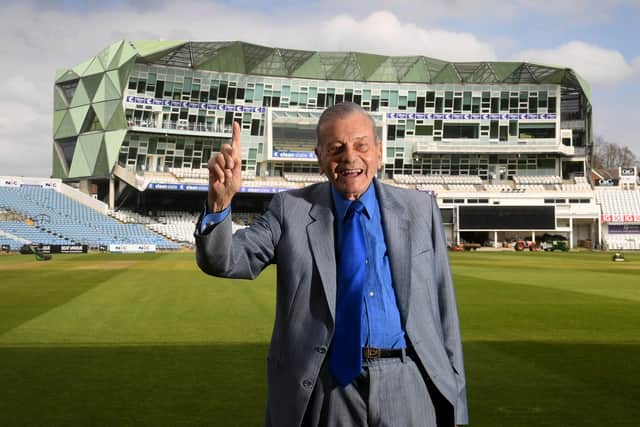
As regular as clockwork – as regular as The Dickie Bird Clock at Headingley cricket ground, you could say – I always knew I would find him there.
As John Masefield put it in the poem Sea Fever… “I must go down to the seas again, for the call of the running tide. It is a wild call and a clear call that may not be denied. And all I ask is a windy day with the white clouds flying. And the flung spray and the brown spume and the seagulls flying.”
Year after year, Dickie had to go down to the seas again.
It was on that windswept bench at Scarborough, just a short month ago, that I last saw him, looking as well and as spry as he had for some time.
One is hardly shocked at news of a nonagenarian's passing – certainly not one who has had his share of health problems – but it was still a shock to hear of Dickie’s death at the age of 92, peacefully at home in South Yorkshire, effectively of ripe old age, which is perhaps the way we should all want to leave for the great pavilion in the sky when the time – may it be long hence – comes to us all.
What I remember most about that last encounter was not of the kind, weather-worn face looking out across a lively North Sea, the blue eyes softly twinkling, the smile wider than the sea itself accompanied by soft chuckles at regular intervals, or of cricketing conversation past or present, but of Dickie’s popularity right to the end.
To sit with him for a time, as I often would and did on that occasion, was to witness the enduring appeal of a man who transcended the game, one for whom the hackneyed term “national treasure” was never more appropriate.
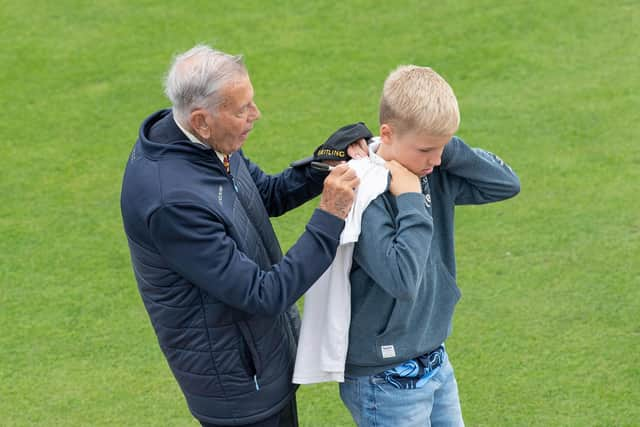
For people came up to Dickie on a regular basis that day, as they always seemed to do, Yorkshire fans who had turned up for the day’s play, or simply general passers-by, still fascinated by a man whose warmth was infectious and who was more approachable than a cuddly toy bearing the placard “feel free to approach and cuddle me”.
“Hello, Mr Bird,” the strangers would say.
“Hello, are you alright?” he would reply, adding such as “it’s very nice to see you” and “I hope you have a good day”, even though he didn’t know them from Adam – or Eve for that matter.
That’s because not only did Dickie have time for people – he was of the people. Not detached. Not bigger than the person who wished him good day and invariably a fond goodbye, too.
He was of a bygone time. Old-fashioned, decent, well-mannered, respectful. He played in an era before money changed sport and knew something of the real world, too.
With apologies to one chap who spoke to him that day at Scarborough, who announced himself as a Sunderland FC supporter off memory, his words to the great man did make me laugh.
After sidling up behind him, as if he couldn’t quite believe the evidence of his senses and needed to inspect the situation a little more closely, he eventually plucked up the courage to ask: “Excuse me, are you Dickie Bird?”
“Aye, I am that, lad. And what’s your name? It’s very nice to see you. I hope you have a good day…”
Eventually, as the procession of admirers continued but the start of play approached, it was time to tap Dickie on the shoulder and say, “Come on, Dickie, perhaps we’d better be heading into the ground now.”
“What time is it, lad?”
“They’ll be starting in about half an hour.“
“Oh right. Aye, we’d better.”
After accompanying him through the gap between the guesthouses on Queen’s Parade and across the adjoining North Marine Road, where there were more admirers and pleasantries to be had, Dickie made his way into the ground as the King might make his way through the crowds into Buckingham Palace.
As he walked – without aid and still steady on his feet – a thought hit me as clearly as the hostile bouncer from the former England fast bowler Frank Tyson that felled Dickie at Scarborough in 1958 and brought tears to his eyes - “the fastest ball I never saw”, as he put it.
Namely, that he was easily as popular and recognisable as any of the modern players – if not more so.
A nonagenarian – long retired as a player and umpire – who could still command huge levels of attention and respect. It was remarkable when you thought about it.
When I said cheerio to him that day, little did I imagine the sad news that would follow – and so soon.
Alas, there is a bench on Queen’s Parade, Scarborough, with its spectacular views out to sea and the town’s stunning coastline, that will henceforth be without the most famous and well-liked man who ever sat down on it.
Goodbye, Dickie.