
Down down deeper and down but status quo remains
IN a turn of events that provides a refreshing if controversial antidote to the increasing footballisation of cricket, the post-Ashes review has concluded without any sackings.
Why, it turns out that there was nothing to see here after all.
Brendon McCullum is still the head coach, Rob Key is still the managing director of England men’s cricket, and, of course, the untouchable Ben Stokes is still the Test captain.
England have gone down down, deeper and down in recent times but the status quo remains, confirmed by the England and Wales Cricket Board at Lord’s on Monday.
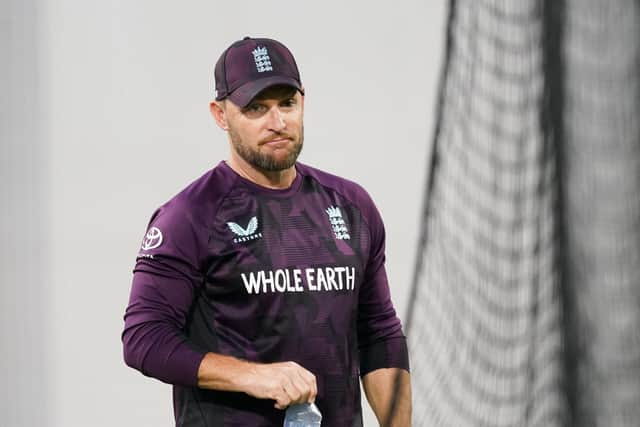

Justifying the move, Richard Gould, the ECB chief executive, cited football’s hire-and-fire culture in perhaps unconvincing defence.
“My old man was a football manager,” said Gould, son of former Wales and Wimbledon boss Bobby and briefly threatening to break out into a burst of Lonnie Donegan’s ‘My Old Man’s a Dustman’.
“Sacking was part of the job. It didn’t necessarily do the right thing.
“Moving people on can sometimes be the easy thing to do. That’s not the route that we’re going to take.
“I’ve seen the driving ambition and determination that we’re lucky enough to have within our leadership group to take the lessons from the Ashes and move forward.
“I think what we’ve seen is a determination from all those involved to adapt and evolve, to understand that there are different ways of doing things.
“We’ve got a lot of people hurt by what went on during the Ashes, but equally determined to now put things right and looking forward to seeking revenge (against Australia) in 2027.”
Gould, a former chief executive of Bristol City FC, was speaking alongside Key as they discussed the findings of a review into a tour that was blighted by poor planning, excess drinking and substandard performances, culminating in a 4-1 spanking that was supposed to be the apogee of the Bazball project.
Reflecting on McCullum’s position, which sees the New Zealander bank more than £1m a year from a contract with another 18 months left, Gould said that “a lot of consideration” had gone into matters rather than simply following public opinion.
“Cricket is a very unique sport in that it takes a team of leadership,” he said. “It’s not like football where there’s a single point of failure or success with a manager.
“We do keep a very close eye on all of our supporters (views). We have a variety of different means, and it’s not just through the formal media that we do that, but neither are we going to select or deselect management based on a popularity campaign.”
Gould went on to deny suggestions of any “bust-up” between Stokes and McCullum, who appeared to misalign as the tour went on, and said that England do not want McCullum to "completely change” but rather to “evolve”.
He admitted that the behaviour of some players had been “unprofessional” but there was no “easy fix” to cricket’s relationship with alcohol, saying that if you “treat everyone like schoolkids” they could “rebel”. Gould admitted that only 30-40 per cent of the post-Ashes review covered what might be termed new ground and that England “need to stop having to relearn old lessons”.
And that, in effect, was that – with what had been billed as a “thorough review” into the Ashes merely covering territory long raked over ad nauseam in the media.
Nor is the ECB going to publish this homework, although it could be summed up in a single sentence - “We made a reight pig’s ear of t’situation and we all wants shooting”, or words to that effect.
Of course, it is a fundamental principle that everyone deserves a second chance, and the ECB at least avoided scapegoating one or two people for a collective failure.
Either they should all go or they should all stay was the preferred option hereabouts, albeit with a slight preference, were a gun pressed to the temple for a definitive option, for the former.
The biggest problem, it appeared to this pen, and one highlighted once more on Monday, was that the ECB and Key especially didn’t just admit that a few things were wrong in Australia and around the set-up generally, but pretty much everything was wrong – be that the lack of warm-up games Down Under, the absence of specialist coaches, the whole off-field culture, the cosy team selections, the decision-making of players at critical times, the declining relationship between England and the counties, you name it. That cannot possibly inspire confidence among England’s supporters.
At the same time, the decisions - or non-decisions - have been made. The show rolls on - to the New Zealand series in June and, soon enough, to the next Ashes when, should that go pear-shaped too, even football’s League Managers Association could be forgiven for demanding that the heads of the cricket chiefs roll.