
Former Sheffield Wednesday midfielder John Harkes on bringing football back to the USA

When the World Cup returns to America this summer, it will find a footballing nation in an infinitely healthier place than when it left in 1994. Former Sheffield Wednesday midfielder John Harkes is proud of the part he played in that, and continues to.
USA 94 was about resuscitating football in the market it always wanted to conquer; co-hosting 2026 is about building on strong foundations.
When Harkes made his World Cup debut at Italia 90, he was not yet a professional thanks to the demise of the North American Super League (NASL) – though the Owls would soon put that right.
Now Major League Soccer (MLS), set up in 1996 as a condition of the US hosting football's blue riband event, draws names of the same calibre as those who graced the NASL – for Pele, read Lionel Messi – but with a proper structure underpinning it.
These days Harkes is technical director of McClean, an independent club in his native Virginia with boys and girls' teams from under-three to under-19s. That it is a full-time job for a 90-cap international who played in Premier League midfields for the Owls, Derby County, West Ham United and Nottingham Forest, speaks volumes for the enthusiasm for the game in his country.
"It just seems to have gone on absolutely leaps and bounds since that (1994) World Cup," says Harkes. "There's no better platform than a World Cup to help elevate the awareness of the game.
"We on the men's side are catching up to the rest of the world. Eight years ago I went to Sheffield Wednesday for their 150-year anniversary. It keeps things in perspective."
Football false-started in America after the 1967 formation of the NASL. It was built on shallow celebrity foundations, and collapsed when Harkes was 17.
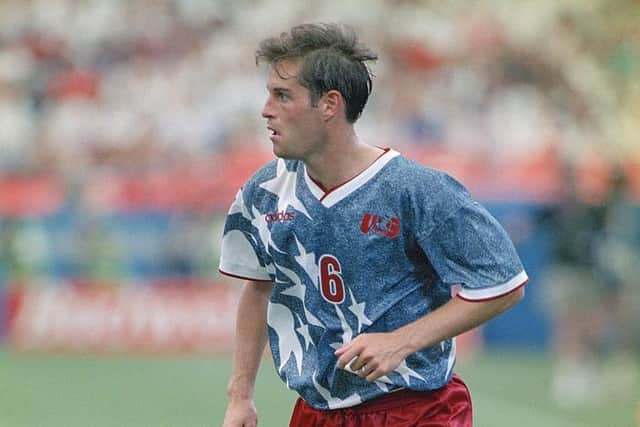

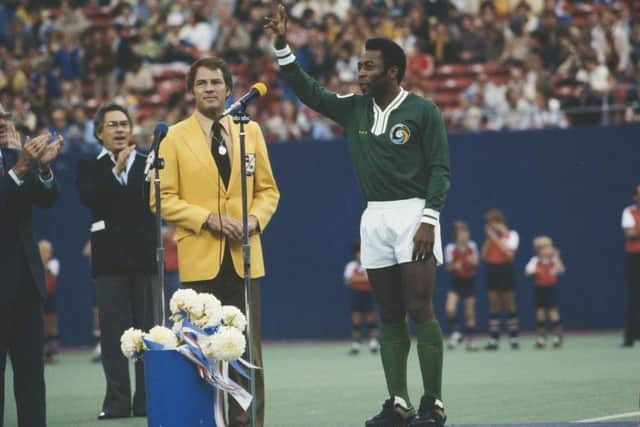
"I was a ballboy for the NASL (New York) Cosmos – Pele, (Franz) Beckenbauer, Johan Neeskens and all those guys," he recalls. "That's what inspired me to play the game so we didn't want it to fold. Luckily we had a lot of philanthropists like Lamar Hunt that kept the game alive."
Harkes traces the second coming of football in his country to the 1984 Olympics, which took place in Los Angeles just as the NASL was breathing its last.
"I think FIFA looked at that and thought, ‘Wow, this is something in the United States, this is our next testing ground, this is where we can grow the game,’” he argues.
"To qualify for 90 almost defied the odds. On the last day in qualifying in 89 in Trinidad and Tobago, all they needed was a draw. We needed to win in 95F temperatures and a hard pitch. Everybody in the stadium was wearing red and against us. We’d been absent from the World Cup since 1950 and the big upset over England 1-0.
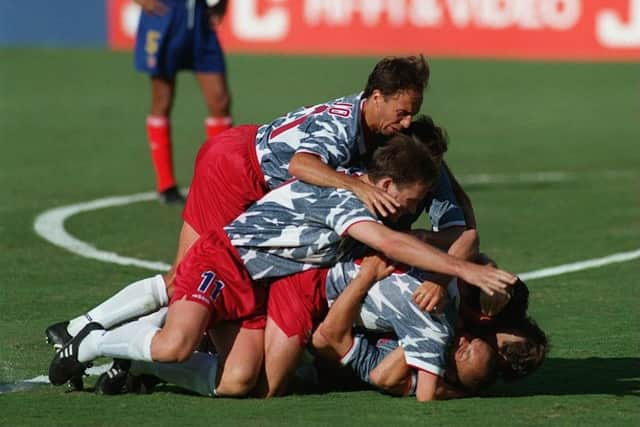
"In 94 there was a lot of unknowns going into that World Cup, certainly how well we would do. We were still young players.
"There were so many great games building up to that. One was against England who we beat 2-0 in Boston (in 1993). I was at Sheffield Wednesday and Carlton Palmer was saying, 'We're going to crush you.'
"First of all I got him to pay the money he owed me, but second of all it was a lot about us proving ourselves. There was only about six or seven of us (playing) overseas.
"Around the world, people were saying why would you give it to the US, they're not a soccer nation? But we pulled it off.
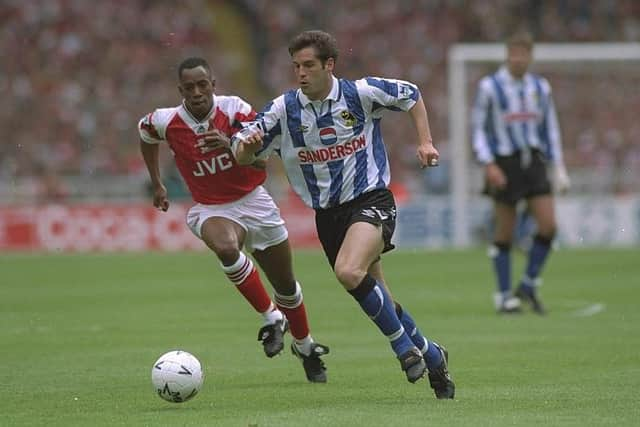
"Getting a draw in the first game, the first indoor World Cup game, it was crazy. Colombia were picked by Pele and many others to win that World Cup because they beat Argentina in the qualifiers 5-0 in Argentina. We beat them 2-1.
"We didn't do that well against Romania (losing 1-0) but I hit the post and we could have equalised and maybe won."
They qualified for the last 16 as a third-placed team, only to run into eventual winners Brazil and another narrow 1-0 defeat.
"It still holds the record for the best-attended World Cup," says Harkes. "It was really an immigrant game. I'm a son of Scottish parents.
"We needed to get the fans on board, which we did in 94, and it catapulted everything from the commercial side, aligning with MLS starting in 96. And here it is, 30 years on, really strong. The level of play is much better across all the teams and the women's NWSL is doing extremely well.
"Previously some of the best players in the world were coming over just to see the end of their careers and what Major League Soccer didn't want to do was repeat that. It was about building up more players from the American side. The infrastructure financially was really poor back in the day.
"I wanted to prove to the world that the US can play so breaking into Sheffield Wednesday and being the first American in the Premier League was pretty amazing. But to come back here and make sure that we had a professional level in our own country, that's what I always wanted to do.
"There was a lot of scary times where it could have failed. It could have gone away in 98 and 99. There's rumours it was a signature away from folding.
"The breakthrough came as we started to consistently get to World Cups – 2002 was a great World Cup after a really horrible 98 in France. We got to a quarter-final, the best we have gotten so far, and started to prove slowly we are a nation that can play, produce the players and the right managers."
The sheer size of the country is not always the advantage one might expect.
"St Louis, they call it Soccer City," says Harkes. "We call Carnegie, Soccer Town, USA. Everybody's fighting for that. We are a vast country, and it's difficult for football to get in every little dark corner.
"I covered three World Cups for ESPN and Fox. Stuart Holden called an Iceland game and he was like, 'I don't get it, how can such a small country, be so successful?'
"I said, that's exactly why they're successful, because they're smaller. They can communicate better.
"In our country, you go from the state of New Jersey, where I grew up, to Virginia, to Colorado, to LA and all the rules are different about five-a-sides, what age group are playing nine-a-sides, 11-a-sides?
"Now I see the US Soccer Federation finally understanding their role. I'm coaching a lot with the U15 national team, trying to develop the youth game a little bit, but also give the culture of what it was like for us back in the day, so these kids understand the value of putting that jersey on."
The US have a strange combination of giant size, yet underdog spirit.
"We're always the underdogs and I think it's because we're a young nation in the football game," argues Harkes.
"There's basketball, baseball, American football, (ice) hockey – you're competing for television time, advertising and marketing, competing for the fanbase all the time.
"When NASL folded, I was a junior in high school and I still had one year left. My dreams were to play for the Cosmos and unfortunately when that folded in 84, there was nowhere else to go.
"So it was go to university, play football while you were there. I went to University of Virginia, thankfully, because I met my wife now of 34 years.
"I was coached by Bruce Arena, who went on to coach me at DC United and with the national team. Now he's coaching my son Ian in San Jose Earthquakes.
"People that were invested in the game back in the day, as a player, manager or the investment people, they're still in it today.
"Today you see so many quality players – beforehand, it was probably a select few.
"People keep saying when are the US team going to win the World Cup? It's difficult to do. Italy won the World Cup in 2006 and they haven't qualified for the last three."
The underdog spirit served Harkes well at Hillsborough.
"I've always had that from New Jersey, that grittiness, that fight," he says.
"To go into Sheffield Wednesday on trial, I was going to punch through the ceiling no matter what. I was just very fortunate I had a guy like Ron Atkinson at Wednesday, who himself had failed, coming from Man United and then getting relegated with Sheffield Wednesday and wanted to get back.
"I saw a bunch of fighters, but also great players. I had to be the best player in training every time because I was an American.
"When it shifted to a whole new platform in 1992-93 and I was the first American in the Premier League, I was proud of it."
And he is proud of what he has done for the next generation, including son Ian.
"He was overseas with Dundee United, five years there, and then he's come back here with New England Revolution, now San Jose," says dad. "That's why we were doing it – for me anyway. I was building it for my son, or my daughters, to make sure they have a league they can play in. People always questioned us – ah, the Americans, they don't know what they're doing.
"But our teams are playing better, Mauricio Pochettino is manager and we're optimistic we're going to do well.
"I don't think a lot of football nations want us to do well. Maybe they're afraid of us doing well."