
Kevin Keegan obituary: The son of a Yorkshire miner who became one of England's greatest players
Kevin Keegan, who has died at 75 following treatment for stage four cancer, was the son of a Yorkshire miner who became one of the most venerated footballers of his generation.

A star of Liverpool in the 1970s, he was adored on Tyneside both as player and manager, managed the national team and made an impression on the game, both on and off the pitch, that few have equalled.
His was a classic rags-to-riches story.
Notoriously turned down by his hometown team Doncaster Rovers, he left school with only two O-Levels and was eking out a living a tea boy and messenger at Peglers Brass Works while playing in South Yorkshire’s Sunday league for Elmfield House and the Lonsdale Hotel team before getting his break at Scunthorpe United.

His rise through the ranks began in 1971 when Bill Shankly signed him for Liverpool. While at Anfield, he struck up a formidable partnership with Welshman John Toshack, going on to win the First Division title three times as well as the FA Cup, the UEFA Cup twice and the 1977 European Cup.
Following that success, Keegan joined West German side Hamburg and was twice named European Footballer of the Year. He is the only British player to have won the award, known now as the Ballon d’Or, more than once.
He returned to England with Southampton in the summer of 1980 before moving to Second Division Newcastle, helping the club win promotion back to the top flight – only to then retire.
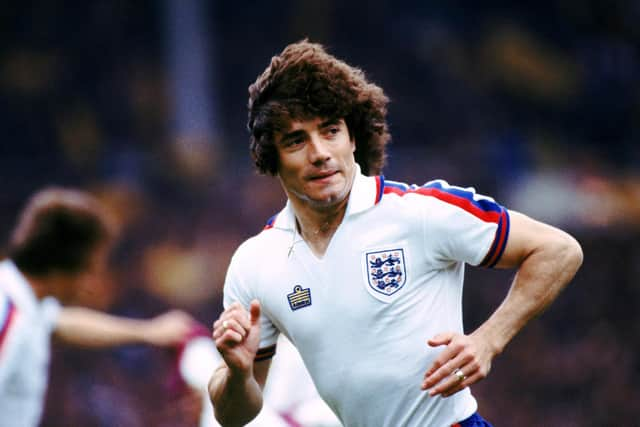
He won 63 England caps, scoring 21 goals, playing at the 1982 World Cup and was also later captain of the national team.
Joseph Kevin Keegan was born in February 1951 at his aunt Nellie’s house in Elm Place, Armthorpe, near Doncaster, the second of three children of Joe and Doris Keegan.
Joe, a Geordie of Irish descent who had seen wartime service in Burma, had moved to the area to find colliery work and young Kevin was placed at St. Peter’s High School in nearby Cantley.
He suffered from bronchitis as a child and his doctors thought he would never be able to play sports.
Nevertheless, he excelled at rugby and captained the school cricket team, and was given his first football by his uncle and his first pair of football boots by his father.
The lad had trials for Rovers and for Jimmy Hills’ Coventry City, but despite being one of two players kept on for an extra six weeks, Hill demurred on a contract, considering him too small.
His luck improved on a Sunday morning in 1966 when he turned out for the Lonsdale Hotel side in a match against Woodfield Social.
Keegan was marked by an older player named Bob Nellis, who was so impressed by his ability that he offered him a trial at Scunthorpe, one of just two professional sides in the fourth division.
The manager Ron Ashman offered Keegan apprentice forms.
Aged 17, he made his debut against Peterborough and, scouted by Liverpool, signed for Shankly in May 1971.
Keegan was almost late for his debut against Nottingham Forest when he was held up in traffic around Anfield and his Ford Cortina stopped by a police roadblock, the officer not convinced by the young Yorkshireman’s tale of being Liverpool’s latest recruit.
Some 12 minutes after kick-off, Keegan had scored his first of a century of goals for the Reds and everyone knew his name.
The Reds went on to win the 1974 FA Cup, with Keegan scoring twice in a 3-0 win over Newcastle.
A return to Wembley for the Charity Shield against Brian Clough’s Leeds saw Keegan, earlier punched in the face by Johnny Giles, dismissed following a brawl with Billy Bremner.
The fracas resulted in both being fined £500 and handed two-month bans by the Football Association.
Liverpool won the First Division title in 1975-76 and 1976-77 and Kop idol Keegan was an advertiser’s dream, promoting the likes of Brut aftershave alongside boxer Henry Cooper.
He also made a memorable appearance on the BBC’s Superstars TV show, picking himself up after a bike crash to go on and win the episode.
Another UEFA Cup triumph followed in 1976 before Bob Paisley’s men were crowned 1977 European Cup winners with a 3-1 victory over Borussia Monchengladbach in Rome.
It was to be Keegan’s 323rd and last appearance for Liverpool, his mind made up to move abroad.
He headed to the Bundesliga with Hamburg, while one Kenny Dalglish settled into Anfield as his replacement.
Crowned the European Footballer of the Year in 1978 and 1979 – the only British player to have won the award more than once – Keegan helped Hamburg claim a long-awaited domestic title before reaching the 1980 European Cup final, where they were beaten by Clough’s Nottingham Forest.
Keegan made his senior England debut in 1972 in a World Cup qualifier against Wales at Ninian Park. Don Revie’s side, however, failed to reach the World Cup in both 1974 and 1978.
When Keegan did finally play at the tournament in Spain in 1982, he had been recovering from a serious back injury and the campaign ended at the second group stage.
He was overlooked by England’s new boss Bobby Robson as he finished his international career with 63 caps, scoring 21 goals.
He returned to English football with Southampton and was voted the PFA Player of the Year in 1981-82.
Relations with manager Lawrie McMenemy, though, cooled over a lack of signings to push the squad on and ahead of the new season, Keegan joined Newcastle.
He helped drive the Toon Army back into the top flight in 1984 before retiring at the end of the season following a benefit match against Liverpool, which saw him flying off the pitch in a helicopter and waving a final goodbye to the Gallowgate End, later starting a new life in Marbella.
In early 1992 he received an unexpected call which would again change the course of his life – an invitation to become the new manager of Newcastle, now struggling in the second tier following the departure of Ossie Ardiles.
After Keegan kept the Magpies up, the backing of chairman John Hall saw Newcastle look towards the newly-formed Premier League.
With club-record signing Andy Cole brought in, Keegan’s men were promoted as Division One champions before finishing third in the top flight.
In January 1995, Cole was sold in a shock transfer to rivals Manchester United, with Keegan left to defend the club’s decision to angry fans.
At the start of the next campaign, Newcastle, boosted by the marquee signings of David Ginola and Les Ferdinand, were irresistible and by January had opened up a 12-point lead.
Manchester United’s relentless pursuit, though, finally got to Keegan during a live post-match TV interview after a hard-fought 1-0 win at Leeds when he delivered his famous “I will love it we beat them” rant in response to comments from Red Devils boss Sir Alex Ferguson.
It was Ferguson and his side who kept their heads to take the title as Newcastle drew their final two matches to finish four points adrift.
The world record £15m transfer of Alan Shearer from Blackburn during the summer lifted spirits on Tyneside, but Keegan resigned in January 1997, returning to the game eight months later as chief operating officer at Division Two club Fulham.
The Cottagers were promoted as champions at the end of the 1998-99 campaign, by which time Keegan was installed as England manager.
He guided England to Euro 2000 but his team failed to reach the quarter-finals. His tenure ended in resignation later that year following defeat by Germany at Wembley, the last match at the national stadium before it was rebuilt.
Keegan got the Manchester City job in 2001, guiding them to the Division One title, before an unexpected return to Newcastle in January 2008 following the departure of Sam Allardyce.
Tensions grew with the board over the club’s structure under owner Mike Ashley and after fans protested at the ground following rumours he had been sacked, Keegan resigned in September 2008. He was later awarded £2m in damages, plus interest, after winning his case for constructive dismissal.
After that he did occasional punditry work and some personal appearances, but remained largely out of the spotlight. He is survived by wife Jean and daughters Laura and Sarah.