
How Howard Wilkinson built Leeds United's 1992 title winners on characters and 'me not we'
He was the disciplinarian who embraced mavericks, the hard taskmaster with a human touch, the progressive pragmatist, a quick-fixer with an eye for the long term. But Howard Wilkinson's greatness lies less in what he was but what he – ridiculously – remains to this day.

This week, at last, he will be recognised. On Wednesday Wilkinson will be inducted into the National Football Museum's Hall of Fame before Leeds United's home game with Chelsea. Last month the club announced its support for a statue of Wilkinson outside Elland Road. A host of his former players will be at Friday's tribute lunch to help raise funds for it and pay tribute to a boss most owe a huge debt to.
"I'm greatly honoured, surprised, a little bit. I've not won the European Cup or taken England to a World Cup final, have I?" protests the 82-year-old, as he tries his best to share the glory and conveniently overlooks the magnitude of what he did do. Fortunately, The Yorkshire Post also spoke to a couple of his former players too, to get a fuller picture of his achievements.
"Oh my God, he was way in front of anybody, way in front," says Mel Sterland, a right-back Wilkinson inherited at Sheffield Wednesday and signed for Leeds. "Howard was the top."
Wilkinson achieved plenty before and after Leeds – taking the Owls from Division Two to fifth in Division One, the peak of his hometown club’s six-year stint in the top tier, and later provided much of the thinking behind not just the buildings but the philosophies of the St George's Park talent factory which has furnished England with perhaps their most technically-gifted pool of players.
What he achieved at Elland Road is simple to spell out and easy to understand – the last Englishman to manage the English champions. Wilkinson guided Leeds to the top of Division One in 1991-92, less than four years after taking over a team only outside the Division Two relegation zone on goal difference.
Just as simple is the thinking behind it: "It's we not me," he repeats more than once.
"Football's a team sport and team means getting a group of people together who have the same objectives, the same desires, the same talent, and want to improve themselves and as a result of improving themselves make a contribution to the team," he explains.


"That was always very important to me. I tried to create the understanding that we are all in this together and we'll achieve a lot more if we all agree to link hands and form that chain.
"I know it all sounds like a hifalutin philosophy but that is team sport – creating a sense that we're all pulling together and not wanting to let yourself down or the team down are important values."
And there was more to Wilkinson than just his crowning glory. The Whites were FA Youth Cup winners in 1993 (beating Manchester United's legendary Class of 92 in the final) and 1997.
"It's hugely disappointing he hasn't had the recognition," says Tony Dorigo, left-back in 1991-92. "To think he's the last English manager to win the title is crazy. This is the English Premier League.
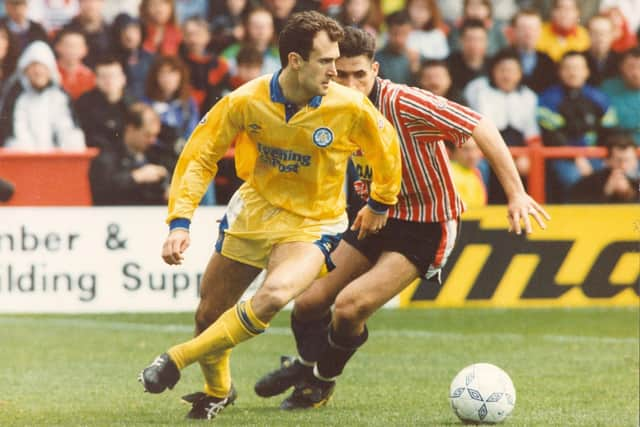
"It makes me more sad. He should be revered for that."
"At least he has been recognised now," says Sterland. "I thought he should have got the statue a bit earlier but it's going to be fantastic for the guy to have a statue and get into the hall of fame."
An unassuming former teacher and dour Yorkshireman, there was a caricature around "Sergeant Wilko" that masked the range of his talents. His salesman technique brought Dorigo and Sterland from Chelsea and Rangers respectively.
"The season before I came (newly-promoted) Leeds finished fourth," recalls Dorigo. "I experienced at home and away what it was like. You could see this club was going places.
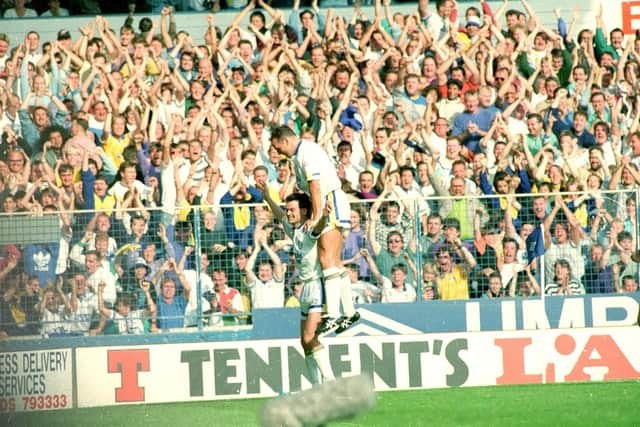
"Then when the manager set it out that, ‘We finished fourth, but this is how we're going to improve as a team and this is how you're going to improve,’ I'm thinking, ‘I can see it. It all makes sense to me.’
"It was sold to me that we need someone at left-back with a lot of experience that can fly up and down like we've got Mel flying up and down the right. I need someone to play with Chappie (Lee Chapman), really quick and a goalscorer, so that was Rod Wallace. Just to add a bit of experience to the squad, that was Steve Hodge. I got told all these things and it all made great sense and how I was going to become better as well.
"You think, the man is just saying that, but everything he said came to fruition.
"His structure and the way he would plan was really evident whether it was defending third, middle third, attacking third, left side, right side, attacking set pieces, defending set pieces, throw-ins, you name it – we did them monotonously all the time
"We knew exactly what we were doing but also had the brainpower to view anything else that we needed to take in to make decisions out on the pitch. He put all these structures in place for us."
Wilkinson had already built that trust with Sterland.
"He was like my dad," he says. "I lost my mum when I was young and I was getting loads of flashbacks.
"All the lads took the mickey out of me by saying, 'How's your dad?' but could speak to Howard, he was just a great great guy.
"I left Wednesday and went to Glasgow Rangers and then I went to QPR to see Trevor Francis.
"Howard Wilkinson rang me up and he just said to me, 'I know where you're going!'
"I went. 'Where am I going, then?' He said, 'You're going to see Trevor Francis.'
"He said to me, 'I'll just just tell you one thing London's far too fast for you. Don't do anything stupid and sign for QPR, come back up the M1, call into the hotel at Nottingham and we'll have a chat.'
"That's what me and my wife did.
"Howard said he was going to sign some fantastic players and win the league. As a player it's just amazing for somebody to call it and and do it.
"The players he fetched in were unbelievable, all winners, all players he could trust and quite a few from Sheffield Wednesday."
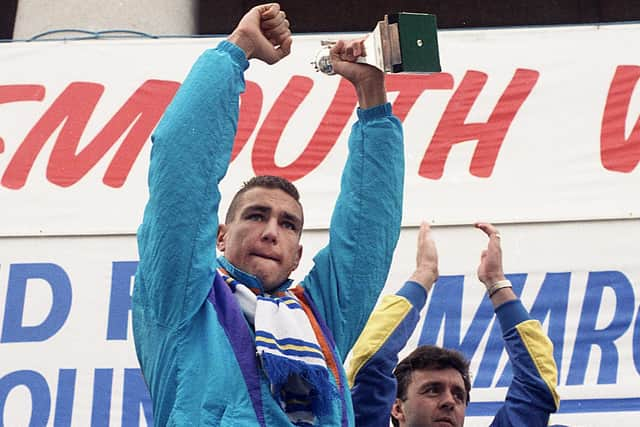
Some were characters other managers would shy away from – Mickey Thomas, Chris Kamara, Eric Cantona and Vinny Jones to name just a few.
"It's a brave manager to have a Vinny Jones-type character come in, but Howard knew at that period of the club's history with the players that he had, that's the sort of character he needed," explains Dorigo. "When the level went up (with promotion in 1989-90) he needed something very different and he was aware of all of that."
"On the list when you're looking at acquiring players rather than developing players is will I be able to pick him on a regular basis and he be able to go out and perform?" explains Wilkinson.
"After that you then look at what's available and you're not always going to get the perfect human being in terms of commonsense, broad outlook, understanding, etc. But the prime objective as far as the world is concerned, and the chairman and the fans, is to win football matches. To do that you need to feel part of an organisation which has a plan, which knows what it is we're trying to do and how we're going to get there."
As Sterland points out: "It wasn't just the players who were playing, it was a squad. Everybody got on. That's why we were successful.
"Once you've got a good dressing room, good honest players who want to want to win things, you've got a great chance and that's what 'Bilko' did.
"It was absolutely mad, but the players who weren't even involved, he used to have them all in the changing room and we were just one big family.
"He got us fit, he got us organised and we knew before we went out we were going to win because of the lads we had around us, the fitness and quality as well."
Fitness was a big thing for Wilkinson, as Sterland knew only too well.
"I used to get fined, not every week but nearly every week," he recalls of his time at Hillsborough. "My playing weight was 13st 2lb, 13st 3lb.
"We used to get weighed on a Friday and I used to dread it. I’d play Saturday, go out Saturday night, get up Sunday morning, go for a run, go out Sunday afternoon, go training on Monday and get weighed.
"I’d weigh 13st 10lb and I got fined £700 because in my contract I used to get fined £100 a pound over 13st 3.
"He got he got the best out of me because my wife said, 'You're getting fined more than you're getting paid!'
"I had it in my contract at Sheffield Wednesday and then I thought I'd got away with it when I went to Rangers. But I came to Leeds and he got in my contracts again! But it was all for a good cause."
Wilkinson knew how to push Dorigo's buttons too. Where Sterland went the whole journey from Division Two to top of the tree after joining in 1989, Dorigo joined for the last leg in 1991.
"I went away with England and had to have a double hernia operation before I'd even played for the club,” he recalls. “”As I'm recovering, he had me in his office and said, 'I think I've signed the softest Aussie ever.'
"I didn't quite know what he was trying to do. Then he mentioned Nigel Worthington who had the same operation, a double hernia. Normally, it takes six weeks to come back. Nigel, he'd come back in five but you, I don't know.
"I'm going, you know what, I'm going to come back in four-and-a-half. If you're used to Nigel Worthington, wait until you see me play.
"Mick (Hennigan, the coach) is chuckling away at the back, laughing his socks off, the gaffer smiles. I walked out of there thinking, 'Jeez, he's just got me, making sure I'm coming back early.' I'm thinking, bloody hell, that was clever."
It was detecting a sense of togetherness and a plan that brought Wilkinson to Elland Road in October 1988.
"When I was first approached it took me about 30 seconds to say, 'No, I'm not interested,'" he recalls, "but (managing director) Bill Fortherby was very likeable and effective. He just chipped away and gradually I came to realise what I was being offered was what in those days was quite rare and these days an opportunity you just don't get, to come and build a club.
"We had several meetings with quite a shallow line of discussion which eventually developed into a much longer conversation dealing with more than just the team and its results, but also the clubs.
"(Chairman) Leslie Silver and Bill Fotherby between them had the commonsense, the knowledge and so on to recognise that what these days would seem utterly impossible and in those times seemed vaguely impossible could be done. It just became increasingly attractive.
"We finished up with three people in important positions at the club who all understood what it was we wanted to be and what we needed to be that, what personal qualities we needed apart from football ability."
And then there was Gordon Strachan.
"Critical," is how Wilkinson describes the signing he made in March 1989.
"I looked at his career, talked to people who'd worked with him, played with him, did my homework, really,” he says. "You need role models in any team situation. The more role models you've got, the better.
"There were times when I might be making my way to the dressing room at half-time thinking, 'I will take my time today,' because I knew when I got in there he would have them sat down, coming out with a few pieces of Latin as he gave a very candid opinion of what was going on."
As the present-day Leeds set their sights on 17th place after promotion to the top flight in May, it is hard to imagine what Wilkinson achieved being replicated, but he takes no satisfaction from being the last Leeds or indeed English manager to win the title.
"I'd like that situation to be turned around as soon possible," he says. "If Leeds do get back to where I think they belong it's a one-club city, it's fans are second to none, and if you've got the right people in the boardroom who understand there's more to it than we thought, that's what happened before I said yes (in 1988).
"It's not just football, if there's more than one person involved in any sort of endeavour it's just a fundamental principle – ‘we’ becomes just as important as ‘me’, and in some case more important."