
How Yorkshire RFU Academy is thriving despite no Premiership club to funnel talent into

There was a line in Tom Burrow’s interview with The Yorkshire Post last Saturday that struck a chord with Stuart Dixon, the head of the Yorkshire RFU Academy from which the former had graduated.
“If you’re in the Yorkshire academy you can end up in a more fortunate position,” replied Burrow, when asked if the lack of a Premiership club to funnel academy talent into was detrimental to young Yorkshiremen like himself. “Where you can actually find the best fit for yourself, you’re not tied down by any contract to sign for your parent club.”
“I sent that quote to all our coaches,” says Dixon a few days later from the Yorkshire RFU Academy’s training base at York St John University. “Stick it on the wall of every locker room.”
As a unique selling point, the England Under-20s captain had hit the nail on the head about the role of the Yorkshire RFU Academy.


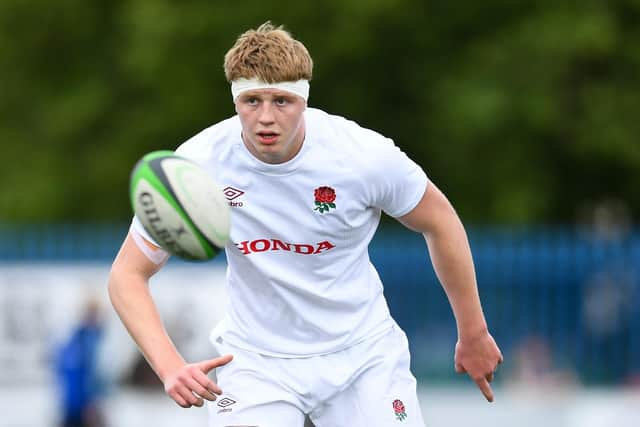
It is an entity that sits alongside the academies run by the 10 Premiership clubs, minus the obvious end game to sell to parents and their ambitious teenage sons. But despite what could be seen as a hindrance, Dixon and his team have created an environment that has sent a handful of players into professional rugby and produced England’s Under-20s captain in Burrow.
Not bad for an academy that was told in the 2019-20 season by a parent club in Yorkshire Carnegie that was slipping into the financial abyss that funding would stop at the end of the season.
It is still alive because of the hard work of Ben Lazenby, Dixon and a number of volunteers who were determined in the wake of the financial collapse of Yorkshire Carnegie - the region’s last Premiership club - not to let the county’s promising talent have nowhere to go.
“Covid, almost ironically, gave us a lifeline,” explains Dixon, who along with then programme lead Ben Lazenby - now at Wakefield Trinity - fought hard to sell the Rugby Football Union on an independent model.

“We were in the office one Friday wondering what to do. We said let’s take two weeks off and let this blow over. That was March 20th, Covid happened three days later. We were all furloughed which kept us on for a bit longer, otherwise we’d have been redundant by April.
“Then the RFU decided with Premiership Rugby that even though the club had gone, it was still important to have a presence in Yorkshire.”
Dixon succeeded Lazenby in October 2020. “The remit was get some rugby played,” he remembers. “We could only run the Under-18s at the time because we were classed as elite sport. We were training at Yarnbury and every single week there’d be a curtain-twitcher who’d call the police about a group of lads training. All I had to show the police when they came was a screenshot of a letter from the RFU.”
Year two was even tougher. “We had to identify a whole new cohort of players that summer, and we’ll forever be grateful to the volunteers who delivered sessions across five sites.”

Playing in an academy league against a dozen academies was tough. They didn’t win a game all year, Dixon forever looking over his shoulder wondering if his programme was being judged differently to others.
But although the RFU were funding the project, they never exerted any pressure on Dixon.
And by year three (the 22-23 season), the tide started to turn.
“Tom Gilchrist came in as full-time coach from Bishop Burton, it allowed us to do more robust planning, to work with individual players,” adds Dixon. “It was a breakthrough year, we had four players sign professionally at the end of it and six players representing England and Scotland in the U18s Six Nations, the most of any academy.”
After living season to season, the Yorkshire RFU Academy was given a four-year commitment from the RFU last autumn.
“All we ever wanted was to be judged like the rest,” says Dixon. “Bollock us if we need it, but also recognise us if we’re doing the good stuff.”
There are still differences with their Premiership peers. The academy structure is Foundation level for Under-15s and 16s, Development for Under-17s and 18s, and Confirmation after that.
Without a club to go onto, players leave the Yorkshire academy after the Development stage. But as Burrow said and Dixon endorses, a player emerging from the Yorkshire academy has more options.
“Our goal is to get as many players into confirmation in other clubs, or offer the player the next best journey beyond that, whether that’s playing University BUCS rugby, or if they go into work, can we signpost them to the next best thing? Even though we finish at 18 we feel a real duty of care,” says Dixon, whose academy has sent two to Sale, one to Bristol and in Ned McCormack, helped a player get on in rugby league at Leeds Rhinos.
“I get it. If you’re a mum and a dad in Yorkshire with a boy coming into our pathway, it’s really difficult to see that opportunity, as opposed to a Leicester Tigers where there’s a roadmap to the top,” admits Dixon.
“Same with a Super League club, it’s a lot easier to see a pathway because there’s six or seven clubs in Yorkshire with academies.
“We only have three centres across Yorkshire (Bishop Burton, West Park Leeds and Doncaster Knights).
“But when you’re in it and people understand it, then actually being under a club can be a drawback because until that club decides what they want to do with you, you can’t go anywhere else.
“Ultimately with us you’ve got a chance with the 10 Premiership clubs, or Super League clubs, or this network of universities in the BUCS Super Rugby.”
The pathway through the Yorkshire academy begins with nominations to attend one of the three satellite centres with around 100 boys at Under-15s and 16s, who then get whittled down to 60 for the Development phase. Dixon stresses that players develop at different times and can enter the programme at any age.
The split between state schools and independent schools favours boys in state schools in the earlier instance, bucking conventional, occasionally damaging wisdom.
A bigger tranche emerges from independent schools often due to the greater time and resources they can put into their rugby programmes.
“We’ve just signed up with Wath Academy, a state school, who have two lads we’d not seen before, twin props, one either side of the scrum, that Ryan (Burrows - Wath’s head of rugby) rang me up and said ‘you’ve got to come look at these lads’,” says Dixon, when asked if they have every corner and demographic covered.
“We massively value state schools. That’s the utopia to have that network across the region.”
Training is once a week at the satellite venues for the 15s and 16s. In the group above at this time of year it’s twice a week and intense: “it’s like a little professional window this seven-week block,” explains Dixon. “It’s hard for these young men.”
The end-game is to keep producing players. Or if a Yorkshire club, like a Doncaster say, got into the Premiership.
“If there was an opportunity for people to play Premiership rugby in Yorkshire, that’s what we have to be about,” says Dixon, even if the current absence is not hindering the opportunities for Yorkshire’s talent. Far from it, in fact.