
Padel in Yorkshire: From Huddersfield to Wetherby, how the Latin racquet sport is finally booming

In June 2011, I was sent to Huddersfield Lawn Tennis and Squash Club by the sports editor of this great organ to do a feature on the emerging sport of padel. In October 2024, now occupying that lofty position atop the Yorkshire Post skyscraper, I despatched myself to Wetherby to do a piece on the emerging sport of padel.
Same sport, still emerging, but 13 years apart. Why? What checked its progress for so long and can padel not only emerge this time but stick around?
To answer those questions I have headed to Grange Park in Wetherby, home to the spa town’s rugby club, pristine bowling greens, junior football team Kirk Deighton Rangers and since exactly a year ago this weekend, Wetherby Padel Club.
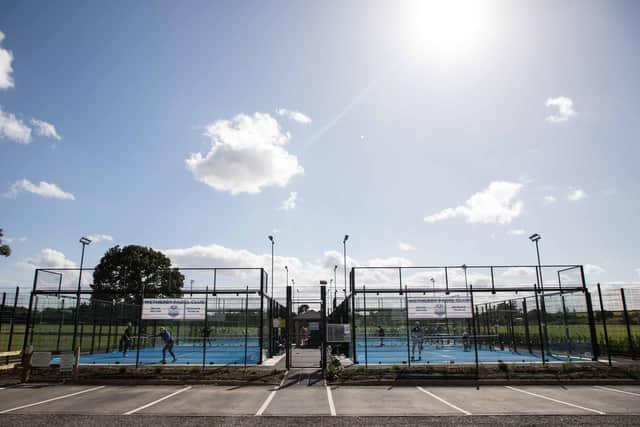
Four floodlit outdoor courts with their bright blue all-weather surfaces taking up a little more than the square footage of one tennis court, sit at the end of the car park adjacent to the rugby pitches.


There is no clubhouse – they have access to Wetherby RUFC’s as part of the lease agreement – no facilities either, just an outer ring of fencing around the courts and a walkway through the middle with two wooden pergolas and a couple of benches to store your kit, plastic seats to watch the action and a vending machine at the far end.
On a clear night, the courts can be seen from the A1, people scurrying around hitting a ball under the lights, like a party on a distant ship on the horizon.
“It’s not fancy up here,” admits Angela Wood, the co-owner of the privately-financed club, a padel coach and also the Yorkshire county team’s ladies captain.
“We’re a bit more rough and ready but it’s inclusive and we’re trying to build a community.”

Angela came to padel like most people do from other racquet sports, in her case, tennis.
Originated in Mexico in the 1970s, padel is a cross between tennis and squash, using the latter’s scoring system and encasing the court with walls which the ball can bounce off, like the former.
“It captured my imagination,” explains Angela, who was and still is a county level tennis coach.
“What I like is that it's very easy entry – shorter racquets, smaller courts. From the moment you start playing you’re having fun, whereas tennis is harder entry and hard to master.

“Padel might be easy entry, but it’s still hard to master.”
A few shots with the carbon fibre racquet and I see exactly what she means, straightforward to get the ball over the net but not necessarily easy to force a winner with the ball – which looks like your typical yellow Wimbledon replica but is actually a fraction smaller – rebounding back into play off the walls.
“Tennis is a power game, whereas padel is very skillful,” explains Angela. “You’re trying to use the court, you’re trying to build points.
"First rule of padel is to hit the ball in. You’re not trying to hit winners, you’re trying to force errors.”
Padel arrived in Yorkshire some 15 years ago. Four members of Huddersfield LT&S club had played it in Spain and had a court built.
It was the only public access court in Yorkshire, one of just three locations in the entire country.
Peter Vann, a member at Huddersfield was one of the architects, and along with other volunteers formed British Padel, the not-for-profit governing body.
For nearly a decade they slowly spread the padel word, until in 2019, the sport was consumed by the Lawn Tennis Association.
“By 2019 the sport had developed to a level where you had 65 courts up and down the country,” says Vann, who served as president of British Padel and still volunteers in the Yorkshire LTA for the betterment of the sport. “Our plan as the governing body had always been to give the sport to tennis, because we’d seen in that period other European countries do the same.
“And giving it to the LTA was the sea change, the single biggest factor in the growth of padel.
“The LTA ‘s credibility factor to be able to say to all its tennis clubs ‘have you heard about padel?’ was huge. When we did it as British Padel they told us to bugger off.
“The LTA brought huge credibility benefits in process, marketing, logistics, standards, coaching, pathways, tournaments. All these boxes got ticked when padel became part of tennis.
“And Covid actually helped. It allowed padel to become correctly embedded into the LTA at a time when the LTA and tennis wasn’t operating because you weren’t allowed outside the house. So instead of the pandemic slowing it down like many thought it would, you were allowing correct embedding of something new into something old.”
The Yorkshire tennis fraternity responded better than most other counties. Courts went up across North and West Yorkshire in particular, either at tennis clubs like Chapel Allerton, or independents like Surge club in Harrogate, the new Slazenger facility in Leeds, and the outdoor courts of Wetherby.
It has become fashionable among the sporting elite, too. Former Liverpool manager Jurgen Klopp plays, Andy Murray has been pictured playing and Leeds United footballers and Yorkshire cricketers have used the facility at Wetherby.
Just last month the LTA launched a five-year strategy to get more people playing padel, to build more courts and ultimately build an infrastructure.
Because they are privately owned, Wetherby cannot tap into the grants to build courts that are on offer, but they are part of a growing ecosystem, nevertheless.
Angela is even helping write the coaching programmes.
“The LTA is a big animal with a lot of money and they’re able to push things along,” she says. “The qualifications that are being written are excellent, there is money available for clubs to put courts in.”
Another striking thing about padel is the participants. On a misty Friday morning when I attend – a day for sitting in front of the fire not venturing outdoors – all four courts are full with people from as young as 10 to as old as their late 60s playing with or against each other, male or female.
“What we have tried to do with this facility is make it inclusive,” continues Angela.
“We’re not members-only here, it’s a community-based facility. We’re trying to break down as many barriers as we can. We’ve got racquets and balls to borrow for free.
“We’re trying to be a little bit cheaper, a little bit more inclusive to get lots and lots more people playing.
“We’ve had 3,000 individual people book a court in our first year which is a fantastic start.”
What is helping at Wetherby is their organic growth. Because their courts are not bolted on to a tennis club, they are attracting players from football, rugby and bowls; the spectators who watch the more traditional sports at Grange Park having their curiosity piqued.
“We are putting racquets in hands of people that ordinarily wouldn’t have played any racquet sports,” continues Angela.
“A family can come down and have a nice time. You can see all generations playing.
“We’re just trying to build a community, we run box leagues and ladders and club championships. We’re just trying to broaden the appeal.”
A competitive Yorkshire league was born this year with 13 clubs involved. In the first iteration it was for players ranked outside the top 100 in their respective age groups to try and build participation. Next year they will look to add an elite league above that.
“We’re copying stuff from tennis and other sports but also bringing new stuff,” says Angela who will captain Yorkshire Ladies at the national county championships in Bristol in November.
“We’ve also holding the first Yorkshire Championships across all age categories at Slazenger next month. Yorkshire were early adopters of padel so the standard of the championships should be quite strong.”
Thirteen years on from that first court popping up in Huddersfield, it appears padel has finally got the tools, the expertise and the interest to build a lasting ecosystem.
“Perhaps Huddersfield went too early,” Angela offers, by no means decrying the vision of padel’s White Rose pioneers. “It stood alone for years and now suddenly you can’t get a court in Huddersfield because of the growth in popularity. For me, the more clubs that pop up the better.”
There are 15 now in Yorkshire, with more to come, and 350-plus nationwide.
The last word belongs to Peter Vann. “The tidal wave of padel in this country is nowhere near breaking yet, and I’m absolutely bloody delighted.”