
Susie Wolff: 'I only ever did one job interview where I wasn't asked about my gender'
Former racing driver Susie Wolff talks to Hannah Stephenson about the sexism she experienced in her journey to the top in Formula 1 and about her new book, the memoir Driven
Formula One queen Susie Wolff was just three when her father bought her and her brother two mini three-wheelers with 50cc engines for Christmas. Before you knew it, she had found her need for speed.
“I’m thankful that I found that passion so early. I love speed, even on a ski slope or out on the water, I love going fast.”
Today, she is a force to be reckoned with in the multi-billion pound world of motorsport.
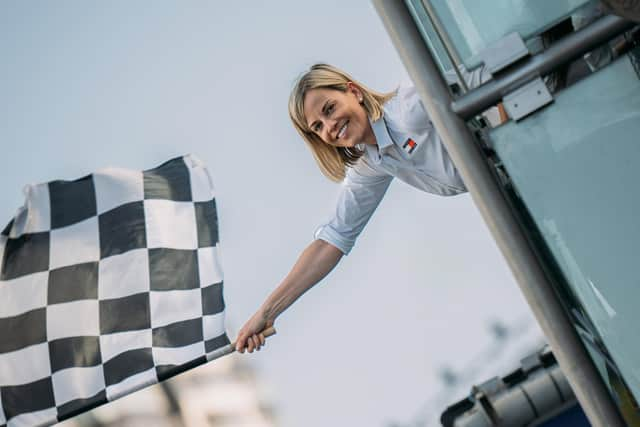

She and her husband, Mercedes F1 team principal Toto Wolff, have become known as a ‘power couple’ in this glamorous industry, although she insists they are grounded.
“We have our feet on the ground. We know that this Formula One world can be crazy because of the media spotlight that’s on it, but we don’t take ourselves too seriously.”
Wolff, 42, retired from racing in 2015, but is now nurturing female talent as managing director of F1 Academy – as featured in the popular Netflix documentary series F1: The Academy – and is warm, chatty and thoughtful as she sits down to discuss her memoir, Driven.
The Oban-born racer has paid the price physically for her sport, the injuries, the accidents, the bruised ribs and her ongoing neck issues, caused by gruelling training in which her head was tethered to a network of weights, a rehearsal for the G-forces to come.
These days, she still has treatment to stop her neck stiffening up.
It’s been a bumpy, often painful, ride but she found success in a male-dominated sport, was hired as a development driver by Williams F1, testing new set-ups in a simulator, but also drove F1 vehicles on track and remains the last woman to take part in an F1 practice session in 2015.
Yet she recalls: “I only ever did one interview where I wasn’t asked about my gender.”
For years Wolff was a woman in a man’s world where male drivers didn’t take her seriously, ridiculing her performances and, when she was winning, would shunt her off the track rather than endure the shame of being beaten by a ‘girl’.
“There are still the macho male drivers who have that view,” she admits.
“But what encourages me is that in Discover Your Drive (an initiative by the F1 Academy to increase female participation in motorsports, starting with karting) there are so many more young girls karting now. I was more often than not the only one.”
The Netflix series has raised the profile of females in motorsport, encouraging big brands to endorse the F1 Academy, along with visible supporters including Lewis Hamilton, who has become a good friend and often shows up on the grid to watch the female competitors.
“He knows what it’s like to be the only one in the room, what it’s like not to be the same as everyone else around you and how tough that can be.
"Most of the drivers don’t know what it’s like to be a girl or to be different from everyone around you, so they have very little empathy for understanding what we’re trying to change.
"It has a huge effect on the environment when you see someone like Lewis coming to support us.
“I think it’s changing for the better,” Wolff continues, talking about the sexist environment it once was.
“We have such an opportunity and such a momentum to really talk to that next generation and show them that motorsport is no longer such a male-dominated environment.
"I’ve only been able to achieve what I have with the F1 Academy because I’ve had all of the support from within the F1 paddock and that is predominantly still male, but the people in decision-making roles either have daughters or they realise how important it is for the future success of the sport to speak to that growing female audience.”
She lives in Monaco with her Austrian husband Toto, team principal, CEO and co-owner of Mercedes F1, with whom she has an eight-year-old son, Jack.
He has two children, Benedict and Rosa, from a previous marriage.
“I feel very grateful for my marriage because it’s what brings me the most happiness. He’s not just a husband, he’s my best friend. It’s an adventure.
"We got married before he was even in Formula One. Sometimes people call us this glamorous power couple, but we’re so far away from that.
“Obviously, through Covid times, you really recalibrated and realised what are the important things in life.
"For us, that’s each other, it’s our wider family, and I’m lucky to have two brilliant stepchildren I have a great relationship with, and now little Jack, so I feel very lucky.
“When you walk into a blended family, it takes time to find your place and to not step on anyone’s toes and to respect history. But I always imagined for the kids what was the best for them, because I had a wonderful childhood.”
No female driver has competed in F1 since 1992, but Wolff hopes to change that.
“I would love to think that in the next five to 10 years there will be a woman in Formula One, because now the F1 teams are investing in young female talent, putting them into the younger driver academies.”
At the end of the book she asks what she would tell her younger self.
Today, she reflects: “Stay fierce, stay fearless, because sometimes as you get older, with the challenges that come with life, you can sometimes lose sight of that little girl of 13 that dreamed of making it to Formula One.
"If I look back, it was a crazy dream to have but she didn’t think it was crazy for her.”
Driven by Susie Wolff is published by Hodder & Stoughton, £25.