
Sir Billy Boston obituary: The rugby league legend who became the sports first knight
One statue was never going to be enough to recognise the immense contribution Billy Boston made to rugby league.

The Cardiff-born former Great Britain winger, who has died at 92, was never likely to be forgotten but, just to make doubly sure, he was immortalised in bronze at Wembley and in his adopted town of Wigan.
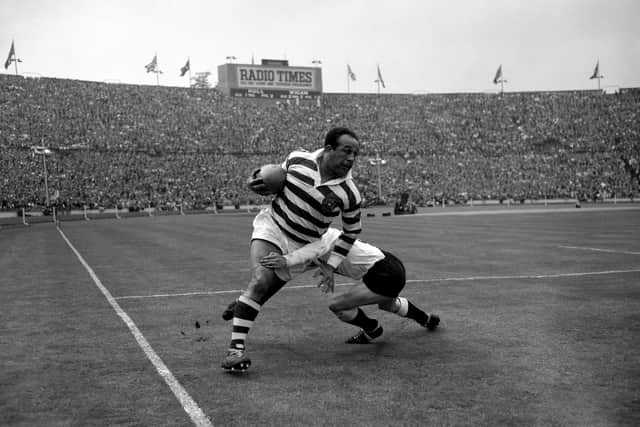
Along with other all-time greats Eric Ashton, Martin Offiah, Alex Murphy and Gus Risman, Boston forms the centre-piece of a statue at the national stadium, unveiled on the 120th anniversary of the formation of rugby league in August 2015.
A year later he helped unveil a statue of himself in Wigan and in December 2020 he was selected alongside Risman and Hull’s Welsh hero Clive Sullivan to adorn a statue to be erected in the heart of the Cardiff Bay area to represent the players who headed north to star in the 13-man code.

Known as the Cardiff Bay Codebreakers, the accolade helped soften the hurt Boston felt over the snubbing by his hometown club.
It took a while longer – indeed his son Stephen said it came “a little bit late” – but in 2025 Boston received rugby league’s first knighthood in a special ceremony at Buckingham Palace.
It followed a campaign by local councillors, MPs and leading figures in the sport to get him honoured.
“It should have been a lot, a lot sooner,” said Stephen, who attended the ceremony alongside his mother Joan and his sisters Karen and Christine.
Boston’s legacy began when rugby league clubs were alerted to the potential availability of a 19-year-old son of a merchant seaman from Sierra Leone while he was playing for Neath but stationed for his National Service with the Royal Signals at Catterick in North Yorkshire.
Wigan sent chairman Joe Taylor and vice-chairman Billy Gore to see Boston and his mother Nellie at their Cardiff home in 1953 and offered him a then-princely sum of £1,000 to turn professional.
When Nellie rejected the offer, Taylor and Gore increased it to £1,500 and, for effect, spread the white fivers over the table.
Boston, one of 11 children, had never seen so much money, but he had no wish to move north and it was at this point that his mother took charge, asking to be excused for a moment.
“Don’t worry son, I’ll get rid of them for you,” she said. “I’ll ask them for so much that they’ll go home.”
So when they went back into the front room, Nellie said: “Right, pay him £3,000 and he’ll sign.”
What Mrs Boston did not know was that before leaving for Cardiff, the Wigan directors had withdrawn £3,000 from the bank and, having given her word, she had no choice but to order her son to take the money.
Apparently, Boston cried, knowing it would mean he would never play for Wales, but later called it the “best mistake I ever made” and, when he made his debut for Wigan ‘A’ team, a crowd of 8,000 turned up at Central Park to witness it.
The rest is history. Six matches later, he was selected by Great Britain for their tour of Australia, where he became the first black player to play for the Lions.
He won 31 caps, was part of the team that won the 1960 World Cup and scored a total of 571 tries in 562 matches, second only to Brian Bevan in rugby league history, courtesy of a combination of body swerve, side-step, hand-off and sheer pace.
There were tears once more when Boston played his final match for Wigan in 1968, when he went on to finish his career with Blackpool before retiring in 1970.
Boston stayed in Wigan, where he met his wife Joan, after he hung up his boots and went into the pub trade until his retirement.
He was an original inductee of the Rugby Football League’s Hall of Fame and was awarded an MBE in 1986.
At the time of the unveiling of his statue in Wigan in August 2016, Boston revealed he was suffering from dementia but continued to attend matches at the DW Stadium.
He died only four days after the funeral of his wife Lady Joan, having been married for over 70 years.