
VAR takes more than it gives – it is just not worth it: Stuart Rayner
“Some people will never get behind it fully,” said the head of English football referees, Sheffield's Howard Webb, of video assistant referees (VAR) last month.

Full disclosure: the person writing this is one of them.
But another weekend brought yet another example of how VAR is ruining the game, and not giving enough back in return.
VAR was sold to us on a lie. We were told it would cut the glaring errors out of the game. That was never going to be possible.

It is true that some do get picked up, but others get put back in.
It was always going to be that way, because far too much of what VAR does is subjective.
Goalline technology deals with a simple matter of fact, and it is good – although Sheffield United fans who remember the June 2020 game at Villa Park would probably like me to add "when they turn it on."
But too much of what VAR does sucks emotion out of the game, brings uncertainty and confusion to those in the stands, and creates as many arguments as it settles.

It relies on fixed cameras in a game that moves all over the pitch, and tries to make hairline decisions with technology which has gaps in it, because it records frame by frame.
Staffing it takes officials who ought to be on the field in the Championship, and sticks them in a television studio in Stockley Park. That in turn means everyone has to shuffle up the pyramid to fill the gaps and is a big part of why the standard of Football League or non-league refereeing is dropping.
Officials are more open to scrutiny because the mantra that the referee's decision is final has been thrown out of the window by the lawmakers themselves.
Plus, the rules those who take charge of and play in games without VAR – the overwhelming majority – are now being changed to suit those in the VAR control rooms.
Maybe some people might think it a fair price to pay if VAR put every wrong decision right. But that is not what is happening.
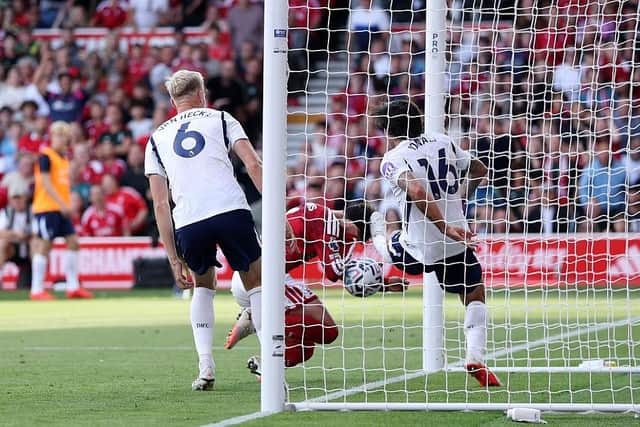
When Nottingham Forest’s Neco Williams had a goal disallowed against Tottenham Hotspur earlier this month – a goal that would have won the game for Forest – VAR Peter Bankes deemed it handball. Judging by the inconclusive angles he looked at, it was educated guesswork.
To look at the camera angle which later emerged but was not available to him, he guessed right.
But should we really be spending all that money, taking all that time out of the game, for guesswork? If we are okay with guesswork, leave it to the man in the middle feeling the game, not some bloke in a darkened room in Stockley Park.
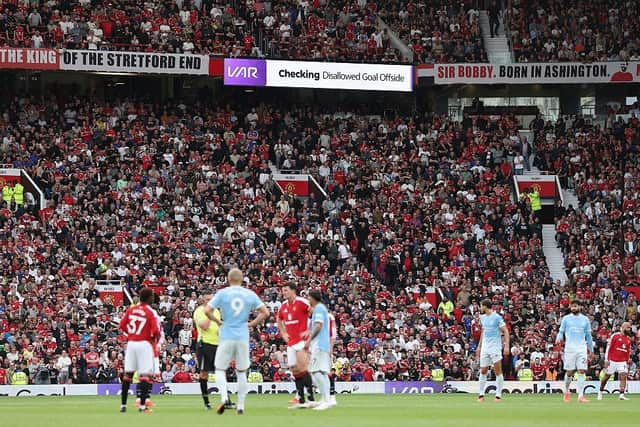
Sunday's goal in the Manchester derby took the biscuit. Erling Haaland put the ball in after Enzo Fernandez jumped in front of a cross but was unable to make contact.
No doubt plenty of Leeds United fans, and many besides, found it funny watching Manchester United lose such an important game that way. But next week it could be Leeds.
The referee was Michael Oliver, the best of an admittedly far from vintage English bunch. His linesman stuck the offside flag up immediately. They got the decision right.
VAR Matt Donohue and his assistant Blake Antrobus somehow decided Fernandez was not interfering with play, even though he clearly stopped Lisandro Martinez clearing the ball and affected the positioning of goalkeeper Senne Lammens, as well as delaying his reaction.
It was a matter of interpretation, but such a bad one it was clearly wrong, as Pro Ref – the artists formerly known as PGMOL – publicly acknowledged.
At the very least, Donohue ought to have sent Oliver to make his own mind up at the pitchside monitor.
It was human error, of the sort on-field officials make all the time, you almost certainly do in everyday life and I certainly do. It was the VAR, not the technology to blame.
But when it happens with the failsafe mechanism, it shows there is nothing safe about it at all.
And for those in the stadium, it was just confusion.
Old Trafford has no big screen. There was no communication other than to say the goal was being checked. Most people probably thought the issue was Haaland. Once the decision was reached it was not explained over the tannoy, as when referees go to the screen.
After what felt like an eternity, the Leeds-born striker could finally go over to celebrate with the away fans.
It showed contempt for the people who paid to go and watch, and brought the atmosphere. If they wanted to know what was going on, they had to message a mate sat behind a telly, or flick through Twitter – not something any fan should be doing when a game is in play. The game needs them engaged.
Football without VAR is far from perfect, but football with it is barely any better when it comes to enforcing rules, much worse when it comes to sucking out emotion and undermining the officials. It is just not worth it. Sorry, Howard.