
'I visited Uganda to see gorillas - it was a truly uplifting experience'
A visit to Uganda to seek out gorillas in the wild taught Jenny McBain about the value of conservation and how the country is using that for the benefit of wildlife and its people.
We left the brilliance of a forest clearing and advanced into the filtered light of the jungle in a state of heightened anticipation.
We were in Bwindi Impenetrable Forest in south western Uganda which is home to some of the most enigmatic and powerful animals on earth.
Once hovering on the brink of extinction, the mountain gorilla population in this part of Africa is still endangered but it is on the rise thanks to strict conservation measures and to the visitors who pay to see them up close.

The experience is a carefully curated one which begins with a briefing. Our guide Christine told us that she could not promise that we would actually see gorillas.
However, trackers had been out since dawn assessing the progress of various groups, so we were in with a good chance.
“Gorillas are lazy. They do not get up in the night to do their business, so they have to bed down in a new nest each night. When the trackers see a recent nest, they know they are on their trail,” she said.
Trackers tend to be either former poachers or those with a military background.
The men who accompanied us, alert and with rifles at the ready did not disclose the nature of their former occupations and we did not quiz them. We had much else to be absorbed with.
There were gnarled roots that threatened to trip us up and snaking streams that had to be navigated rock by rock.
From time-to-time a branch cracked underfoot and monkeys swung deftly from one tree to the next. Exotic birds flashed by in a blaze of colour.
We had already had some incredible encounters with wildlife, up to that point.
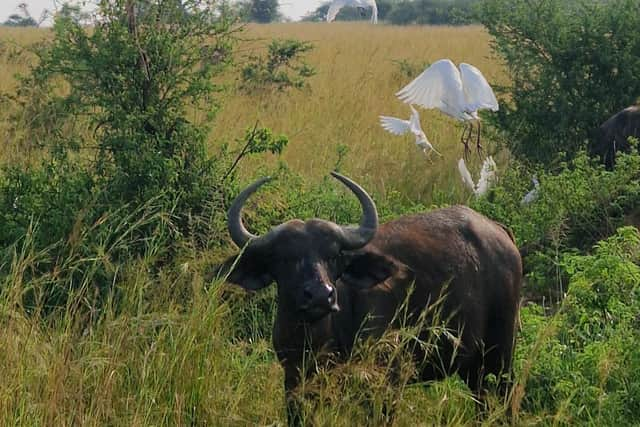
An early morning game drive in Murchison Falls National Park took us up close to elephants and giraffes and, in the distance, we had seen a leopard draped around the limb of an acacia tree awaiting the right moment to pounce on his prey.
We had taken a river cruise along the Victoria Nile and come up close to basking hippos and to crocodiles lying on the riverbank in a state of stillness, mouths open in order to cool themselves.
We had also visited Kibale National Park in the west of the country where we went on a chimpanzee trek.
Such experiences have great impact and we recalled them as we headed towards a point where a gorilla family was likely to be found.
After a couple of hours, the news we had been waiting for came through on Christine’s mobile. A group of gorillas had been spotted not far from us.
Buoyed with excitement we picked up our feet and pressed on through the heat of the day as light flashed through the canopy above.
It was time to put on face masks in order to prevent the passing on of disease.
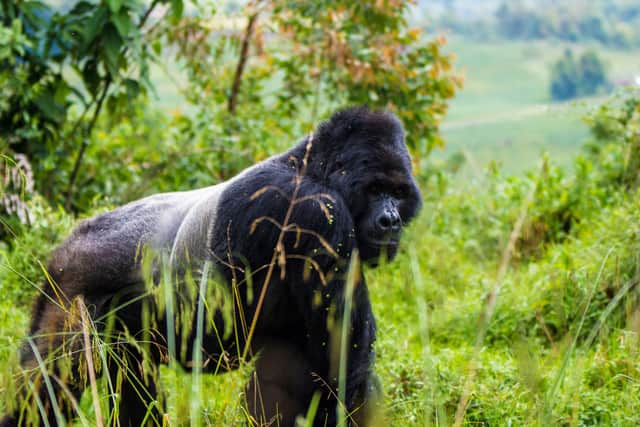
And then we saw them. There in a small clearing was a family group of gorillas just hanging out, grooming each other and eating freshly plucked leaves.
A baby laughed and beat his chest. The old alpha male seemed wise but not world weary and the young represented hope for the future.
It costs $800 per person for this experience and it is managed so as to cause as little disturbance as possible.
Only some of the gorillas in the forest are considered to be suitable to be close to humans.
That is because they have been singled out as having characteristics that make them candidates for something known as habituation.
It was the American primatologist and conservationist Diane Fossey who pioneered the process whereby a primate’s trust is won over bit by bit over the course of a few years.
Fossey, spent decades in neighbouring Rwanda, living closely with gorillas and observing their behaviour.
She ultimately lost her life because her love of these animals and her work on their behalf, ran contrary to the interests of poachers whose primary source of income was derived from hunting them.
After years of monitoring gorilla behaviour and advocating for their protection, she met with a violent end but her legacy is one that extends way beyond the scientific community and into the realms of government policy.
It is now widely understood that conservation actually pays because if you look after animals and take care of their environment, then visitors will come and with them comes revenue.
Twenty per cent of visitor fees to all 10 Ugandan National Parks is invested in local projects such as hospitals and schools.
The day after our gorilla trek, we paid a visit to a women’s charity on the edge of the forest.
There participants who have encountered various difficulties in their lives learn how to make a living weaving and sewing and we enjoyed watching them work.
When we were getting ready to leave having done a spot of shopping, there was an explosion of colour and noise as the women danced and sang.
Some of our group took part and with considerable effervescence, everyone moved to drum beats, shaking and jumping and responding to the primal call of periodic ululation.
Looking on as I held a beautiful baby girl called Queenie, I reflected that these Ugandan women may be poor according to Western, material standards but they are wealthy in ways which are not easily quantifiable.
It was Winston Churchill who first described Uganda as the “Pearl of Africa”. That is as true now as it was over a hundred years ago.
Thanks to the fairly recent enforcement of strict environmental laws, it is a land rich in biodiversity and one that is populated with many wonderful animals, including gorillas.
The approach to conservation in Uganda opens a window on the art of the possible and makes a visit there truly uplifting.
Flights form Gatwick to Entebbe start from around £600 return.