
'I went on a family holiday on a narrowboat - it is a beautifully tranquil way to travel'
Jennifer McBain was unsure how the different generations of her family would get on during a break on a narrowboat. But the beauty of travelling along tranquil canals in Scotland won everyone over.
Going on holiday with people you don’t live with day to day is always a risk.
Factor in the confined space of a narrowboat and all that the fickle Scottish weather can serve up and that risk is somewhat amplified.
Knowing all this, we booked up for an inter-generational trip along the Union Canal, beginning close to Falkirk, a town situated at a midpoint between Glasgow and Edinburgh.
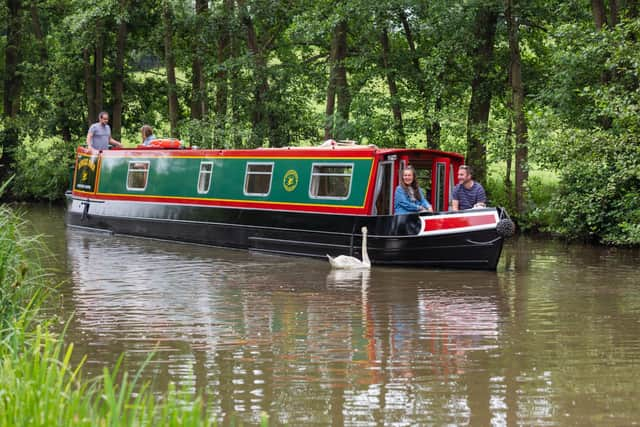

A party of four, myself, my son Ben, his Norwegian wife Silje and my grandson, Sverre boarded the Black Prince Holiday’s vessel, Florence.
From the outset Sverre showed all the enthusiasm and engagement we could wish from an eight-year-old boy. He was not at all concerned about any of the potential pitfalls of our undertaking.
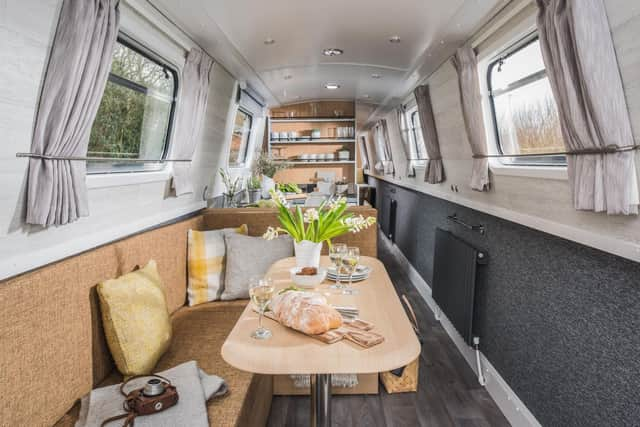
Things got off to a good start. We loved the generous accommodation which included a living room/kitchen - a double cabin, a twin one, and two loos; one with a shower.
We underwent an induction with former policeman George who proved to be an effective instructor.
He talked us through everything we needed to know, including daily engine checks and how to power and steer the vessel.
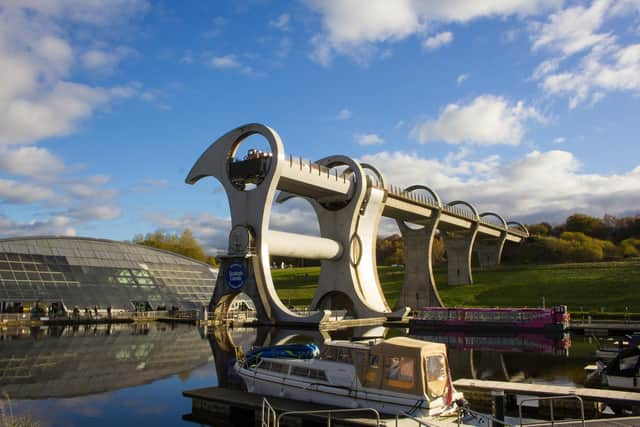
We soon stowed away our belongings and provisions and set off for the Falkirk Wheel. This incredible feat of engineering, completed in 2002, is the only fully rotating boat uplift in the world.
Normally it serves to unite the Forth and Clyde Canal and the Union Canal and it replaced 12 locks. Right now, though the Forth and Clyde portion is inaccessible to traffic from Falkirk so we headed to Edinburgh.
On a short, four-night schedule, we did not plan to go all the way to the capital but rather to take our time and absorb our surroundings.
The Falkirk Wheel is pretty incredible. Both Ben and Silje are professional engineers and they understood better than most what an undertaking its construction had been.
We all enjoyed the experience of being on a watery elevator and then proceeding along the canal’s route.
The weather was kind to us for most of the trip and we unwound mile by watery mile, seeing lots of plant life, birds, and farm animals along the way.
The galley kitchen was perfectly adequate for the preparation of meals which we were able to enjoy together.
We glided over the Avon Viaduct, giving us a stunning vantage point over treetops and surrounding countryside. Then we stopped in Polmont where there was a special surprise for Sverre.
My younger son, Ru had come to join us for the day. At 22, he is half a generation younger than Ben, so our trip temporarily became one involving three and half generations.
Uncle Ru maintained his reputation as the fun, cool adult in the family.
We decided to visit Linlithgow. None of us had been there before and we were drawn to the history of its grand palace.
This striking, semi-ruinous building is a memorial to King James the IV and his descendants.
Mary Queen of Scots was born here and then spent a long time in captivity within its confines, separated from her son King James VI of Scotland and I of England.
In the courtyard there is a grand fountain which has outlasted by centuries the opulent lifestyle enjoyed by Scottish monarchs in times past. On special occasions, it flowed with wine.
Its unicorns and stags’ heads are stone memorials of those lavish times, enjoyed of course by kings and courtiers rather than commoners. (Strangely enough the mythical unicorn is the national animal of Scotland.)
We found Linlithgow to be a very pleasant town, but as evening approached, Uncle Ru had to return home to Glasgow, and we needed a good night’s rest before proceeding a bit further eastward along our proposed route.
Canals played a key role in the commercial development of the United Kingdom. Astonishingly enough it is almost 2,000 years since the Romans built England’s first canals.
This will come as no surprise to many people from Yorkshire. In around 120 AD the Romans built the Fossdyke from Lincoln to the River Trent, for drainage and for navigation.
The Caer Dyke was constructed even earlier than that at around AD 50. Debate as to the original purpose of the latter is ongoing.
What is indisputable is the role that canals played in the industrial revolution when the increase in production led to a demand for effective transportation.
One horse can tow a load up to 50 times greater when that load is on a canal boat as opposed to on a road. This is due to a relative lack of friction.
The golden age of canal building began in the 17th Century and was largely concluded by the early 19th Century.
As steam trains became more common and extensive railway routes were developed, some manufacturers and merchants switched allegiance to the new technology. In the 20th Century road transportation grew apace.
We took short trip by road to visit the famous Kelpies. These are almost impossible to describe in words alone.
Stunning, large steel structures celebrating Scotland’s long history with heavy draught horses, they were designed and welded by sculptor Andy Scott.
Kelpies appear in Scottish mythology as monsters who masquerade as beautiful horses which entice people on to their backs at the waters’ edge and then immerse them into watery grave.
England in general is not short of canals and Yorkshire alone is home to three major such networks. However, a visit to Scotland to holiday on a canal boat is worth the effort.
A marvel of modern engineering, historical places of interest and public sculpture on a grand scale are just some of what is on offer.
As far as we were concerned our trip also turned out to be a perfect way to enjoy each other’s’ company and I am glad to be able to report that inter-generational harmony did, in fact, prevail.
www.drifters.co.uk or call 0344 984 0322. Prices from £713 for a three or four night break.