
John Ruskin: Exploring the linked-up Lakeland gardens
It’s a tall order being in charge of eight different but joined-up gardens covering a total of 250 acres. And it’s an even more daunting task when you have to match one of Britain’s greatest creative pioneers who established the linked-up Lakeland gardens in the first place.
But Simone Daye is a woman with a mission - and with a tremendous responsibility to do justice to John Ruskin, the 19th Century artist, philosopher and thinker who did so much for the Arts and Crafts design movement.
Ruskin taught us to savour natural beauty, and was the brains behind the experimental gardens surrounding Brantwood (www.brantwood.org.uk), his home above Coniston Water in the southern Lake District. The house and its surrounding fell-side gardens are a joy in their own right, looking out on the fjord-style ribbon lake, with the mountain of Coniston Old Man towering above the far shore.
The house itself is fascinating, and gives an insight into the contribution that Ruskin made as an artist, collector of minerals and rocks from around the globe, and in his writing and philosophy on the natural world. Just 40 minutes drive away on the South Cumbrian coast you can complete your experience by staying at the four-star Grange Hotel (www.grange-hotel.co.uk), a suitably stylish and tastefully refurbished place to stay for a few nights. Perfect, and in keeping with your Ruskin experience.
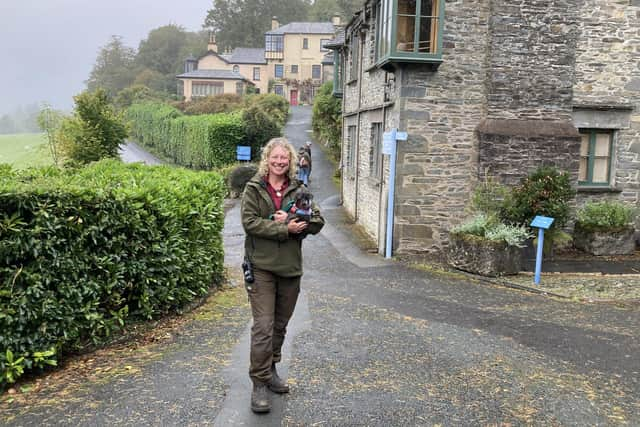

Surrounding Brantwood are Ruskin’s gardening creations, which stretch from lakeside to fell-side, and which incorporate no less than 11 kilometres of connecting pathways.
As Head Gardener and Estate Manager, Simone is tasked with restoring and maintaining the eight very different gardens. Full marks to the Brantwood entry for this year’s RHS Chelsea Flower Show after their wisteria project won them a gold. It augurs well for the rest of Simone’s projects.
Next to the lakeside harbour is the Lowland Garden, where many visitors arrive by either motorboat or on Coniston’s amazing steam yacht gondola, an attraction in its own right. Up top is the High Garden, with its scenic pathways and viewing platform, from which the vast panorama of the lake and fells open up. Then there’s the Professor’s Garden, where the socially-aware Ruskin experimented with allotment plants, with the aim of helping ordinary people with their nutrition and self-sufficiency. It also acted as Ruskin’s personal retreat where he could think, create, and commune with nature.
Visitors are fascinated with the scope of it all – and Simone herself has a wide and varied background that seems appropriate for the eclectic tastes of the original owner of Brantwood. Australian-born Simone – “my mother was a £10 Pom who emigrated from Britain” – came back to the mother country and was a self-admitted ‘Jill of all Trades’, working as a sports coach and then as a garden guide at York Museum.
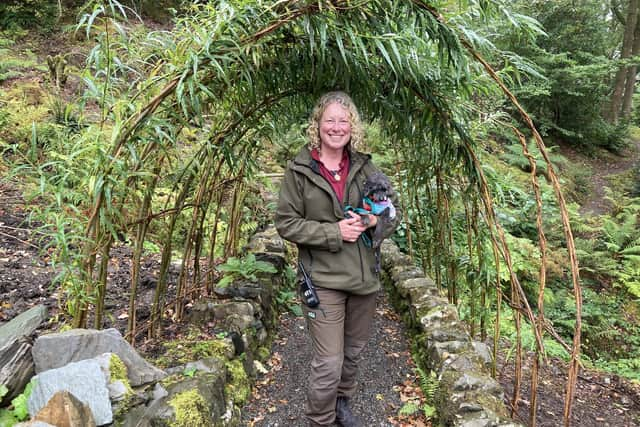
She met her Leeds-born partner Martin Rivett, a mountain leader who also works at Leeds Beckett University as a part-time lecturer in business sports management. They moved to live near Malton, in North Yorkshire, where Simone enrolled for WRAGS, which stands for Working and Retrain As a Gardener Scheme. She worked at nearby Ness Hall, and was placed with gardener Alan Richardson, who was formerly in charge of the rose garden at Castle Howard. More followed at Ardley Hall, and Simone eventually took her RHS exams in Skipton. Ultimately, she worked in South Cumbria, moving on to Brantwood, where she plies her trade in her early 50s. Quite a journey from Sydney through Yorkshire to England’s South Lakeland. Her enthusiasm shone through the lakeside morning mist as she walked my wife and I round Ruskin’s eight unique historical gardens. The Moss Garden, on the fell side, has to be carefully tended and cut, and is close to Ruskin’s Seat, made of slate, and designed for contemplation. The Painter’s Glade is an unexpected open woodland clearing that is connected to the garden pathways. The Fern Garden houses a large and growing collection, the Maple Walk has mature and distinctive trees, and the Zig-Zaggy Garden features terraces that represent Dante’s seven deadly sins.
After the house and gardens, a short drive away in Coniston, you can visit the village’s Ruskin Museum (www.ruskinmuseum) which focuses on local life through the ages. Pride of place is Donald Campbell’s Bluebird, the speedboat in which he came to grief exactly 60 years ago next January 4. Campbell was aiming to beat the 300 mph water speed record, choosing Coniston which is long and narrow, with very few obstacles. Tragically, the vessel reared up and flipped over, killing Campbell, before plunging to the lake bottom. Now brought up and restored, it is there for all to see.
Being surrounded by style, taste and fine things demands that you stay at somewhere in the same vein. And when you go up the winding driveway of the imposing but welcoming Grange Hotel,, you feel you’ve found the answer. Built in 1866, this neo-Italianate property certainly has all mod cons, including a spa, leisure facilities and an indoor swimming pool. The hotel’s Carriages restaurant serves traditional and tasty cuisine, with Cumbrian ingredients where possible.
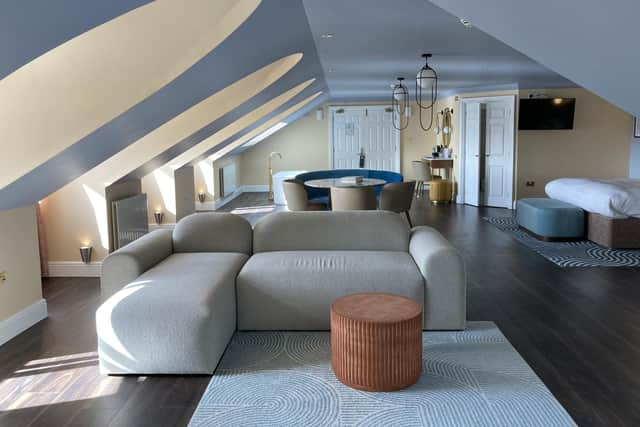
If you can stay in the beautifully-designed and spacious Golden Sands penthouse suite, all the better. It has superb views over Grange-over-Sands bay and its winding promenade, and is restful and quiet into the bargain. The whole building, with its 55 boutique bedrooms, has had a multi-million pound renovation, and has left this four-star hotel with an Art Deco ambience.
Just as important, the hotel is well run and the attitude of the attentive staff is commendable. Smiles and helpfulness seems to be standard. Perhaps that reflects the fact that The Grange is not part of a large property chain, but is an independent historic destination.
The hotel could not be better placed. A short stroll takes you to the nearby rail station, which was designed by the same architect. Train journeys round Morecambe Bay are very scenic, and link you up with Lancaster, Manchester, Yorkshire, and beyond.