
Adam Gatehouse on ringing the changes at Leeds International Piano Competition

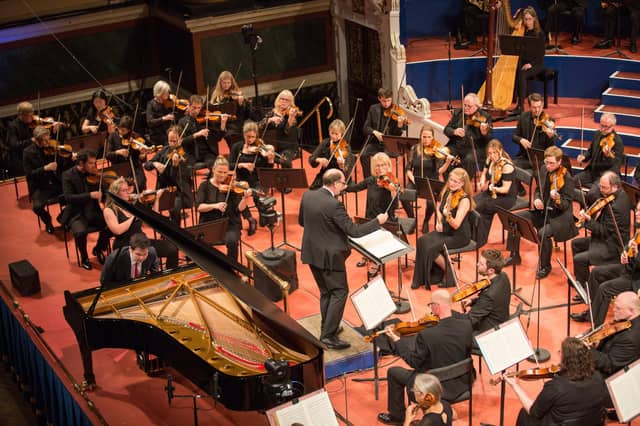

Leeds International Piano Competition has certainly been ringing the changes this year, with a raft of new initiatives aimed at bringing the contest closer to the community in which it is based as well as reaching out to a global audience.
But talking to The Yorkshire Post via video, artistic director Adam Gatehouse sounds like a man whose mission to modernise the 61-year-old Competition has only just begun.
In late August organisers launched the ‘Pianodrome’, an intimate, 100-seater mini venue made with wood from 40 old pianos and based within Leeds City Museum, which has hosted performances by the likes of Lucy Illingworth and Brad Kellaher, winners of the Channel 4 TV series The Piano. “It is fantastic,” Gatehouse enthuses.
Across Leeds city centre, a Piano Trail features 12 playable pianos. “And to accompany that,” Gatehouse says, “there’s some sculptures made by the people who made the Pianodrome from recycled pianos, it’s very eye-catching.”
A Piano Cube, formed from four pianos, also sits outside the city’s Radisson Blu hotel, and nearby there are elephant tusks also made from old instruments.
In partnership with Kew Gardens, emptied-out shells of old pianos have also been turned into piano planters which have been filled with plants by local communities. “They’re absolutely wonderful, beautiful things which are across the city, you can’t miss them,” the former conductor of Ballet Rambert and the Dutch National Ballet says.
As in 2021, the Competition’s first round was staged internationally – this time with a larger field – at six venues in Paris, Berlin, Vienna, New York, Beijing and Seoul. The second round and semi-finals took place last week in the Great Hall at the University of Leeds, while for only the second time in the Competition’s history, organisers have had to find a new venue for the concerto finals with the Liverpool Philharmonic as Leeds Town Hall is undergoing major renovation. They will instead be hosted by St George’s Hall in Bradford on September 20 and 21.
That they will be broadcast not only by BBC radio and television but also streamed globally by medici.tv is all part of the “strongly” held vision that Gatehouse had for the Competition when he and Paul Lewis took over the reins from its founder Dame Fanny Waterman in 2015.

“There was no talk at the time of us being co-artistic directors, they just wanted our advice as to how we thought a competition like the Leeds could best go forward,” he recalls. “So we sat down and looked at it hard, because I’d already been on the jury twice, to see what we felt the competition needed.
“One of our priorities was we wanted to make it as humane as possible. Competitions can be very cut-throat and can have quite a vicious competitive atmosphere to them; we wanted to make that as humane as possible so that the experience for the competitors coming was as gentle as possible.”
Another priority was to grow its audience internationally. “I was first on the jury in 2012 and I realised (then) that the elite world of classical music competitions knew about it but nobody in the city had the faintest idea a) that it existed and b) that it was happening at the time. There weren’t any posters, there were no banners, there was nothing. It was partly broadcast on BBC radio and edited versions of the finals on BBC TV but apart from that it was just taking place in Leeds and quite frankly, the audiences for the competition apart from the final were really quite small.
“So as a priority we really felt we wanted to take it out to the world, make it much more outward-facing. With in in mind, we arranged for it to be live streamed through medici.tv. In the competition in 2018 we had audience figures of 1.2 million, in 2021 that went up to 5.8 million on multiple platforms. We are also now streaming through to China and 150 countries worldwide.”

With the longer-term in mind, a series of “career-enhancing” activities called Competitor-Plus have been tailored for those taking part. A substantially increased prize package includes a record contract and guaranteed concert tours.
“Each of the 24 who come to the second round in Leeds will receive a one-to-one session with a careers adviser, which we pay for, they will also have sessions with Askonas Holt, one of the top classical music management organisations in the world, and Warner Classics, who are also our partners, with medici.tv and Premier PR, we will give them digital advice and help them with their websites and social media,” Gatehouse explains.
“We wanted from the outset to be more than just a competition. When I took over it was a big competition for three weeks every three years in Leeds and in-between nothing. So we also felt as organisation we needed to do better than that across the year in the years in-between and expand the activities within the organisation.”
Competition organisers are keen to strike a gender balance at this year’s Competition, with more than a third of the pianists reaching the second round women. “In 2021, it was just an anomaly of how it went with our voting system, we ended up with an all-male final,” Gatehouse says. “We vote anonymously, we don’t discuss anything as a jury, but suddenly we were confronted with the fact that from a semi-finals where we had four women and six men, we had five men in the final.
“As a jury, we were all quite shocked by that because when we looked at the voting it turned out that eight out of the nine of us had each voted for at least one of the women to go through, but because the votes had been too evenly spread – if there had been one who had got most of the votes she would have got through, or even two – but that’s how it was.
“That set us thinking, and we’ve done a lot of research, we’ve spent days consulting with lawyers and people who are specialists in gender equality, and we’ve come up with a raft of measures which we hope will prevent that sort of thing happening again.
“Obviously our first priority is to find the best pianist, so we’re not imposing any quotas because right from the word go we said you can’t combat an imbalance by creating another one artificially, it has to come naturally. But we put in place various measures, for instance in the pre-selection round we had 366 people, which incidentally was more than 40 per cent more than in 2021 and nearly 100 per cent more than in 2018, and 31 per cent of those applicants were female.
“We applied a completely blind audition system to the pre-selection round, so the jury of four knew nothing about the candidates, they just had a number and their repertoire and we listened, we didn’t watch. So they didn’t know the gender, the age, where they came from, who they study with or anything like that, which was a bit of a high-risk strategy because it could go either way, but what transpired was the percentage of females to male that were selected to go through to the first round exactly mirrored the peercentage from the pre-selection round. So we had 31 per cent of females going through to the first round.
“We applied a slightly more qualified approach to the first round, so they were filmed, we could see the gender but we didn’t know their nationalities, who they studied with or who’d recommended them. From that process the balance between female to amle actually went up to 38 per cent, so coming to Leeds in the second round will be nine women and 15 men.
“While retaining our anonymous voting system, we had put into place various firewalls which allow us while voting to take a look at how the voting is going in terms of gender balance, and if it looks as though it’s lopsided then we can re-vote.
“Without in any way trying to influence our jury’s decision because we totally respect our jurors’ integrity, and our prime aim is to find the best pianist, but we do know in the world of piano competitions it is heavily imbalanced – it think it’s 18 per cent females have won competitions as opposed to 82 per cent men – and in the general piano world if you look at the top 450 pianists who are out there internationally, only 23 per cent are female. It is part of quite a complex situation but if you look at the statistics, at entry-level to conservatoires there are actually more women than men but by the time it comes to graduation, and particularly post-graduation and taking that through, then the women drop out and the men carry on.
“We have no ready answers as to why that is, but we do feel that we can at least put in place measures that enable us as an organisation and the jury to question whether we are doing the right thing, and without in any way seeking to influence their judgment, we do allow them the possibility, should the balance be skewed far too much in the male direction to reconsider if they want. They’re not forced to, if they re-vote they can vote exactly as they did before, but just to at least reconsider in the light of (the initial result).”
A “passion” of Gatehouse’s is to have a “very strong” learning and engagement programme. “We have a commitment to taking the piano out to not just children but communities of all sorts, both locally but also nationally and internationally.” Their Count Me In programme for children, staged at the Carriageworks Theatre, in Leeds will be distributed digitally with the help of world-famous pianist Lang Lang’s foundation, which has ties in China and the US.
As well as sparking interest in the piano in schools, Gatehouse hopes to reach out to “rusty pianists – those who studied when they were younger and want to start up again”. He adds: “We are evangelical about that, about spreading the word about the piano and getting it out to as broad a public as we can.”
His vision is for the Leeds to continue to evolve year on year. One of his ideas is for a “piano-verse” which “acts as an umbrella for anything that’s out there to do with the piano – it can be piano lessons, it can be keyboards, how a piano works”.
“There are so many things out there in the digital sphere but they’re all spread around, so we would in a way act as an umbrella for all of those things. We could be the go-to place if someone wants to find out anything about the piano, they can come to us.”
Also, he believes, “people’s perception of the piano and how they consume music generally is evolving – from just in the 24 years of this century, we’ve gone from the CD being the prime mover to now CDs are becoming almost niche and everybody’s consuming on Spotify and Apple Classical and all those different platforms. Big record companies are having to adjust to a swiftly changing environment.
“For instance, Warner Classics, less than half of their music is on CD, it’s increasingly more on streaming. You’re getting labels like Platoon, which works under the Apple umbrella and doesn’t offer physical CDs at all. So the new generation of pianists are going to have to be operating in a different way – that’s the way the world is evolving so we have to evolve with it.”
Leeds International Piano Competition finals take place at St George’s Hall, Bradford on September 20 and 21. This year’s finalists have been announced as:
Kai-Min Chang (Taiwan) Junyan Chen (China) Jaeden Izik-Dzurko (Canada) Khanh Nhi Luong (Vietnam) Julian Trevelyan (United Kingdom)