
As theatres go dark due to the Coronavirus crisis, we look at some of Yorkshire’s gems


On Saturday night I was at Leeds Grand Theatre for the world premiere of Northern Ballet’s Geisha.
The manager of the Grand, Ian Sime, told me to expect the announcement of the closure of the venue within the week. It came within days.
The dominos kept falling. At the time of writing, most of our regional theatres are closed, some for now, some for weeks, others indefinitely.
It gives me the opportunity to channel AA Gill (not a comparison, you understand). Gill once said at a job interview that he wanted to ‘interview places’. With buildings closed and productions shuttered, this feels like a chance for me to ‘interview’ the region’s theatres.

Over the coming weeks I will take you, through these pages, on a theatrical tour around Yorkshire.
Some of the theatres I wanted to write about this week were a little nervous about this article. ‘Sensitive times’, I was told, understandably.
I knew exactly the theatre company to which I should turn.
“What can you do? We go on,” says Alan Lane, as he drives home from yet another 12 hour shift at The Holbeck. Lane is the artistic director of Slung Low, one of the boldest theatre companies this region has ever produced.
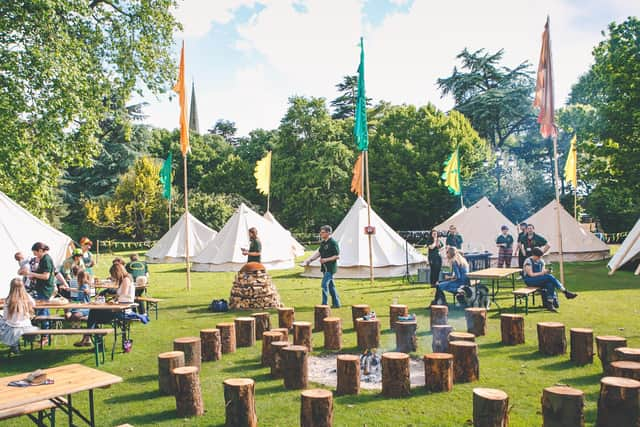
A company birthed in Sheffield, raised in Bradford and which came of age in Leeds, it seems the perfect place to begin the theatrical odyssey I plan on taking in the coming weeks.
Slung Low now faces, as do all of our nation’s theatres, the most difficult challenge it has ever encountered. “It’s unbelievable but it is almost as hard to shut down a building as it is to build a production. Logistically, this is tough,” he says.
When I first called him, Lane and his team were trying to work out what to do with many gallons of beer. When you run a venue as well as a theatre company, that’s the kind practicality you deal with.
Slung Low celebrates its 20th birthday this year and began its life in Sheffield, where Lane and other founder members had attended university, but it found its home and purpose in the early 2000s when it moved to Bradford and under the guidance of Theatre in the Mill’s Iain Bloomfield, began to make work in West Yorkshire.
With Time at the Mughal Gardens in Lister Park in Bradford and then They Only Come At Night, a vampire adventure staged in a multi-storey car park Slung Low announced itself as a theatre company that would be making work a little differently. It would be making theatre outside of theatres for a start. Large scale shows followed – and by ‘large’ I mean blowing up a tanker in Manchester, staging Moby Dick in the Leeds docks, sinking a ship in an apocalyptic future in Hull, creating a literal riot in Sheffield city centre with Camelot: The Shining City – large. It did all of this from a series of railway arches in Leeds until last year when Slung Low made The Holbeck, the oldest working men’s club in the country, its home.
“As a theatre company here in the community, we have a moral and social and political purpose. Gathering people around the fire and telling them a story is essentially what we do, that’s what theatre is. What do we do when gathering people becomes not an act of community, but an act of aggression? That is why we are facing an existential crisis right now,” says Lane.
There were several things Lane and the Slung Low team had to do this week: convince members that closing down the club was the right thing to do, pay all the artists they work with and work out what to do next. “The question we always ask is how can we be kind and how can we be useful? Right now that means a lot of different things,” says Lane.
“We have a van which we use to transport our sets. If people in our community need to have food delivered, we’ll do that. Our principles have always been: we have it, if you need it, you can have it too. Radical generosity is what we do.”
Lane talks like this. It’s indicative of the company he leads; they’re into being useful, being kind and ‘radical generosity’. An example? All the shows they stage at The Holbeck and around the country are pay what you decide. They organise cabarets featuring classical cellists and world class artists like School of Night and Divina De Campo. Slung Low is a company that doesn’t just redefine parameters – it creates entirely new rules. “We ask questions like why shouldn’t a working men’s club in South Leeds have some of the best culture on offer in the country on the doorstep?,” says Lane. “Right now though we need to work out how to make sure we are here at the other end of this, because we will come out of this and people will need stories to help them understand what has happened and who we are on the other side.” Slung Low will be there to tell those stories.