
Carlos Alomar: 'What I wanted to do was look at me and David Bowie’s legacy'
As two thirds of the D.A.M. Trio, guitarist Carlos Alomar and bass player George Murray carved their own place in the history of modern pop music by playing on David Bowie’s ‘Berlin Trilogy’ of albums.
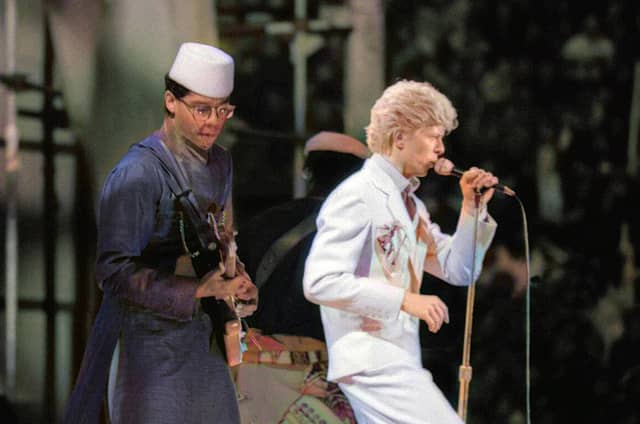


Now, almost 50 years on from those records – and nine years after the deaths of Bowie and the third member of the trio, drummer Dennis Davis, the pair are reuniting for a UK tour which includes a gig in Sheffield.
Alomar describes the chance to perform with Murray again as “stupidly awesome”, explaining the reunion came about at a Bowie Convention in Liverpool, where they shared a stage and Alomar realised that his former bandmate had “still got it”.
“Then you have the fans, who were very appreciative, and rightly so, they said, ‘You should tour’ in the question-and-answer (session). I’m like, I’ve heard this before. See that guy up there? He’s a promoter, why don’t you hound him? Well you know what, they did and they put a buzz in his ear and it was wonderful.
“George and I really bonded, so getting back together was blissful to say the least. Then we went back home and the California fires happened...and I started becoming very disturbed that I was going to lose George. (After several phone calls) I found him, he was in a hotel, he’d escaped – and that solidified it. The minute I thought I haven’t done a tribute for Bowie, I haven’t done anything for Dennis and I’d just almost lost George, Carlos, come on, what are you doing?”
A believer that “everything has its time, we get what we want when we’re supposed to get it, not when we want them”, Alomar says he would have felt “emotionally crushed” if he had attempted to perform a tribute to Bowie and Davis in 2016. But then all the Bowie legacy tours started happening, along with the documentary film Moonage Daydream. “It just became this ball,” the guitarist says. “I was all right being there but I noticed no-one can represent the D.A.M. Trio – the syncopations, the groove, I realised that the minute we got together. The D.A.M. Trio swings, the band was playing square, when we got together with the square band, they swung.”
He says he appreciates and respects the other alumni tributes but says: “What I wanted to do was look at me and David’s legacy. Everybody knows the name of the Spiders From Mars, some people might not be able to tell you the names of the members, but the brand, it’s iconic. The minute I did an interview and I named them the D.A.M. Trio – Dennis Davis, Carlos Alomar and George Murray – we had a brand, we had a name, we were somebody, otherwise who were these three jazz guys that played behind Bowie through all those albums?”
Alomar first worked with Bowie as band leader on his 1975 album Young Americans, with Davis joining him for the New York recordings of Across The Universe and Fame that featured John Lennon. Alomar says that although he had “hung out” with Murray a little in the circle of session players, it was Davis’s “relentless” enthusiasm that earned Murray a place on Bowie’s next album, Station To Station. “The twins are the bass player and the drummer and if he says he’s good that’s just great,” Alomar recalls. “Once I heard him play, oh my God, it was a match made in heaven.”
The “jazz mentality” between the three of them meant Station To Station was “a wonderful blend of jazz, funk and R&B” alongside the “Kraftwerk precision” that Bowie wanted, Alomar says. “When Dennis Davis plays his hi-hat patterns are in thirty-second notes, so he’s always going to be in tempo. It was an amazing time for David and I...everything came together in that time, and it created the bond of brothers that lasted very much into the future.”
Alomar believes personality was the deciding factor for Bowie when it came to musicians with whom he chose to tour. “David had a wonderful knack to being able to discover people and their potential without actually putting them in that arena,” he adds. “So if you are very limited in your way of doing things but you know how to do it well then I’d rather have you than a guy that does it well and overplays. It’s a delicate balance indeed and David was a craftsman in being able to put the right rhythm section together and then bring in the soloists as he deemed necessary to fill those holes.” Even then, they contributions “might make the cutting-room floor and not the album”, Alomar says. “Creativity is the most important aspect, and professionalism, I think, which goes a long way in the studio. If you’re unprofessional and things get a little dark it can really bring down the vibe in the studio, and no artists wants his vibe to be crushed by one musician who is an idiot or jerk.”
For this tour, Alomar and Murray will focus on Bowie’s Berlin period. The guitarist says he’s chosen the rest of the band carefully. “When you assemble the band you have to listen to the material and decide the essence of what it is that you need,” he explains. “Sometimes David Bowie would throw curves in when it came to arrangements, sometimes he would give you a lot of background vocals like Young Americans or a full horn section like Serious Moonlight, or how do I work with a violin player, a synthesiser player and a piano player? The combinations are always so odd, and yet you have to bring new life to Life On Mars.”
When it came to finding a drummer, he needed someone sufficiently powerful. “If you only play with four tom toms I can’t use you, Dennis used six – how do you think we got all of those damn rhythms? If you’re thinking you need 54 beats per measure, I need a lot of drums,” he says. Fortunately, Tal Bergman fitted the bill.
Alomar met guitarist Kevin Armstrong at a convention. “Here’s the perfect example of personality – what a sweetheart of man,” says Alomar. “We jammed, we took from each other, so I found that he’s a professional, he can learn whatever he needs to, plus he’s a Bowie alumni and respectfully he will do the job. Having tht kismet moment in the convention, it kind of made sense.”
Axel Tosca, who has worked with George Clinton, will play keyboards and piano – “That man has got 18 hands, when you hear him playing, it’s over,” Alomar says.
Alomar’s daughter – and Tosca’s wife – Lea Lorien will provide backing vocals. “She works with a TC Helicon and Television Harmony Machine and she can sing one note and a 14-piece choir will start singing,” he says. “Because of all the technological stuff I need for the tour, I need a certain sound... I need male harmonies, well, that machine will turn a female harmony into a male harmony. All the electronics that we use can easily be duplicated by Lea.”
Singing lead vocals will be Michael Cunio, who has performed across the world with Scott Bradlee’s Postmodern Jukebox.
Don’t go expecting any of the Brian Eno instrumentals from Low and ‘Heroes’, though. “We’re not doing the slow, lethargic material that Brian did,” Alomar says. “I intend to wear your ass out.”
Carlos Alomar presents The D.A.M. trilogy at Sheffield Octagon on Sunday November 23. https://www.facebook.com/damtrilogytour/