
Dame Evelyn Glennie: 'I think everything boils down to listening'


Breaking barriers has been a trait of Dame Evelyn Glennie’s long career in music. Although profoundly deaf from the age of 12, she was determined to become the first person ever to forge a full-time career as a solo percussionist.
Now with more than 40 recordings under her belt, she has worked with orchestras and ensembles around the world, as well as collaborating with artists as diverse as Mark Knopfler, Björk, Lesley Garrett and Yolanda Brown.
A familiar face at the BBC Proms, where she has appeared 19 times, she reached an even greater audience at the opening ceremony of the London 2012 Olympic Games, where an estimated 900 million television viewers saw her perform.
She has also designed her own instruments and become a respected educator, on a mission to “teach the world to listen”. In 1993 she was awarded an OBE and made a Dame Commander of the British Empire 14 years later.
Next week she will be discussing what it takes to succeed when the world isn’t built with you in mind with content creator and deaf advocate Tasha Ghouri and broadcaster and arts accessibility campaigner Dr Hannah French at Leeds International Festival of Ideas.
Speaking via video to The Yorkshire Post, she says she didn’t always feel that barriers within music were there to be broken. “I think that you go into a profession first of all with the passion for what you feel you would like to do,” she says. “In my case the career of a full-time solo percussionist was a priority. I wasn’t thinking about myself as a so-called disabled person, it was much more a career needs to be sustainable in order for me to put food on the table 10 years on.
The first time she “became aware that a shift needed to happen” was when she was refused entry to the Royal Academy of Music. “The decline wasn’t because of the standard to get in, it was because of the institution’s assumption that professional orchestras would not accept a deaf musician. Now that’s a really dangerous position to be in, to use the word ‘assumption’ first of all; I can completely see where they were coming from because 90 per cent of percussion players would go into orchestral playing back in those days. (But) I realised you can’t base that assumption on whether somebody is deaf or blind or has one arm, one leg or whatever. That was the first step to realising society needs to be careful, not just in a musical sense but in every sense, as to how they label people, their expectations.
She believes that “everybody has a story to tell and the entry point for many people is quite different to what people assume”. For her, she says: “I needed to ask the institution to really look at the person. Is that person focused? Are they determined? Do they have a clear vision? Are they hardworking? Are they level-headed? Etcetera, etcetera. Well, that is nothing to do with deafness, that’s the person. So I think everything then stemmed from that.”
Growing up on a farm in rural Aberdeenshire, Glennie remembers that a “high percentage of youngsters played music” thanks to free tuition in Scottish schools. She first learned to play the family piano from the age of eight, followed by the clarinet two years later. “I don’t remember it as a calling, it was simply there, and I was very lucky to be brought up in that kind of environment,” she says.
The turning point came when she became fascinated by the percussion section at Ellen Academy’s school orchestra. “That’s where the seeds were planted,” she says. “I saw the percussion, was absolutely enthralled by that and thought, I’d love to give that a go… A few months later I got the chance to meet the peripatetic percussion teacher Ron Forbes who became absolutely key. He made that difference of what it means to hear and what it means to listen, and when he asked me to put my hands on the wall of the music room to feel a timpani it was as though the sun rays had come up because I was no longer thinking about what I was hearing through the ear through the hearing aids, but what was I feeling through the body, so that was a massive turning point. That was a great example of somebody who listened – listened to the person, listened to the circumstance – and that changed my life. There’s barely a day goes by when I don’t think of Ron Forbes in one way or another.”
When at 15 Glennie decided she wanted to become a solo percussionist there were no role models in classical music for her to emulate. “It was really only when I went to the Academy that I realised that the career did not actually exist, so my role models were my fellow school pupils. We were all pushing each other and encouraging each other. Also at that time we didn’t have people come into give masterclasses or workshops and it was entirely orchestral-based, so all of the solo playing I did was practically underground. You’d go into the music library and sift through pieces written for piano or violin, flute, you name it, you’d look at a piece and think that might work for percussion, I’ll give that a go. You had nobody to play it to, so you were just making your own decisions, your own analysis...which actually in hindsight was probably a really good thing because when I started collaborating with composers on new pieces you couldn’t go into a record store and find 10 different recordings of that piece, you had to rely and have faith in your own judgment, your own interpretation, your own journey with that piece.
“And I think perhaps because of the access to YouTube and all of those sort of things where people can share their wares, sometimes a bit too soon we see a million performances of one particular piece of all different standards then it can have a bit of a pull on how you listen to yourself and what are your own ideas. So we’re quite quick to feed things into our system rather than thinking, OK, this is what I feel and now I’m going to let that out into society. For me, I’d rather take a longer route than a shorter one.”
To create a repertoire for solo percussion, Glennie bought a copy of the British Music Year Book and “took pen to paper and wrote” to a selection of composers listed in it. “I got some replies and some people didn’t reply,” she recalls. “Some people said ‘My commission would be x amount of money’ and I thought, how do I do that? So that was another brick to be put into the equation and we’d have to navigate through how to commission a piece of music. One thing led to another and I found that I did an awful lot of school lecture demonstrations, going into schools going, this is a marimba. Those commissioned pieces from the composers who I’d written to were really nice short pieces of music, absolutely ideal for the things I was doing at that time, and it was just your first taster of working and collaborating with composers. Then eventually you were asking for bigger pieces, you tried to find funding and collaborate with orchestras so that they could actually put the money up and you would be in a position to give the world premiere. That’s normally how we work now.
“I just tried to work with composers all over the world to create a body of repertoire so that any player now can immediately come along and say, ‘I want to be a solo percussion player’ and they don’t have to wait for repertoire. It’s still crucial that they commission pieces because we want to keep it going but nevertheless there’s not waiting for two years for the next main concerto, there’s already a big body of repertoire available.”
Over the years, Glennie has struck up fertile working relationships with composers such as the American Michael Daugherty, who has written two concertos for her, and the Canadian-Chinese Vincent Ho, who has also written two concertos and some shorter pieces. She also mentions Sir James MacMillan, whose Veni Veni Emmanuel she famously performed at the Proms in 1992. “That was the first ever percussion concerto in the history of the Proms,” she says. “We’ve kept in touch over the years.”
“All of the composers one way or another have been really special,” she adds. “Some of them have since passed away or retired, but that collaboration of working on a piece of music that started from a conversation to then having it presented for a recording is quite a journey and it takes quite a time as well so you did build up a relationship with the composers that is really special if you think about the story of that journey. One of the things that we are aiming to do with The Evelyn Glennie Collection, for example, is to document those stories whilst I’ve still got some marbles left, so I can put those onto tape and video and then that will be part of the collection as well and be great for people who want to research this particular journey. It’s quite important for us to do that.”
Glennie, now 61, has also composed her own pieces. “Improvisation has always been important to me from the get-go, and then I started dabbling here and there, using things that are going to develop technique-wise and they ended up into pieces of music. I wrote a little piece that I was exploring on the xylophone at school at the age of 13 in order to explore four mallet playing, then that developed into a little marimba piece and it’s become quite a popular piece, called A Little Prayer, and it’s been arranged for all sorts of different combinations of instruments.
“But the media writing, for films and TV and that type of thing, I guess that’s happened in the past 20 to 25 years or so. It’s just been something that I’ve always been curious about and then had the opportunity to do. I normally collaborate with people when I do those projects – for example last year I collaborated with Dan Jones on the six-part ITV series Code of Silence [starring Rose Ayling-Ellis]; the second series is happening now so we’ll start composing and recording for that from the end of October this year and that will go into next year. Different projects like that pepper the diary, as it were.”
Glennie regularly performs barefoot so she can ‘feel’ the music. She explains that the feet are important for most musicians. “If they were allowed to take their shoes off in an orchestra, they would gladly do that,” she says. “It’s like a security blanket. Of course you can still perform if you’re wearing shoes but sometimes the instruments I play which are often hired, so they’re not always my own, and because marimbas and vibraphones come in different heights and different sizes of bars, it’s not just a uniform standard size like a piano, sometimes the lowest height is still quite high for me, so I then deliberately wear shoes on those occasions otherwise your posture is all out of sync. But a lot of sound does come through your feet and it’s quite an important part of the body to feel the sound.”
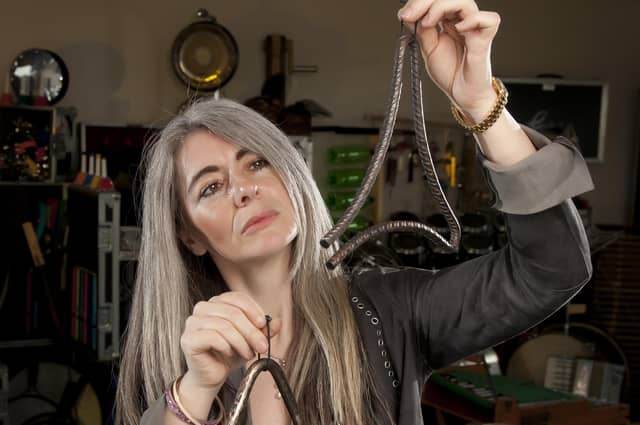
Having helped design dozens of instruments herself, Glennie is always searching for new sounds. “Behind me I’ve got some old lampshades on top of a very large timpani that I was fully exploring,” she says. “I’m always on the lookout for new sounds because a lot of those sounds are actually really handy in the media sector. Sometimes you may just need a sound and then with the skill of the recording engineer, depending on how they place the mic...they can really pick up things that the human ear can’t pick up, and then they’re able to augment or manipulate that. So we use all sorts of things like bombshells to umbrella stands to lampshades to CD racks to homemade shakers. Anything at all. In fact I was in a store the other day where they had old birdcages so I took a stick and ran it up the cage to see if that was going to be useful. Not really, but it’s fun to try those things, and really important as well because you are looking for sounds that will have a place somewhere in a project.”
At her recent late-night Prom that Glennie performed with the Fantasia Orchestra, the programme ranged from Vaughan Williams to John Coltrane and Radiohead. She says she sees the tendency to categorise music by genre as too restrictive. “For me, it goes back to Ron Forbes, my teacher at school, where he saw all of his pupils as sound creators first and foremost, then musicians and then percussion players,” she says. “We’re often defined by our instrument and then the kind of music that we play; rarely are we defined by the fact that we’re sound creators ultimately whether you’re playing a Beethoven violin concerto or the most squeaky gate piece of music on the planet. We’re basically creating sound. In my own world and my own little mind, I don’t like to be judged as a particular type of musician. Definitions don’t mean that much to me, but I can absolutely understand why it could be helpful for some other people.”
In a TED talk she gave 16 years ago, Glennie spoke of her mission to teach the world to listen. In a noisy world, she says we need to appreciate how sound can transport us from one emotion to another, and also develop a greater empathy. “I think everything boils down to listening,” she says today. “In everything that we do, and every type of society at the end of the day, any age that we happen to be, listening is the kind of glue. It’s lovely when we are being listened to and when we can give that give of listening to somebody else. Equally, listening can be hard work, so we need a break from listening. So it gives us an opportunity to examine and interrogate what is my listening landscape at home or in the workplace or in the community, what sounds do I simply not need that are there that are affecting me in someplace or other, or what is my listening diet, how many harsh sounds have I experienced today as opposed to nature sounds?
“Also, listening is not always connected to a sound. I think that’s really important to say. Listening also involves our sense of sight and our sense of smell and our sense of touch, all of those things, and it also is about what we write, what we decide to text or put in an email or write on a note to somebody. We’ve kind of lost the grace of communication and that’s really affected our listening skills. So when somebody says, ‘Hey, can I have this?’ without saying ‘hi, Evelyn’ or whatever or ‘that will be wonderful, thank you’ it can eat in to the quickness of responses, but it’s quickness that isn’t about deck. Saving time on something isn’t always the best way to nurture that kind of communication and nurture our listening skills. So I do worry about that quite a lot in society because I think as we’re all getting older for longer the care that we’ll need when we’re much older if listening isn’t absolutely at the top of that list we have a big problem – and I think we’re beginning to experience that already.”
Apart from working on the soundtrack to Code of Silence, Glennie has a busy diary for the next few months. Among her longstanding projects is her archive, The Evelyn Glennie Collection. “We have a wonderful group of volunteers who for the past 10 or 11 years have worked diligently on putting The Evelyn Glennie Collection together. The collection consists of over 3,800 instruments as well as thousands of items of correspondence, of photographs, of costumes – just everything to do with the journey. We are very keen to let people know that the collection is open for research purposes – we have had one person already use the collection for her PhD who then went on to write a published book.”
Then there’s the work of The Evelyn Glennie Foundation whose aim is to teach the world to listen.
“That takes up quite a bit of my time as well as the concerts,” she says. Last week she performed at the Hidden Notes Festival in Stroud; in November she and the Welsh harpist Catrin Finch will premiere ReConnection, “a brand new, hour-long piece of music” by the British composer Jill Jarman at Perth Theatre and Concert Hall. She will also collaborate with the New London Chamber Ensemble at Malvern Festival, and then heads to Italy for a discussion – “It’s about strategic philantropy for the arts,” she says – before spending a weekend in Wimbourne and Bristol talking about Beethoven “specifically from the point of view of his deafness – it’s about trying to dig down not so much about his music but society at the time and the deaf world”.
Dame Evelyn Glennie and Tasha Ghouri will be in conversation at Leeds International Festival of Ideas at Leeds Playhouse Courtyard Theatre on October 8. https://leedsinternationalfestival.com/event/strength-beyond-the-silence/