
From Bradford with love: The lost art of cassette tapes that kept hearts connected
For over two years, Asim Rafiq Mirza and his now wife Asma Mirza would send cassette tapes back and forth, he in Bradford, she in Pakistan. The recorded message were a chance to feel connected despite the 6,000km distance between them.

Marriage was part of the plan, but it was through these tapes that a fondness blossomed.
“Essentially they fell in love on these tapes,” explains sound artist Wajid Yaseen. “They sent tapes to each other every two or three weeks for about three years. It’s so lovely.”
Asim and Asma’s story is captured in a temporary exhibition in Bradford as part of the area’s 2025 City of Culture programme.
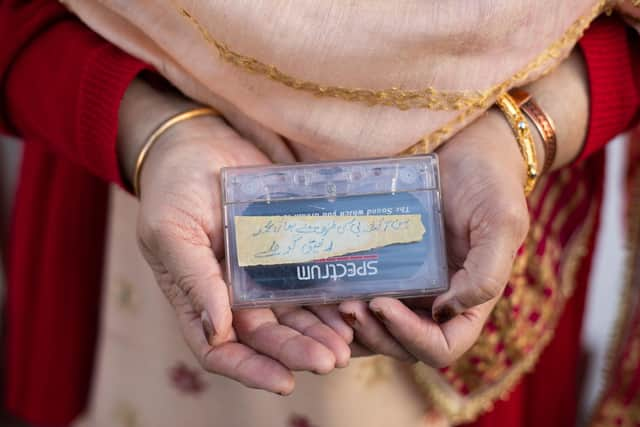

Tape Letters is produced by Modus Arts, of which Wajid is director, and showcases the innovative use of cassette tapes as a method of long-distance communication by British Pakistanis who migrated to the UK between 1960 and 1980.
The display features portrait photography, quotes and audio recordings of 12 families from Bradford, exploring themes of migration, identity, language, technology and communication.
Asim and Asma came to know more and more about each other thanks to their conversations via tape, and found the process to be a way that they could express their feelings from miles apart.
Asim told the Tape Letters project that he would lock himself in his bedroom and block the bottom of his door so that his brothers and sisters couldn’t hear the messages that he was recording to Asma - and the pair would both eagerly await the arrival by post of the next cassette.
Asma says: “There was no cordless phone, and I couldn’t speak to Asim in front of my family — not even a proper hello. So he sent me a cassette and said, ‘Tell me what’s in your heart.’ That’s how it all started. I kept those tapes locked in my suitcase so no one else could hear them. They were more than just messages — they were how we stayed connected.”
Wajid was inspired to begin what would become the Tape Letters project nearing eight years ago after discovering some of the cassettes that had been sent and received by his own family. He had grown up in the 1970s in Manchester, where his father had a keen interest in devotional hymns called Naats and would often be invited to sing in people’s homes or at public ceremonies in British Pakistani communities.
Some of the singing was recorded on cassettes and it was these that Wajid was searching for when he came across his family’s tape letters, wanting to hear the voice of his late father, who had passed away in 2001.
“When I was a kid I’d be pulled in by my mum to say hello to some auntie or uncle in Pakistan,” Wajid remembers. “People like my mum who couldn’t read or write letters would essentially use (cassette tapes) as an equivalent of a whatsapp voice note to record audio messages to family members who would listen to them and respond.”
“I thought it was just our family that used to do this,” continues the 56-year-old, who lives in London. “But I started asking around and found out it wasn’t. There were thousands of families who did this. It’s an entirely hidden history that I stumbled upon.”
Wajid and Modus Arts have since managed to secure cassettes from a number of families across the UK and have interviewed people both in this country and Pakistan about the practice of recording messages on tape. Their oral history project Tape Letters, supported by the National Lottery Heritage Fund, Arts Council England and London’s Bishopsgate Institute, now includes 200 testimonies - and the content has been used to create numerous outputs including an archive, exhibitions, a podcast, and learning resources.
Shanaz Gulzar, the creative director of Bradford 2025, hopes visitors to the Bradford exhibition will be able to celebrate the “real-life connections formed through this long-lost method of communication”.
She remembers in her own childhood sitting down with her parents to record greetings to relatives.“For those of us born and brought up here, we had very little connection with family over there because we couldn’t go visit, we couldn’t afford it,” she says. “For us recording these tapes was a bit of a chore and we did it to please our parents.
“But for the older generation, for whom it was their brothers and sisters, their parents, their grandparents, it meant the world to hear their voices and to be able to communicate like this…It was really important to my parents’ generation because they were the ones who had left and made a brand new life in another country and were trying to maintain a relationship with family thousands of miles away.”
The format offered a cheaper alternative to international telephone calls, whilst also providing a more accessible option for those unable to read or write letters. At a time when the telephone was communal, the tapes left room for intimacy in messages to loved ones and enabled the speaker to convey humour, capture disbelief, sing songs or speak poems aloud.
Tariq Javeed Mirza recalls recording messages with his cousins to send back to his father and other relatives in Pakistan. He came to the UK at the age of 15 in 1966 and was unable to visit his home country until seven years later. Hearing each other’s voices was a “delight” for his family.
Asaf Hussain, another contributor to the project, agrees. Hearing the voice of whoever was talking was what really mattered. Asaf remembers receiving detailed tapes with updates from relatives and crowding around the cassette player with family to “listen like it was the news”. “It brought a kind of closeness that phone calls never could.”
These days, the practice is largely unknown to many, even within British-Pakistani communities, with many original tapes lost or later recorded over. Tape Letters aims to unearth, archive, and represent a portrait of this method of communication, with the Bradford exhibition looking back on life in the city for new arrivals in the days before technology connected us all in an instant.
“Analysing the archive has felt akin to undertaking a sort of ‘sonic archaeology’,” Wajid says, “a deep dive into a wide range of fields and themes, including memory studies, linguistics, migration, discrimination, communication technologies, class and socio-economic dynamics, and many others.
“Although it has become a surprisingly complex social history project, it primarily demonstrates the deep and inherent need for people to communicate with each other in whatever way they can, wherever they’re originally from or wherever they find themselves in the world.”
Tape Letters is on display in the Gallery space of Loading Bay as part of Bradford 2025 UK City of Culture. It is open Thursdays to Sundays, until June 15.