
Mark Radcliffe: 'This feels like kind of bonus time that I might not have had'
Known to millions of listeners as the avuncular voice of the BBC Radio 2 Folk Show, broadcaster Mark Radcliffe has also had a long line of musical ventures of his own – the latest of which is a duo with his friend David Boardman.
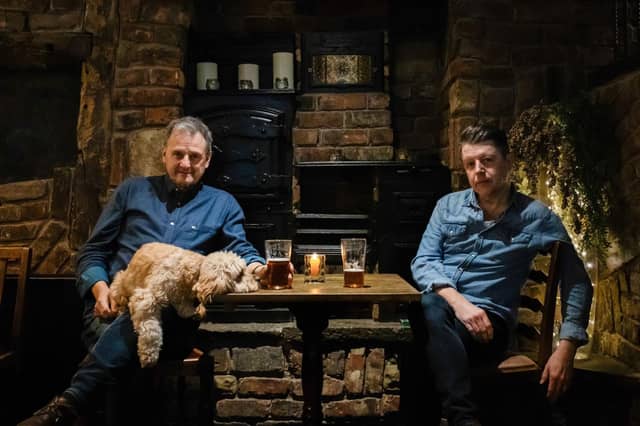


Later this week the pair play at Hebden Bridge Trades Club, while in April, they’re due to perform at Pocklington Arts Centre.
He and Boardman struck up a friendship when Radcliffe moved to the Cheshire town of Knutsford. “David was in an Americana band called Fine Lines when I moved to Knutsford and I was finding my way into a new town and getting to know a few people, and he was short of a drummer, and I started out playing the drums, so just as something to do I said, ‘Well, I’ll play the drums if you like’,” the Boltonian recalls.
“So we started doing that and then he said he wrote lots of music but he found it hard to write the words and I said, that’s funny, I’m sort of the other way round. I said, if you want to try it, I’ll give you some sets of words and we found it fitted together quite naturally.
“At one point it was a seven-piece band and we did quite a lot, we toured with Kiefer Sutherland, and then it became that getting seven people around was difficult, like herding sheep and expensive, you need lots of gear and an engineer and all that, and because we wrote the songs together, we used to play them on two acoustic guitars and I would harmonise with David, one day we thought, this is quite good on its own maybe, and we’d only have to take two acoustic guitars and go in a car, so that’s how it started.”
Now 66, he finds the practical side of being able to drive to and fro gigs with minimal equipment suits him. “I like a pint but I don’t drink much any more, and I don’t like staying out late, really. We were doing a gig in Ludlow and my agent phoned me and said, ‘I’ve got some bad news, it’s on a Sunday and they want to make it a matinee’, I said that’s not bad news, that’s marvellous.
“Playing the drums involves some equipment and we’re not at the level where we can afford to pay someone to set it all up for you. Late nights, vans, drinking – I’ve done all that, so something that’s very simple, I do like that.”
Things particularly clicked during lockdown when the band couldn’t play together and instead he and Boardman became “hooked on the Everly Brothers and that two-part harmony thing”.
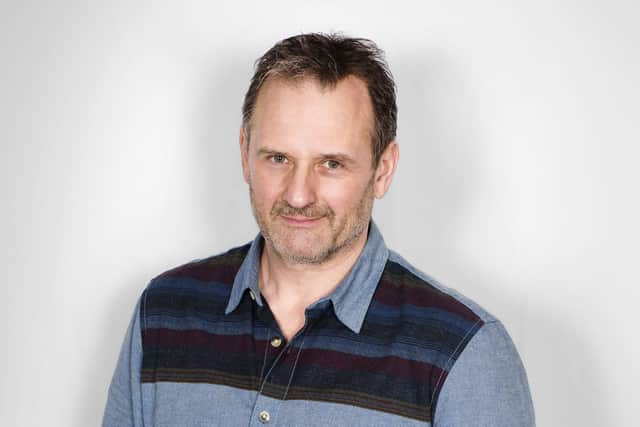
“I do really like it now when there’s only two of us. Sometimes we take a mate to drive us, but if we’re on at 7.30pm we actually don’t need to get there more than an hour before, the soundcheck takes five minutes.”
In a video on social media, Radcliffe jokingly described their songs as “depressing”, while Boardman preferred “thoughtful and meditative”. Today Radcliffe quips that his concerns are more “late-life crisis” than midlife, but adds: “Recently I think it’s moved on… We’re just working on a new album now and those tend to be about specific things rather than my feelings about stuff.
“On the first album (First Light) it was more like that, but I think you can exhaust that and no-one wants to hear an old bloke moaning on, do they? I don’t think we do many happy songs, although there are a couple on this new album which are very upbeat and joyous. A lot of them are reflective. I wrote a song for this new album, The Right Side of The Tracks, which is about my three daughters, summing up their whole lives with one four-line verse for each of them – and that’s giving thanks for the life you’ve had, so I think I’m more positive than reflective in that way.”
After serious health struggles – in 2018 he underwent surgery, radiotherapy, and chemotherapy for cancer of the tongue and lymph nodes – he says that “all this time feels like kind of bonus time that I might not have had”.
“I am really grateful to be alive and to be able to do all this stuff, so I try to avoid being too depressed, but we do play very quietly and it’s just two guitars and two voices so if you’re waiting for it to kick in, it doesn’t really, but I like that as well.”
He recalls the American blues singer Seasick Steve once told him that “people kind of meet you more than halfway if you don’t seem to have got much”, adding: “I quite like that notion. It’s like, listen, this is all we’ve got, this all we can do, and we think it’s worth hearing, we hope you do too, but we can’t turn up the drums and bass and let some firebombs off.”
Their set is mainly originals, but occasionally they venture into covers of songs by Bruce Springsteen, Slade, the Everly Brothers and Hank Williams. “We love Hank Williams, those songs are so heartfelt and amazing and emotional,” Radcliffe says. “They’re deceptively simple – the chords are simple but the instrumentation, the fiddles and guitars and the pedal steel are amazing, the musicianship was superb. I sort of regard Hank Williams as the first rock star, the whole lifestyle, the way he looked and everything.”
The shows also include a fair amount of conversation. “I think people that come to see me expect a bit of chat and I quite like doing that,” says Radcliffe. “Before this I did about 60 or 70 one-man shows and in that I would do two 45-minute sets and I would do about three songs in each half, but now we do about six in each half, so there’s more music but I still chat as well.”
He says one of things he has “always loved” about folk music is storytelling and the connection with the audience. “When you think about all the people who came out as comedians from the folk scene – Billy Connolly, Mike Harding, Jasper Carrott, Max Boyce and Jethro from the West Country – all these people started doing songs and telling stories about the songs and eventually the stories took over, and I always liked that. Even though I like all kinds of different music, a lot of the time you go and see bands and they wouldn’t say a word to you, as if they were doing you a favour by being there. The idea of the folk scene that I really loved was that people would make you feel part of it and tell you what they were doing and tell you the stories behind it.”
The day we speak Radcliffe is about to do an evening of stories at The Lowry in Salford with his old friend Marc Riley, with whom he formed a fondly remembered broadcasting partnership known as Mark and Lard that ran on BBC Radio 1 for 11 years. They also had a band called The Shirehorses, and although they’ve worked separately since 2004, their live reunion has sparked considerable interest, with more dates now added throughout the year.
Radcliffe says: “It’s 21 years since we finished and me and Marc haven’t worked together since. I think people are vaguely disappointed to find out that there was no big Liam and Noel (style) falling out, but having decided to go our separate ways – or in some ways it was decided for us, it was suggested that this might be the way forward and that’s fine, nothing last forever – but I think for Marc it was more difficult than it was for me because I’d done shows on my own before and he had to reinvent himself from being Lard, who was playing all the daft characters, into being a presenter. So he wanted some space to do that and we just went off on our own tracks, really.
“We’d lived very intensely with each other for a long time, we worked very closely, so when it did finish there was a little bit of a relief that we didn’t have to keep coming up with it every single day, and going into work and staring at a blank computer screen and thinking we’re on air in four hours. So it was quite nice not to have that pressure any more. Then Marc said, ‘We should do something, do you fancy doing The Shirehorses?’ I said, no, not really, we’d probably get cancelled, but I don’t really feel like I could be that guy, but I said I don’t mind doing something reflective, a sort of ‘audience with’. People are going to theatres and watching podcasts and things, so it’s a good time to be doing that.
“I’ve got a theory that they’re the only gigs that people can afford any more because band gigs are so expensive,” he adds. “If you want to go out and see something you can come and see us for 30 quid or whatever. Somebody was telling me that Khruangbin at the (Manchester) Apollo was £75, it’s a lot… With ticket prices, it’s a funny thing, I think people have become gig tourists. People want to go to these big events so they’ll pay £1,000 to see Taylor Swift and fine, fair enough, I’m sure it’s a great show, I haven’t seen it myself, then you can say you were there, you do your Instagram thing, but people are forgetting the little gigs these days.”
He thinks after the “straggling gigs” up to the summer “that will be it, we’ve no plans to do any new work together” but is content to celebrate their old show. “People obviously still love it and remember it fondly, so the last thing I would want to do is tarnish that memory in any way,” he explains.
The pair first encountered each other at Maida Vale Studios in London in the 1980s when Radcliffe, who’d previously worked for Piccadilly Radio in Manchester, was producing sessions for John Peel’s BBC Radio 1 show. “Marc had left The Fall by then and was playing with his band The Creepers and he turned up and we knew so many of the same people in Manchester that it seemed bizarre we hadn’t met (before),” Radcliffe recalls.
“Then when I came back to Manchester and was doing a show on Radio 5 called Hit The North, I was a producer at the BBC and Marc was a record plugger working in the North and he used to come in and do things and eventually he started doing a gossip column on that show about the Manchester scene because Madchester was gig at the time, but it was terrible, he didn’t know anybody, so I used to berrate him for not having any gossip, and that was the germ of the Mark and Lard relationship.
“It became apparent that we had something – I don’t think we thought it would take us as far as it did (to the Radio 1 Breakfast Show) – but we used to go for a pint and made each other laugh and it was clear there was something there, and we thought let’s explore this and see where it takes us.”
Working with John Peel was an education. “I was thinking about this recently when Johnnie Walker died,” he says. “When I was growing up I never really wanted to be on the radio, I wanted to be a musician, but listening to the radio there were only really three presenters who felt like they were talking to me – that was Johnnie Walker, Annie Nightingale and John Peel, who seemed to be sensible human beings who were playing records that they liked, rather than people who were presenting a radio show on their way to doing a TV quiz show – nothing wrong with that, fair enough, that’s great, a lot of people like that and I don’t denigrate that at all.
“Someone like Tony Blackburn is still going with massive enthusiasm to this day and I have inordinate respect for him, he’s a top guy, so I don’t knock that at all, but I knew that it wasn’t me or for me. So I think that John Peel, and his producer John Waters, taught a lot of us that sometimes you could fight your own corner at the BBC, and if you fought it and became enough of a pain in the a*** they’d sort of leave you alone to do it your own way. Him and Annie and Johnnie a bit, they were the ones that made the people who were running BBC radio stations aware of the fact that not everybody did have to be the Tony Blackburn/Noel Edmonds character, that there was room for some of these other people, even if it was late at night. They blazed that trail that allowed all of us to come through at that time.
“It seems to me that sometimes it’s gone a little bit back the other way and that daytime radio now seems to be a very mainstream proposition. Where we were doing stupid comedy sketches, I’m not saying that people should’ve carried on doing that, but it does seem to me that a lot of radio – and I’m not just talking about the BBC but commercial radio - a lot of it is jabbering about who’s been voted off Love Island and things like that. I know people are interested in that and I don’t want to knock people’s shows, that’s mainstream culture, but I’ve just never felt part of it particularly myself and I think that John Peel and Annie and Johnnie taught us that you could be that way, to get on you didn’t have to compromise.
“That became a double-edge sword when we got to the Breakfast Show, we probably should’ve compromised, it might have lasted a bit longer. Mind you, it was too early to be getting up at that time, so I was quite glad when it finished, but then so was the audience.”
Mark Radcliffe and David Boardman play at Hebden Bridge Trades Club on February 27 and Pocklington Arts Centre on April 17. An Audience with Mark and Lard visits York Opera House on March 23, Ilkley King’s Hall on May 22 and Leeds City Varieties on June 22.
Mark Radcliffe presents The Folk Show on BBC Radio 2 on Wednesdays at 9pm, and he and Stuart Maconie will be playing highlights from the BBC Radio 6 Music Festival on their 6 Music show on March 29 and 30 between 8am and 10am.