
Martin Simpson: Veteran man of folk and fingerpicking wizard describes inspirations
Martin Simpson, veteran man of folk and fingerpicking wizard, lives high on a Sheffield hill with his wife Kit, whose father was the folk musician Roy Bailey.
From the front their house looks unremarkable, but the rear offers a windy panoramic sweep towards the Peak District. Martin can walk the dogs from the back gate, and sometimes meets his friend and neighbour Richard Hawley, to chat about guitars and food and family.
Martin has released 12 solo albums with Topic Records. The most recent was Skydancers, a stand-out collection built around the title song, a commission from TV presenter and naturalist Chris Packham. The song highlights the plight of the endangered hen harrier.
Simpson, a keen ornithologist, says he was “incredibly delighted to write” the song.


Before lockdown he was playing about 120 gigs a year, but that has gone down. “A lot of places shut. What I am trying to do is do fewer, better gigs.”
He recently performed a sold-out gig at the National Centre for Early Music in York, where his astonishing guitar skills were on show.
“I love the Early Music Centre, what a great venue. It’s incredible to play in. It has the most fantastic natural reverb. It’s like playing in a live brilliant studio situation, it’s really good.”
Simpson bounds with confidence on stage, resonant with songs and stories. Making coffee in his kitchen he seems smaller without the animating engine of performance. Yet when talking about music or guitars, his friendly fierce passion suggests a flame still bright.
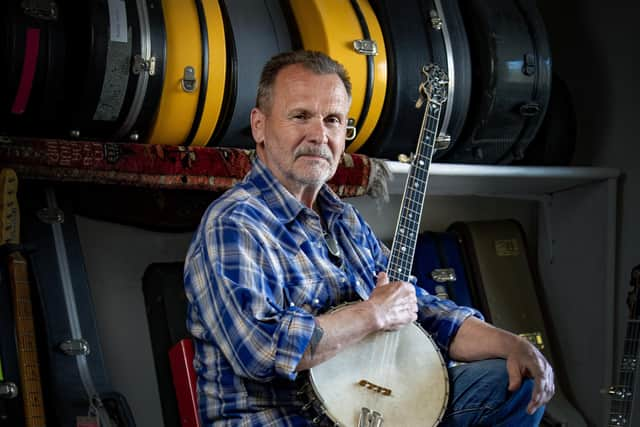
Up in his room of guitars and banjos, SImpson picks up an electric guitar and plays a song planned for an album due next year.
“It’s an arrangement of a song by Cyril Tawney called the Grey Funnel Line,” he says, after the private recital.
He started playing when he was 13, not far off 60 years ago, when he was given a guitar for Christmas.
“The folk clubs had all kicked off at that point and I lived 300 yards from the Good Companions Hut on East Common Lane in Scunthorpe, which is where the folk club started. It wasn’t licenced at that point, which meant that I could go, at the age of 13, and they served tea. Everyone went there who was interested in folk music.
“I was playing guitar very badly and singing with a recently broken, very squeaky voice. But people were incredibly encouraging.”
When he was in the sixth form at John Leggott School, two teachers started a folk club. “We would go on bus trips to see Pentangle, school outings,” he recalls, smiling, adding that he now counts the band’s famed double bassist Danny Thompson as a friend.
Another key moment was hearing Paul Robeson on his mother’s 78s.
“I really enjoyed the melancholy, listening to Sometimes I Feel Like A Motherless Child. This is extraordinary, this is what I want to do when I grow up. I want to make people cry for a living.”
So does he like an emotional song?
“Oh, yeah, just a bit!”
Simpson is now 71, does he see any reason to stop?
“Er, no!” he says.
He is known for using open tunings. This is a touch technical for non-guitarists, perhaps, but the instrument is usually tuned EADGBE. A common trick is to drop the low E string to D, known as Drop D, but Simpson takes a deeper dive.
“I play a lot in CGCFCD. That’s one of my favourites. I like tuning down to C.”
He puts this information with the recording, cryptic runes for curious guitarists.
“People want to know,” he says
Self-taught, he adopted open tunings early on, “as they really, really fascinate me”.
“Everything I do in terms of my technique is to try and make playing the guitar as easy as it can be.”
Occasionally, he comes up with a ‘new’ tuning, only to face a banjo heckle. “It always turns out to be an old banjo tuning,” he says.
When given that guitar on Christmas Day, he said: “This is what I am going to do for the rest of my life. I feel so fortunate as so few people have that moment…”
Here he makes a whooshing take-off sound.
“I think it’s an incredible privilege to be able to pursue something you love like that.”
When he starts something new, he will sit down with a tune and “fettle it”.
“I’ll arrange it without too much active thought. You don’t want the theory to get in the way. What you are trying to do is get an arrangement that is emotionally effective. Because the reason I do this is because I was so moved by music that I wanted to move other people.”
Simpson’s family line is strung wide. His father, Bill, was born in 1899 and fought in the First World War, while his daughter, Atlas Simpson, is only 20. Bill was a singer too, who took the lead in local musicals, but struggled to make a good living.
He explores those difficulties in his tender song, Never Any Good – a tribute to a father who “taught him nothing yet taught him everything”.
As for Atlas, she sang on two songs at the NCEM and appeared on her dad’s recorded cover of the Emily Portman song, Bones And Feathers, when she was 11.
Simpson is also known for his slide playing, when a bottleneck gives the guitar a bluesy voice. His curiosity was sparked by a record called The Country Blues, a compilation of old recordings.
He borrowed the album from an older bandmate and never gave it back.
“I still have it, a slab of vinyl, and on that there was Robert Johnson playing slide and Blind Willie Johnson. I heard that and went, Oh my God, what is this?”
When he writes his own songs, is it music or lyrics first?
“I’m in the middle of three songs, only one of them has what you could call a tune so far. So I think the answer is the words come first. It’s not the easiest thing I do in my life, writing songs. I know people who write very readily, in fact it’s aggravating.”
When he started writing Skydancers, he only had the first half of the first line – and he got that from Richard Hawley.
“We were sitting talking guitars and having a nice hang, there was some avian activity, and Richard said: ‘The bird completes the skyline’.
“I said to him ‘you b*****d!’ and he said, ‘it’s all right, you can have it’. So I had that line and wrote the song from there.”
Let’s leave the last word to Hawley.
“When Martin gets his guitar out and lets a few demon riffs fly it’s like a jet fighter just flew through the house leaving us all open mouthed with our hair on fire. He’s an incredible guitarist, one of the greatest I’ve ever seen let alone known, but the greatest thing about him is that he carries it so lightly… that’s his real strength and talent.”