
Mike Scott of The Waterboys: 'What I liked about Dennis Hopper is that he never lost that sparkle'
He was one of Hollywood’s last great rebels, a maverick actor, director and screenwriter whose searing portrayals of characters such as drug dealer Frank Booth in Blue Velvet and an unnamed and unhinged photojournalist in Apocalypse Now earned him a permanent place in celluloid history.
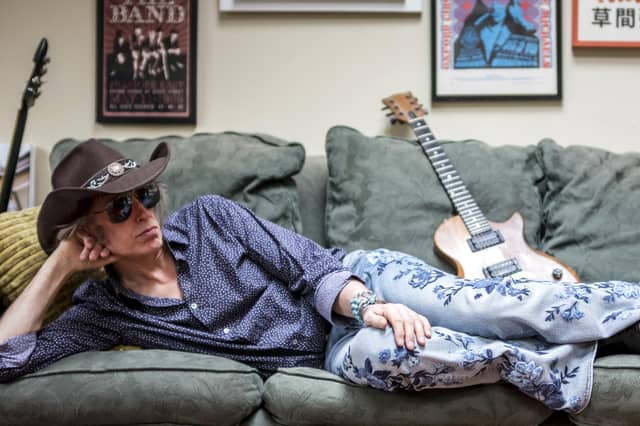


Off-screen Dennis Hopper lived just as hard – marrying five times and battling drug addiction. Yet he was also cultured – painting, sculpting, writing poetry, collecting art and becoming a noted photographer. Plenty, then, for songwriter Mike Scott to get his teeth into when creating the song cycle Life, Death and Dennis Hopper with his long-running band The Waterboys.
“It happened organically,” says the 66-year-old Scot of the new album, out this week. “I had written a song called Dennis Hopper, it was on a Waterboys album five years ago called Good Luck Seeker. It was a fun song, all the lines rhymed with Hopper – ‘His suit’s as slick as a lick by Cropper’ and so on – and at one point we were going to do that as a single and I thought wouldn’t it be fun to do that as a little digital EP, I wanted to do a couple of B-sides.
“Hopper had a very colourful life, I thought it would not be too hard to find a couple of incidents from his career to write a couple of extra songs about, so myself and one of our keyboard players, Brother Paul, constructed two more tracks and just when we were looking at doing this digital EP some of my other band members went into a studio secretly and recorded some instrumentals and sent them to me as a wonderful surprise with a note saying ‘Can you put lyrics to these?’ I used all seven of them, I wrote lyrics to all of them.
“One of them was on our 2022 album, three of them are on Life, Death and Dennis Hopper and the rest are going to be on an album of cutting-room floor tracks that’s coming out on Record Store Day later in the year. Once I got those instrumentals they sparked a whole lot of new Dennis Hopper lyrics because it was what I was thinking about at the time.”
Figuring that he had too many songs for an EP, he spoke to his record producer friend Simon Dine, who suggested he should do an instrumental for each of Hopper’s five wives. “I thought that was a wonderful idea and instead of doing them all myself, I commissioned friends to do them. Suddenly we had 12 or 13 tracks and after that it was just identifying which episodes in his life to dramatise and write songs about.”
During a 50-year career in Hollywood, which included other notable movies such as Rebel Without a Cause, Easy Rider and True Romance, Hopper provided the missing link between James Dean, Francis Ford Coppola, David Lynch, and Quentin Tarantino. Scott was intrigued by his broader cultural importance.
“He was a photographer, he photographed a lot of rock superstars in the 60s and he was friends with them,” he says. “This is one of the things that fascinated me most about Dennis was how the arc of his life followed, and in some cases led or contributed to, the development of popular culture. He was in Rebel Without a Cause right at the beginning of the birth of the teenybopper, the birth of youth culture, and James Dean mentored him and then he was friendly with Andy Warhol, he was at the beginnings of Pop Art, he knew all the Pop Artists in Los Angeles and he was right in that milieu and all the different scenes he was part of in the 1960s, fascinating.”
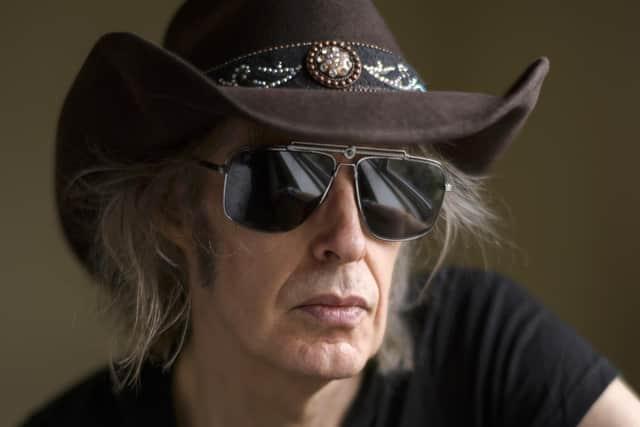
Having immersed himself in several biographies of Hopper, Scott says he warmed to “his foibles and his follies”, adding: “I liked it when he had the success with Easy Rider it went to his head so much he said ‘I’m going to save Hollywood, we’re the most creative generation in 2,000 years, we’re geniuses, man’ – all that, it’s hubristic and ridiculous but very lovable.”
When it came to steering a course between the sides of Hopper, Scott says he followed his instincts, citing the sweariest track about Frank in Blue Velvet as an example. “I didn’t do it because Frank was a scary character, I did it because it was such a significant role in Dennis’ career, because it was the role that brought him back to prominence after his lost years, so I felt that was a really important moment in his story. It was very good fun to do as well, it was like me playing Dennis playing Frank.”
The album includes numerous guests including Steve Earle, Fiona Apple, Kathy Valentine and Patti Palladin. But perhaps most eye-catching is Bruce Springsteen, who features on the song Ten Years Gone.
Scott says apart from Earle, his original idea had been to sing the parts himself – until the seasoned A&R man Dave Bates suggested he should get others in. “I should say at first I didn’t like his idea but after a couple of days I saw the wisdom in it,” he says. He realised he could “surrender” the spoken part at the end of Ten Years Gone to someone else.
“I thought what a great opportunity to get a dramatic, powerful voice, especially if it was an American voice, someone who could deliver dramatically in a filmic narrative way, and I thought about actors but then I remembered my teenage bootlegs of Bruce Springsteen when he would do these wonderful stories over the vamp that the band would play and he had that dry, dramatic delivery. So my manager contacted Bruce’s manager and it came back that he would do it and he recorded three takes – and I picked from the three takes.”
While Hopper often lived life on the wild side, Scott saw a universality in some of his experiences. “The early dreams and absorption in art and culture turning into triumph and then turning into failure, then a long period of wilderness and then coming back and reinventing himself, it was such a wonderful story,” Scott says. “It’s like an archetypal hero’s journey, I suppose, or one variation of it.
“What I liked about Dennis is that he never lost that sparkle, even in his ads – as I say in that song he never sold out because he was a countercultural holder. I always had the feeling that underneath he had a sparkle or a glint in his eye when he was smoking pot on the set of his adverts.”
Given the album’s musical breadth, Scott says The Waterboys will not attempt to reproduce the whole of it live. “It’ll be enough to tell the arc of the story,” he says. “To do the whole thing live like a Broadway show, that would be good fun but it would take an incredible amount of preparation, extending the band, funding that. (On this tour) we’ll play 40 minutes of it.”
It’s now 42 years since Scott founded The Waterboys and he has been the band’s only constant member throughout the past four decades. Looking back, he says that although he was “effectively a solo artist” when he signed he signed to Ensign Records back in 1981 after spells in the bands White Heat, Another Pretty Face and The Red and the Black, being out on his own “just did not attract” him.
“I wanted the mantle of a band name and colleagues, I wanted band members, pals to tour with, but I always knew the music was going to change and people would come and go. My model was the Plastic Ono Band – John (Lennon) and Yoko would be the constants but there would be people who would come and go. Sometimes it would be Klaus Voormann on bass, sometimes it would be Eric Clapton on guitar, sometimes it would be Alan White on drums, sometimes Jim Kelner. I liked that.”
The Waterboys’ career is sometimes seen as being divided into four distinct phases – starting with the ‘Big Music’ of their first three albums then progressing the Raggle Taggle folk music of Fisherman’s Blues and Room to Roam, followed by a period of mainstream rock and the more recent albums on which Scott has embraced multiple genres including soul, funk and even hip-hop.
He points out another: “The spiritual music from 1995 to 2003 when I’d been living in a spiritual community and that fed into the records and the songwriting quite strongly.” And the one-off An Appointment with Mr Yeats record – based on the poetry of WB Yeats – that he made after he moved back to Ireland in 2008. “It was a very specific theme record, a bit like this one (Life, Death and Dennis Hopper), where I didn’t do it all myself, I did it in collaboration with band members...my mates like Steve Wickham, we set Yeats’s poems to music, that was a wonderful record to make.”
What he describes as “the modern era” began with Modern Blues in 2015. “The crucial thing for me was partly living back in Ireland and living back in a city (Dublin), but also Brother Paul (Brown), our keyboard player, joined the band, he’s from Memphis so he brings original, first-hand American music into the band and I’m very grateful to have that input.
“He’s played with a lot of soul artists, he’s played with Wilson Pickett and Isaac Hayes and Ann Peebles for real, so he brings that world into The Waterboys and that changed a lot for us when he came in. He’s an incredibly creative influence as well. Steve Wickham, our fiddler, left but Brother Paul has now been there for 10 years for the whole of the modern period.”
At one stage in the late 1980s, when their song The Whole of the Moon was a massive international hit, The Waterboys seemed on the verge of becoming a stadium rock band like their celtic contemporaries Simple Minds and U2. For Scott, such a move was never on the cards.
“Record companies and our agents definitely saw us like that in the early Waterboys, what (was) called the Big Music, that cinematic rock music that we played on the first three albums,” he says. “There was a guy called Ian Flooks, he had an agency called Wasted Talent, and he booked us supporting U2, we did 20 shows opening for them and we did 20 or 30 shows opening for Simple Minds, he definitely saw us as ‘Right, here’s the next one coming up’. It’s not that I rebelled against it but it was a miscasting. The Waterboys weren’t that kind of band, our music never changed in a kind of incremental way that would bring that size of an audience along, and I would never play the game enough for all that stuff to happen.
“I like those bands and I respect them, I’m always very touched by how much Waterboys influence I can hear on later U2 records after we toured with them. I hear my melodies and my chord sequences and my ideas on their records, so I’m touched that they took all that, but to me it’s kind of music by prefects and I was never going to play the game and I always wanted the music to change dramatically and radically.
“I grew up as child of the Sixties and I was paying attention and when The Beatles and Bob Dylan and really everyone in that fast-changing, fast-evolving culture would make incredibly different records on each album – in fact in those days they were changing on each single – what are they going to do next? That to me is normal. I always wanted Waterboys music to change. When we changed into the Fisherman’s Blues music the people that had been grooming us for that kind of stadiium or arena rock stardom were horrified, (they were thinking) ‘he’s blown the whole thing, he’s changing the music, what the f*** is he doing’. But to me, I was following the artistic impulse, it was completely sane. What would’ve been insane would have been to me is to deny that, to push it back underground and to repeat what we had already done. I would’ve turned into a squarehead, man, I was never going to do that.”
Life, Death and Dennis Hopper is out now. The Waterboys play at Sheffield City Hall on May 9, York Barbican on May 15 and O2 Academy Leeds on June 17. https://mikescottwaterboys.com/