
Nigel Kennedy: 'Beethoven would’ve given anyone a beating if they called him classical'
On his most extensive British tour for more than a decade, violin virtuoso Nigel Kennedy is in Sussex and on the hunt for a refreshing brew when The Yorkshire Post catches up with him. So far he’s struggled to track down a cup of Sussex Tea, which he recalls was “amazing” the last time he drank it.


“I think it’s gone defunct – as opposed to Yorkshire Tea, which has gone from strength to strength,” he says, noting wryly: “You would never have got Geoff Boycott touching the Sussex Tea.”
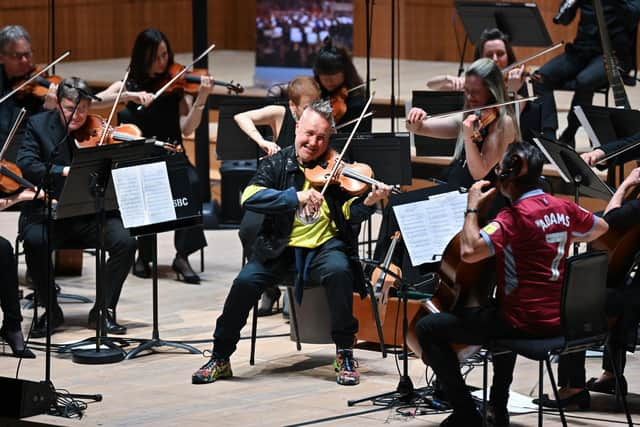
This year’s run of 35 UK dates over two legs – in spring/summer and autumn – leads up to his 70th birthday in December and he’s been thoroughly enjoying sharing a stage with double bassist Alec Dankworth and cellist Peter Adams.
“What’s been lovely about it, apart from the fact that I’ve got amazing musicians onstage with me which means that every night is going to be enjoyable because of what they’re doing, but...quite often musicians go Birmingham, Manchester and London and everybody has to go to one of them to hear you; it’s been so nice – and I think people value it – that somebody’s going to their own town, so it’s a bit more personal from that point of view.”
The tour last weekend included a nostalgic return to Malvern, where he lived in the 1990s – “I’ve got a lot of happy memories, let alone the birth of my son (Sark) there, and many friends,” he says – but since his move to Poland in 2006 his visits to Villa Park to watch his beloved Aston Villa have been less frequent. “I’m like one of those semi-bourgoisie plastic fans these days, so I only get to between 10 and 15 games a year,” he admits. But he is taking the opportunity to watch Villa’s Europa League semi-final games while he’s in England. “It’s a bit of an anticlimax playing (Nottingham) Forest because first of all we’ll lose and then it’s not this exotic country that the opposition comes from,” he says, chuckling.
Fifty-five years on from when he first performed in public – busking on the streets of New York City while he was a student at the Julliard School, before guesting at Carnegie Hall with fellow violinist Stephane Grappelli – Kennedy feels the most important lesson that he has learned is to savour the now.
“Being a kind of communicator and playing music that people are actually paying me to go out and do, it’s just such a beautiful way of life… If I was talking to a younger musician who hasn’t had so much experience onstage...the real thing that I’ve enjoyed is the actual magic of the moment. Not yesterday, not tomorrow, but right now what’s happening on the stage,” he says.
“What I’ve managed to really make the most out of as well is that particularly in classical music and now quite a lot in jazz...is that not everything is planned," he adds. “Plans are important but reaction to the reality of the moment is really important, and I think it’s undervalued a lot in music.”
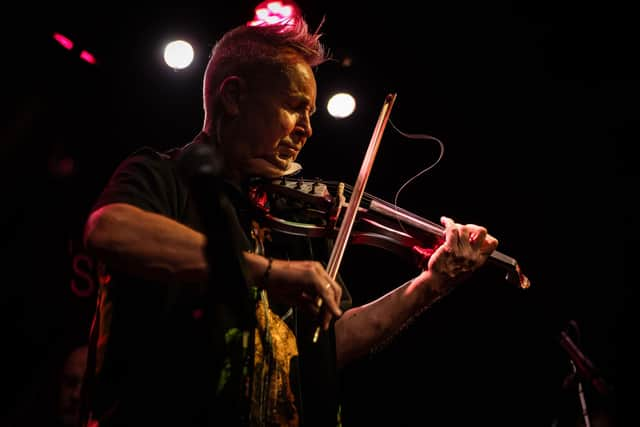
Audiences will differ depending on the day of the week, as will the acoustics of each venue and the mood of one’s bandmates, he says, “so there’s nothing really the same”.
“You can say, oh, I’m playing Vivaldi or Miles Davis or Hendrix again but it’s never again, it’s almost always like the first time.”
Kennedy’s current set includes a tribute to his two great mentors, Yehudi Menuhin – whose music school he attended in Surrey from the age of seven – and Stephane Grappelli. Kennedy says he “sometimes” felt a lot of gratitude towards Menuhin “and other times when he was getting a bit officious with me, then I felt the opposite”, but he adds: “I would say this magic moment thing, (Menuhin and Grappelli) both had it in abundance, man. They had a 1,000 per cent of it.
“Yehudi playing the notes which were predestined to be played by people like Brahms or Bach, or Stephane playing really off-the-cuff in the moment. But they both had such generosity, not just that they helped me, but to the audience in general, they gave so much.
“They didn’t hide behind some kind of invisible shield where they just played perfunctorily the right notes in the right way but nobody could be offended; they gave of themselves, of their soul, and so for that I’m always going to be grateful – and grateful to Lady Luck as well for having met these two people who were from in those days the opposite sides of the spectrum. To have two totemic type of people have were such a positive influence, never ‘you can’t do this or you can’t do that’, but more pointing out the possibilities of what we could do.”
Menuhin passed on his interest in Indian classical music to Kennedy, while Grappelli imbued him with a love of jazz. “It was just the example that these two guys weren’t so categorised and pigeonholed that they couldn’t listen to and enjoy other types of music. Stephane would say, ‘Have you heard Baden Powell from Brazil?’ and ‘I love how Herbie Hancock does this’, so he wasn’t just stuck in his own little pigeonhole, and Yehudi was far from it. He was going to India and he knew Ravi Shankar before The Beatles realised that India is not a form of rubber.”
Kennedy also credits Menuhin with giving him a life-long love of the works of Bach. “This dedication to Bach and this endless journey that one can have with his music, definitely (came from) Yehudi. He also had a short association with Glenn Gould who was the leading exponent on the piano… There’s a couple of recordings of Glenn Gould and Yehudi doing the sonatas for violin and keyboard.
“Yehudi was immersed in it, and having learnt it from (George) Enescu, it’s almost like I feel the third in line because Enescu, particularly with the solo sonatas for violin by Bach, he saved them from complete obscurity, and then Yehudi took over the mantle, and now for instance in this tour, I’m playing the Bach Chaconne which is a 16-minute-long beautiful set of variations on inversions and all kinds of stuff with a rhythmic motif. I thought, man, the odds are stacked against me and it’s going to be too much to ask people to sit through 16 minutes of this stuff but I started doing it anyway and it’s been winning. If it was a beauty contest, people are taking to this Bach Chaconne better than they were to Mary Stävin.”
This tour also offers a rare chance to hear Kennedy play the piano in public. It’s an instrument that he says she has come back to after many years, having learned it as a child from his mother, who was a piano teacher. “I was shoved under the piano as a baby when she had nowhere else to put me. She was teaching these people who were coming in playing Schubert and Beethoven and suchlike and I was hearing at Zeppelin levels with big bass being underneath,” he recalls. “I did study with her for a couple of years before I got into Yehudi’s school then Yehudi asked me to turn it off, so to speak, because he wanted me to concentrate on the violin, then then in the Covid period of time while BoJo partied and the rest of us weren’t allowed to, I had a lot of time and I kind of reinstigated my piano and I learned new stuff which I’d never played before.
“I do love playing the piano, I think it gives the audience a break from having to listen to two hours of violin, which sometimes can be a bit tedious or a little bit squawking. But also one has harmony on it and I can also lead the band in a much more natural way just by showing the harmonies on the piano. They can hear it rather me having to say D9 or D minor 7 or G7 or G half-diminished. You don’t have to say all that stuff, the band can listen to it and react off it.”
In concert he’ll be performing Japanese composer Ryuichi Sakamoto’s theme music to the film Merry Christmas, Mr Lawrence. “I love Sakamoto’s writing,” Kennedy says, “and also what he did with the Yellow Magic Orchestra in the first place. I remember going to the Beacon Theatre quite a few times when I was living in New York to hear the band.
“Somehow they got banished from my memory pursuing other things for the best part of 40 years then I suddenly started remembering this stuff, and watching that film with David Bowie, Merry Christmas, Mr Lawrence, and all this beautiful piano writing which Sakamoto did as a solo artist, he was a remarkable and very heartfelt musician. I love the gap between the notes, rather than jamming every second with loads of notes. It’s beautiful to hear how the notes relate to each other, and Sakamoto is someone who’s got the soul and is a master of that.”
The songs of Jimi Hendrix has been a mainstay of Kennedy’s repertoire since the 1990s. He’s reluctant to compare the late guitarist to classical composers, though. “I really don’t like to get hung up with these definitions of it,” he says. “I say to my band let’s do this acoustic or electric, but Beethoven would’ve given anyone a severe beating if they called him classical because Haydn and Mozart were classical – the era of classicism – so for Brahms to have been classical, he would’ve thought it was just an idiot calling him that.
“It think it’s a bit inane, everybody gets all so posh and high and mighty about classical music as it’s so-called but they misuse it. It’s like thinking the whole of art is only painting, it’s a ridiculous idea. There’s a certain iditioic attitude to think it’s classical or it’s jazz or it’s this or that.
“Frank Zappa was writing very carefully what his players would play, James Brown had that amazing penalty for anyone that played the wrong note – $150 – so his band was remarkably smart and together for financial reasons, there’s a lot of careful writing. Duke Ellington’s beautiful writing is really expressive, whether it was with Strayhorn or without Strayhorn. There’s something really great about that subject, I reckon. He was saying whether it’s been thought of one second before it’s played or ten hours before it’s played and put on a bit of paper, that is still composing, it’s been conceived and then executed.”
The violinist has long bridled against eltisim within the classical world. He says that feeling began when he was a teenager. “I did find that if some of my mates came to some of those early classical music club type of gigs that I used to play, they were made to feel very unwelcome. You could actually see people moving a seat away from them, so I thought there’s something wrong here because it’s actually lucky that some of my friends like the music I play.
“I’ve got quite a few friends who dislike classical music, so I thought it was lucky that I’d got a few who were open-minded enough to get into it without having this privileged background where one would automatically have access, so I knew there was something wrong about the lack of access to great music. Everyone deserves to listen to great music, it doesn’t matter what genre it is and why some elitist group should commandeer and confiscate a type of music or art from different segments to society. To me, that’s preposterous. It started happening from quite a young age where I realised, man, if ever get the chance I’d like to put a few things right.”
Kennedy’s relationship with fame – which came when his recording of Vivaldi’s The Four Seasons with the English Chamber Orchestra sold three million copies in 1989 – was always an uneasy one. In the early 1990s he retreated to a house in the Malvern Hills, rarely performing in concert halls at all.
“When I had a kid that became important that I could have some time with him, and I started to notice that it was impossible to give my girlfriends or partners in life a decent time because I’d go to the pub and I’d be signing autographs all the time, or there’d be an unnatural dynamic where I’d be the centre of attention more than other people,” he says.
“Obviously, we all love that people listen to us when we play our music, but everybody’s 100 per cent a person just like everybody else, so if I walk in and the people I’m with can’t get the respect that they should be given then it kind of gets in the way of normal social interaction. I though particularly having a kid, I cen’t be in a situation where I can’t talk to my kid if I go to a pub or a restaurant. With a (football) game it’s all right because if I’m going to watch the Villa if you’ve got 30,000 or 40,000 people it’s like an extended family, we’re all part of that, but with the rest of it, just these everyday things that one might have done...even with your kid a trip to the shops can be quite fun as long as you can just say, no, you can’t eat all those sweets, you’ve got to get something else, but if you haven’t got time to tell him not to grab hold of loads of complete s***e then even shopping can’t be done properly.”
Having lived in Poland for the last 20 years with his wife Agnieszka Chowaniec, Kennedy has found that music is valued slightly differently in central Europe. “It depends where you are,” he says. “I’m living in the highlands and there’s a specific form of highlander music and people who play it are fantastic at it, but it’s a little bit like Ireland where these great musicians are butchers or librarians or undertakers or whatever you might have as a job, doctors even, and then they’re playing in the evening in the pub in Ireland and in Poland it’s more like for weddings and parties or religious services. The highlanders will come in and play their stuff in the church on December 24 and that’s a beautiful evening.
“So it’s different in different parts of Poland. I suppose there might not have even been those borders, it changed a lot when for a little while they had Moscow and Vilnius and parts of Ukraine (when Poland was part of the Soviet-controlled Eastern Bloc).
“So in the middle of Poland it’s all mazurkas and stuff like that if you’re going for traditional music, and the jazz thing is specifically important, I think, because like how the black community had no outlet in America and then jazz evolved because it was the one freedom of expression, in Poland it was censorship. It wasn’t communism pure and simple in Poland but it was very much influenced by that, and there were informers and censors, so instrumental jazz became really important for the students because everybody knew what it was about, there weren’t lyrics so they couldn’t censor it, but basically it was an anarchic form of music which gave a whole generation of people a chance to have their own voice. I love the comaradery of the jazz community.
“I’d say rock music, there’s no comparison with the rock that America and England have done, it all sounds nice and quite diligent but it’s lacking in the amazing originality that we had in England in the 70s where one could be ranging from Deep Purple and Jeff Beck to Nick Drake and Fairport Convention and Fleetwood Mac and then the prog rock stuff, it was just such a huge contribution to music that England did, the Stones resurrecting the blues, even the artists from America could then get a white audience and not just be segregated to a black audience only. Whereas the more instrumental and acoustic music, I’d say Poland’s got a soul to it which is very deep and there’s a big respect of musicians and artists.”
Kennedy’s musical tastes remain eclectic; his only yardstick, he says, is “that it’s normally got to be more than 20 years old then I know it’s not a gimmick done by some marketing monkey”. Latterly he’s been listening to the rapper Notorious B.I.G., drum & bass exponent Roni Size and Baxter Dury. “He’s amazing, fantastic,” he says of Dury, “and he’s got the voice of his dad but it’s kind of a more current context – he puts all that French in because he’s living in France.”
“Also, there’s all of this old music – I’ve got back into Fela Kuti and Seun Kuti, obviously he’s still around. There’s a band called Newen Afrobeat, and there’s some amazing, soulful stuff which Seun has done with them. Abdel Gadir Salim from Sudan. I’m quite into the African stuff, it depends on the day.”
As to what he would still like to achieve as a musician, Kennedy says: “I would like to meet Seun Kuti one time...and I would like to get my Palestinian mates together again and play… I’ve got more general aims than specific. It’s just enjoyable of each other as people and less categorisation of music. We all belong together, and I love the narrative of a good show, and to more open up the doors to brotherhood between people, rather than division.
“As a musician, I don’t kid myself, I’m not a politician, so I just turn over if some musician starts talking politics at me, I don’t want to know. But music shows that we are all of the same flesh and blood, so I’d like to do things along those lines without preaching at anybody.”
Nigel Kennedy plays at Hull City Hall on May 12, Harrogate Royal Hall on May 14, Scarborough Spa Hall on May 16 and St George’s Hall, Bradford on October 8. https://regencyconcerts.co.uk/