
Peter Ormerod on charting David Bowie's spiritual journey

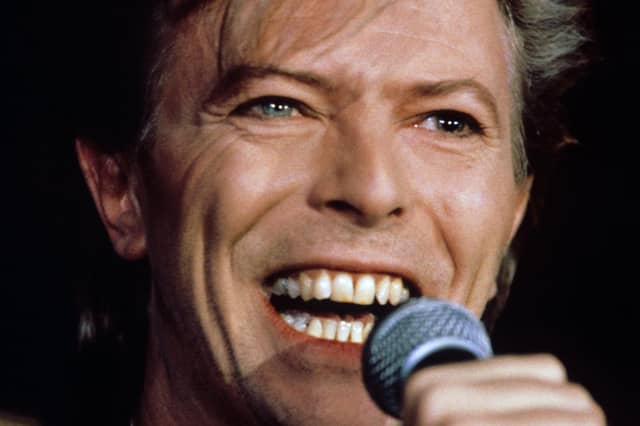

Peter Ormerod’s book, David Bowie and The Search for Life, Death and God, is certainly not your standard rock biography.
A 250-page exploration of the quest for spirituality within the work of rock’s great chameleon, it’s also something of a personal meditation on what Bowie has meant to the author since being moved to tears by his music as a 17-year-old listening to Hunky Dory. He will be speaking about it at Ilkley Literature Festival this weekend.
“It’s one of those times where the strands of your life start weaving together,” explains Ormerod, who is an entertainments editor for Iconic Media, the parent company of The Yorkshire Post. The son of a vicar, he’s “developed and retained an interest” in religion throughout his life – something he found mirrored in the 26 albums that Bowie made between 1967 and his death in 2016.
“When I first listened to Hunky Dory one of the things that really beguiled me about it was the sense of there’s something a bit out of reach,” he says. “There are these amazing melodies, beautiful arrangements, all this stuff that’s very pleasing to the ear, but there’s also this whole sea of imagery that’s so bewitching as well, and that sounded a bit sinister, a bit strange. There’s some references in it that I thought were odd but made me want to dig a bit deeper.”
Bowie’s fascination with the occult was writ large in mentions of the Homo Superior, Golden Dawn and Aleister Crowley. “All of that tickled my interest,” says Ormerod.
Over time he came to realise “there was so much more to this in Bowie’s work”. But after reading numerous biographies of the singer, as well as Leah Kardos’ book Blackstar Theory, he came to believe there was room for his own analysis. “I always suspected from how I heard his work and how I heard him talk that this stuff was actually quite important to the work. A few years ago I thought I’d love to read a book about this, why don’t I try to write one.”
Through research, interviews and “more and more listening”, the book came together. Ormerod saw “elements” of Bowie’s spiritual journey that were similar to his own. “My dad’s style was always mainstream Church of England, but I always thought there’s more to this, I know that this is one way of understanding religion or God or Christianity, even, but I suspect there’s more breadth to this and we are only seeing quite a limited picture.”
His book follows Bowie from a choirboy at St Mary’s Church in Bromley through this dabblings with Buddhism, the occult, existentialism, the Kabbalah, Gnosticism and even the Nazis’ obsession with magick and the Holy Grail. By the mid-1970s Bowie was in “such a bad way” through drug abuse that he exorcised a swimming pool in Los Angeles “because he saw Satan rising from it”.

“He was genuinely terrified of the experiences that he had and he sought to escape from them, he had enough sense to see the damage that was being done to his psyche,” Ormerod says. “Hence we get a song like Word On a Wing On Station To Station where he cries out for help in a pretty Christian sort of way to God. He wanted to change, he wanted protection and safety.”
Ormerod is inclined to agree with Bowie’s ex-wife Angie assessment that the flirtation with fascism was down to naivity about the occult and heavy use of cocaine. Bowie himself later disavowed the interest.
“It’s an awful thing to say, but I think he would’ve been interested in Hitler as a figure and the way he could command a stadium. However you want to put it, it all gets very dark very quickly,” he says. “But the idea of dictators, the idea of power, I’m sure he would’ve found that very interesting. He did make other political statements around that time in the mid-70s when obviously he wasn’t in the best of mental states. But I’m willing to believe him and believe Angie that his main interest in the Nazi stuff was the search for the Holy Grail and the search for the Spear of Destiny, and it was very bound up with the reading he was doing in the early 60s – this idea of Nazism being bound up with esotericism and occultism.”
In later life, after marriage to the supermodel Iman and the birth of their daughter Lexi, love became a key theme of his work. By The Next Day in 2013, he was also back to posing big questions – nowhere more so than in the ballad Where Are We Now? “It’s a song I almost feel emotional talking about,” says Ormerod. “Of all the chapters in the book, it’s the one I most enjoyed writing because I think The Next Day gets overlooked because of Blackstar casting such a massive shadow, but it’s a fascinating album in itself.

“On one level it’s a very conventional album, there’s nothing too out-there on it at all musically, but if you spend some time with it these things really do strike you. It’s song after song of love being corrupted or debased or abused in some sort of way, and amid those you have this one song, Where Are We Now?, where in a way it’s a very straightforward love but it’s a love that’s gone through a lot of change and seen a lot of the world, but where it’s boiled down to ‘As long as there’s sun, as long as there’s rain, as long as there’s fire, as long as there’s me, as long as there’s you’, after everything that’s all that matters, it’s existence and it’s love. It’s an incredibly powerful statement.
“He had been increasingly interested around that time in the idea of unconditional love, the divine idea of love and I think that suffuses that album. You see that love and then you see its absence, the destruction and the violence that happens when it isn’t there, and then you see what happens when it’s present. That theme gets developed in the play Lazarus as well. You don’t think of Bowie as like Chris De Burgh, writing love songs as such, but it’s interesting that the presence of love is in the songs and the way he sings about it as a spiritual force from a pretty early stage, as a sort of entity, not just as an emotion but as a force. And you hear it in a song like Under Pressure as well.”
David Bowie and the Search for Life, Death and God is published by Bloomsbury Continuum, priced £20.
Peter Ormerod will be talking about David Bowie – Life, Death and God at All Saints Church, Ilkley on Saturday October 10 at 6.15pm. https://ilkleyliteraturefestival-tickets.ticketsolve.com/ticketbooth/shows/1173675761?mc_cid=e7f9573b4c&mc_eid=1d8de33c40