
Review: Louder Than Words festival at Innside, Manchester


The well-established festival celebrating music writing has its strongest year yet with an impressive line-up sparking many thought-provoking discussions.
Now in its 14th edition, Louder Than Words festival has become the go-to event for fans of literature about music.
In recent years, the three-day event – co-founded by Jill Adam, a former educator who had a spell as chairman of Harrogate International Festivals, and John Robb, the journalist and frontman of post-punk band Membranes – has benefited from a fertile period for musicians’ memoirs and the bill this time included Jon McClure of Reverend and the Makers, Steve Diggle of Buzzcocks, Dave Rowntree of Blur, Rusty Egan, Edward Tudor Pole, Baz Warne of The Stranglers and Billy Bragg.
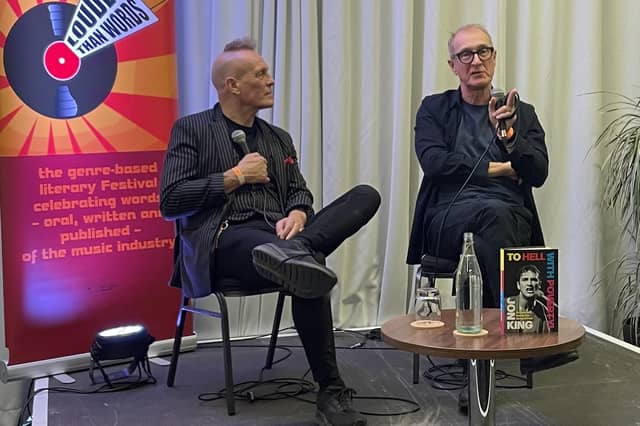
Our Saturday began with Jon King, vocalist with Gang of Four, the post-punk iconoclasts who formed in Leeds in 1976. In a lively conversation with John Robb, King jokingly suggested that if a film were ever to be made of his life he’d be played by Danny Devito. He talked of his working-class upbringing, and his scholarship to Sevenoaks School where in its day “bullying was really encouraged” yet in its art department he formed lasting friendships with future musicians Tom Greenhalgh, Kevin Lycett and Mark White, and future filmmakers Adam Curtis and Paul Greengrass.
He also touched upon his undergraduate days at the University of Leeds, studying in “the most radical art department in the world” run by Sir Laurence Gowing and Professor Tim Clark, and his love of Situationism. Of his fractured relationship with Andy Gill, Gang of Four’s guitarist who he’d know from Sevenoaks, he observed: “You start off as a gang, then you become an archetype. Andy and I started fighting a lot.” However in his memoir, To Hell With Poverty!, he spoke with fondness of their youthful friendship.
What divided the band in the end, he suggested, was alcohol and money, the latter of which he said he “genuinely didn’t care about”, instead he wanted to be “politically radical and pure”. He said, philosophically: “Art doesn’t prosper in comfortable times. Misery produces great art.”
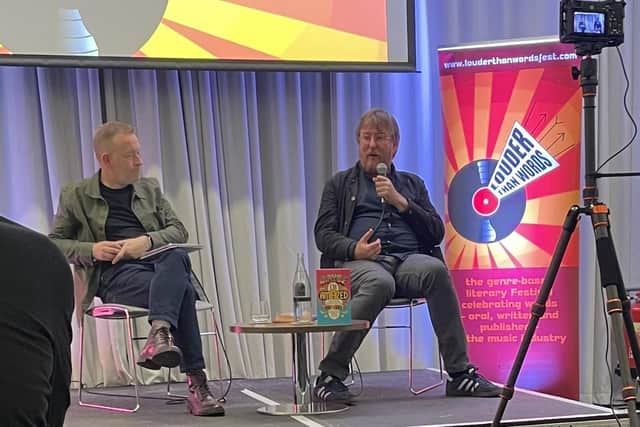
During the afternoon, Clare Grogan reminisced with her brother-in-law Douglas MacIntyre about her parallel careers in music, with the band Altered Images, and acting, in films such as Gregory’s Girl. She talked of her teenage influences – Poly Styrene, Debbie Harry, Siouxsie Sioux and Suzi Quatro – and said that for a period she had taken fame in her stride. “It was only in retrospect I realised how crazy that was,” she said, adding: “I think how great my family and friends were in keeping me grounded. In Glasgow, nobody likes a show-off.”
She joked that Altered Images’ stubborness had “broken” music industry veteran Mike Chapman during the LA recording sessions for their third album, Bite. “We were four feisty Glaswegians who were overambitious,” she said. When the bubble burst, she said she felt “lost” and “retreated” from the limelight, raising a daughter and supporting her husband Stephen Lironi through cancer. Since recovering, he has become a renowned restaurateur as well as co-writing more songs with Grogan in a revived Altered Images.
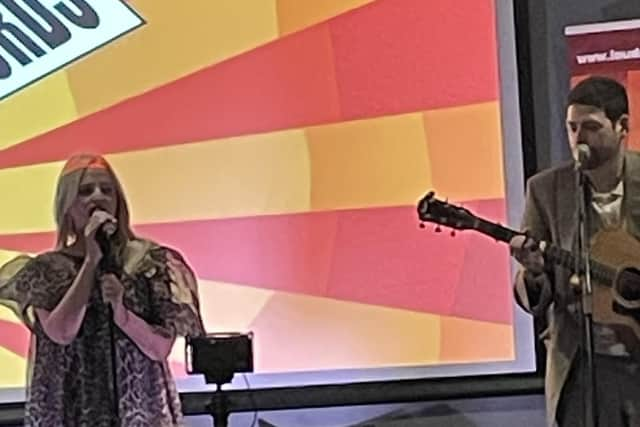
As an added bonus, Grogan treated festival-goers to a short acoustic set accompanied by guitarist Andrew Cowan, concluding with Happy Birthday, the song that for her has kept on giving.
In the early evening, Dan Jennings and Nicky Weller, sister of Paul, talked about how Jennings’ podcast Desperately Seeking Paul had become a phenomenon, leading to 180 episodes with multiple guests discussing different aspects of the former Jam and Style Council frontman’s 50-year career. It has also spawned a hefty authorised biography, Dancing Through The Fire, which Jennings described as a “rollercoaster of a story” which he’d had to edit down from 1.5 million words to 250,000. “I hope you get a full picture of Paul,” he said.
Nicky Weller, who ran both bands’ fan clubs, revealed that she preferred it when more girls started coming to The Style Council’s gigs and that they were some of her “favourite times” with the “hilarious” Mick Talbot. Asked to pick a favourite album, Nicky chose On Sunset, which she said was “one of the most amazing albums” that Paul had done, while Jennings opted for Paul’s first, self-titled solo album, commenting that the singer is “brilliant at knowing when to shake things up”.
Meanwhile, Matt Johnson of The The proved perhaps the day’s biggest draw. In conversation with Jason Wood, with whom he has collaborated on the forthcoming book Cognitive Dissident, the singer-songwriter discussed how he had “pretty much retired” from pop music after The The’s singles collection came out in 2002. For 15 years he concentrated on fatherhood, conserving buildings, composing music for films by his brother Gerard, and publishing a book by his father, but he returned to songwriting in 2017 when his then partner Johanna St Michaels persuaded him to finish We Can’t Stop What’s Coming in memory of his brother, Andrew, who had recently died, for the documentary film The Inertia Variations. He described the experience as “cathartic”.
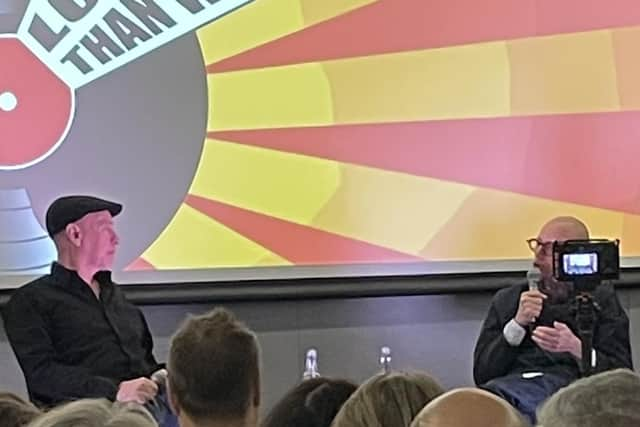
Realising that “we’re all dangling by a very fine thread”, he undertook a Comeback Special Tour, for which he spent long hours stripping the songs back “to their essence” then rebuilding them because he “wanted the catalogue to be filtered by this wonderful band” that he had assembled. It culminated in a concert at the Royal Albert Hall, two days after his father had died, which he said was “very emotional”.
There were insights into growing up in the Two Puddings pub in east London, run by his parents; his uncle was a successful music promoter. His brother Andrew was a punk, Matt liked its do-it-yourself attitude “but not much of the music”, apart from Wire. Hearing Private Plane by Thomas Leer, however, inspired him to make music by himself. Johnson said there had been “three strands” to his musical career: “traditional singer-songwriter, soundtrack writer, and musique concrete”, explaining that he “love(s) playing around in studio”. Answering questions, he expressed regret that a mooted duet with Leonard Cohen had not come off, and when asked what he thought his best songs is, he replied: “I’ve not written it yet.”
On Sunday, the Bristol and Tokyo based photographer Beezer discussed his two-volume photo collection Until Now: A Life in Photos 1982-86 with Pete Webb, founder of PC Press. Among those in captured in the 700 images in his books are the Wild Bunch (later to become Massive Attack), Mark Stewart of The Pop Group and Ari Up of The Slits plus scenes from Glastonbury and Womad festivals and St Paul’s Carnival.
Beezer’s photographic career began aged 16 when, after leaving school with “low grades”, he took an audio-visual course. “Every day you would go out with a camera,” he said. “Because we were getting to grips with the basics of photography, we would shoot anything. It was an invaluable way to start learning how to use a camera.” He photographed Ari Up with her newborn twins while they shared a squat in Ladbroke Grove; there he also met Neneh Cherry. Mark Stewart, he said, “hated having his photograph done”, but it meant Beezer developed an eye for getting an image quickly.
Today, Beezer likes to take photographs on his phone as well as still using his camera. He takes dozens every day. “If I showed you a week of my photographs, it would just be spaces and places and people,” he said.
Richard Jobson’s lunchtime conversation with John Robb was filled with black humour. Growing up in Fife, he shared a room with his brother Francis who loved Captain Beefheart, Iggy Pop and the New York Dolls. Later, Francis became a Hari Krishna monk but retained a fondness for “the most extraordinarily violent films” and once blagged their way into a season of Don Siegel films by accosting Clint Eastwood en route to the cinema in Edinburgh. He would later die in mysterious circumstances in India. “He was fearless,” Jobson said, “and I learned a lot from him.”
As a child, Jobson led an “insular, quiet life” because of his epilepsy; instead he “drew solace” from films and music. At 16 he successfully auditioned to be the singer in Stuart Adamson’s band Skids, and they would go on to score hits such as Into The Valley, Masquerade and Working for the Yankee Dollar. Adamson quit after their third album to form Big Country, but Jobson fondly remembered him encouraging him to become a lyricst himself. “Stuart lyrics were more social realist whereas mine were more leftfield,” Jobson recalled. Of their relationship, Jobson said he became “a huge irritant” in Adamson’s life. “He wanted family life, a mortgage, stability; for me, it was just an adventure.”
Talking about his semi-fictional book The Kreuzberg Sonata, Jobson explained that he had tried to write it as a memoir of his time in East Berlin but found it “too problematic”, and instead turned it into a fictionalised tragic love story. Having for years been “a bit dismissive” of his work in Skids, latterly he’s come back to them, finding their songs had “a validity”. Next year he is planning a three-day celebration of the band – and his work with The Armoury Show – at Portmeirion.
Discussing his book Caledonia Screaming: The Last Untold 1977 Punk Story, Grant McPhee told Ryan Walker that he had written it to “rectify some of the wrongs” that had been applied to Scottish punk culture. He said it was a mistake to think of the country’s nascent punk scene purely in terms of record releases because there were very few of them in 1977. Rather, a movement was bubbling away under the surface, with a network of fanzines and independent record stores stocking imports from the likes of the Ramones and Television.
Glasgow’s city fathers might have tried to ban the Sex Pistols from performing but they did play in Dundee, and The Stranglers were actually welcomed. Vic Godard and Subway Sect were particularly influential in Scotland, McPhee said, and the likes of Josef K were fans of Television while the Rezillos mixed punk attitude with glam rock. Edwyn Collins, who would go on to form Orange Juice, wrote for the punk fanzine Ripped and Torn, and Simple Minds morphed from punk band Johnny and the Self Abusers into globe-trotting stadium rockers under the watchful eye of Bruce Findlay. When post-punk arrived in 1978, Scottish record labels such as Fast Product and Postcard Records, flourished.
Meanwhile, John Harris, talking about his book Maybe I’m Amazed, explained how “10 songs and many others” are woven into his family’s life. The memoir explains how he came to better understand his autistic son James’ perspective on the world through his love of music, in particular his fondness of The Beatles, Kraftwerk, The Clash and Mott The Hoople.
Harris said when his son was diagnosed aged three, paediatricians had talked starkly “in terms of impairments”, and he related how fighting his local authority for an appropriate Education, Health and Care Plan for his son had been “a new level of hell”. Nonetheless, James has been able to learn prerequisite skills through play and music has become his great love. He has even been gifted with perfect pitch which helps him play the bass guitar and keyboards. “It’s like magic,” Harris said admiringly. Answering a question from the audience, Harris expressed concern at apparent suggestions by Reform politicians and Donald Trump that neurodiversity was being “overdiagnosed”, but he said he was confident that they would not succeed in “putting neurodiversity back in its box”.
Elsewhere, Budgie proved a hot ticket, talking to John Robb about his memoir, The Absence. The Siouxsie and the Banshees drummer – born Peter Clark – told of how he’d suppressed the pain he felt from the tragic loss of his mother when he was a child for years, and it was only after publication of his book that he and his sister had discussed it.
Youthful distractions came from breeding budgerigars – from which he later earned his stage name – and drumming – his first kit was a red sparkle Olympic, which he customised with a second bass drum. Cutting his teeth in the St Helens cabaret band Chuck and The Young Ones, he fell into the punk scene in Liverpool while he was studying at art school. In the Spitfire Boys and Big In Japan, he worked with Paul Rutherford and Holly Johnson, later of Frankie Goes to Hollywood. The latter, short-lived band also included Jayne Casey, “the most outrageous, outlandish creative person in Liverpool”, Bill Drummond and Ian Broudie.
But it was in London where his professional career thrived. After a spell working with Sex Pistol Glen Matlock, he was invited to join The Slits, forming a particular bond with singer Ari Up. “She was a handful, she was out of control most of the time, but very sweet and very young,” he said. Upon leaving The Slits after recording their album The Cut, he was approached by Siouxsie and the Banshees’ manager Nils Stevenson to fill the slot vacated by Kenny Morris. “I was a fan of their attitude, I did not know about their music,” Budgie said. Nevetheless, so began a 28-year journey that included nine Banshees albums, four Creatures albums, and a 16-year marriage to singer Siouxsie Sioux.
All in all, this Louder Than Words provided a thoroughly thought-provoking weekend. Roll on 2026.