
Review: Louder Than Words festival at Innside, Manchester

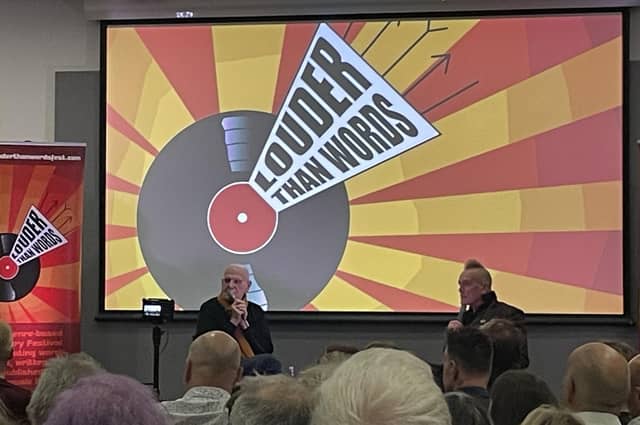

Now in its 14th edition, Louder Than Words, the music literature festival founded by Jill Adam, former chair of Harrogate International Festivals, and John Robb, the musican, journalist, author and broadcaster, is such an essential part of the North’s cultural calendar that it can attract a raft of famous faces alongside some of the cream of Britain’s music journalists and authors.
Among those appearing at this year’s three-day event in Manchester were John Foxx, Irvine Welsh, Nick Heyward of Haircut 100, Baz Warne of The Stranglers, Pauline Black of The Selecter – interviewed by the Harrogate-born comedian Maisie Adam, Gary Kemp of Spandau Ballet, and The Young Ones star Nigel Planer in conversation with fellow actor Christopher Eccleston.
Our Louder, however, began on Saturday with Graeme Thomson, author of acclaimed works on Kate Bush, John Martyn and Simple Minds, talking about his latest book, In Another World: The Four Seasons of Talk Talk, with Nige Tassell, whose 13th book, Truly Gifted Kids, is critically-praised attempt to “illuminate the mystery” of Prefab Sprout.
Thomson explained that rather than writing straightforward biographies, he prefers to “delve” into the “world of the music” of his subjects and had longed to write a book about Talk Talk as they’ve soundtracked his life since the drummer in his then band introduced to him to their masterpiece, Spirit of Eden, in the late 1980s.
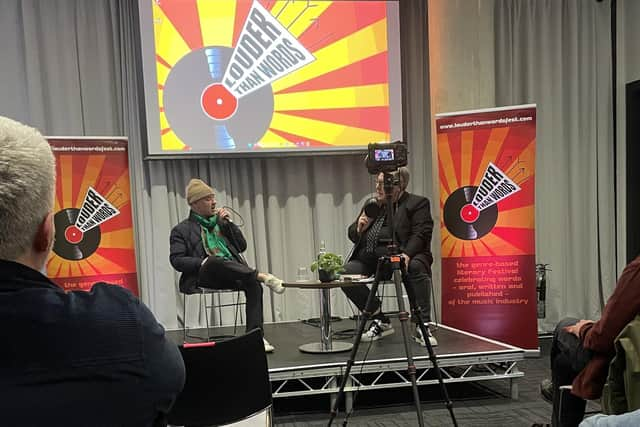
For Tassell, Prefab Sprout “have always been there”. After discovering them in 1984 on the Channel 4 programme The Tube, they were the first pop stars he ever met – a year later when he summoned the courage to speak to Martin McAloon at a gig. Although his school friends found them “a bit soft”, Tassell was entranced by songwriter Paddy McAloon, whose voice he found “so different” to his 80s contemporaries. His book, compiled from vast research, is a travelogue of sorts in search of the inspirations for McAloon’s songs. At the end of it all, though, Tassell admitted: “I’ve written 90,000 words on him and he’s still a bit of an enigma to me.”
In his book, Thomson focuses on the last three albums created by Talk Talk – The Colour of Spring, Spirit of Eden and Laughing Stock – plus the lone, eponymous solo album by their singer Mark Hollis, who died in 2019. Once occupying the “moodier end of synth pop”, the band’s methodology “changed dramatically” from The Colour of Spring onwards, with Hollis becoming ever more obsessive about finding the exact sounds that he could hear in his head but struggled to articulate to fellow musicians and recording engineers. Endless hours in the studio proved an “attritional way of working”, Thomson said, while the £1m cost of making Laughing Stock and the self-titled solo album “almost bankrupted” Polydor Records.
Prefab Sprout, on the other hand, were more prolific and willing to play the commercial “game”, Tassell conceded, but Paddy McAloon’s complex songwriting, which had much in common with his hero Jimmy Webb, only occasionally found favour in the mainstream – notably with Steve McQueen and Jordan: The Comeback – before McAloon began to lose his sight and hearing due to detached retinas and Meniere disease.
What remains with both artists, however, is a remarkable body of work that’s ripe for rediscovery. Talk Talk’s work has 4m listeners a month on the streaming service Spotify while a new generation is discovering Prefab Sprout through the video game Grand Theft Auto. “They would both probably say posterity will judge us,” Thomson observed. “They were both seeking a timelessness and classicism in their songwriting.”
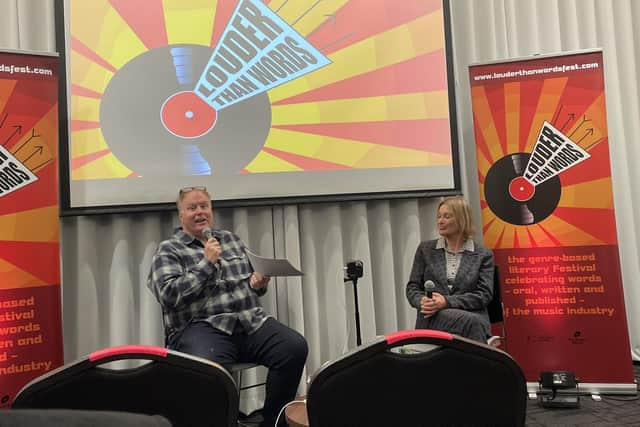
A talk called Atypical Girls brought together the songwriter and academic Helen McCookerybook with music journalists Molly Tie and Penny Kiley in a fascinating conversation chaired by John Robb.
McCookerybook, author of The Lost Women of Rock Music, recalled her own transition from Brighton squats to forming punk band The Chefs. “We were awful,” she admitted. “We wrote songs based on stories in the papers – but that’s how punk started. We got loads of gigs after that.” Mentored by the “fantastic” Vi Subversa of the Poison Girls, they gradually got better and found an audience. The bass, she found, was “a brilliant instrument for shy people” because its sound “shakes the floor and punches people in the chest”. “It changed my entire personality and my prospects,” she said. Through the ethical messages in their songs, they also sought to make feminism “more fun”.
Kiley, who worked for Melody Maker and wrote the memoir Atypical Girl, said she found being an audience member during punk “incredibly liberating”, explaining: “It was seeing your peer group doing stuff and going, ‘I can do that’.” Punk also taught her “to fight your corner”, she added, which became invaluable later on during newsroom clashes when she worked at a North West newspaper.
Tie, who is the UK editor for Punktuation magazine and author of Rebel Grrrls: The Real Story of Women and Punk, discovered the movement in the late 1990s, working her way back from pop-punk and emo to the 1970s. “I was searching for my own genre of music,” she said. The influential US group Bikini Kill became her “gateway to feminist punk bands”. During the writing of her book, which charts 50 years of women in punk, she found: “Everyone I spoke to has found something about punk that has changed their life for the better. Each era has treated women differently, therefore their liberation has come in different forms.”
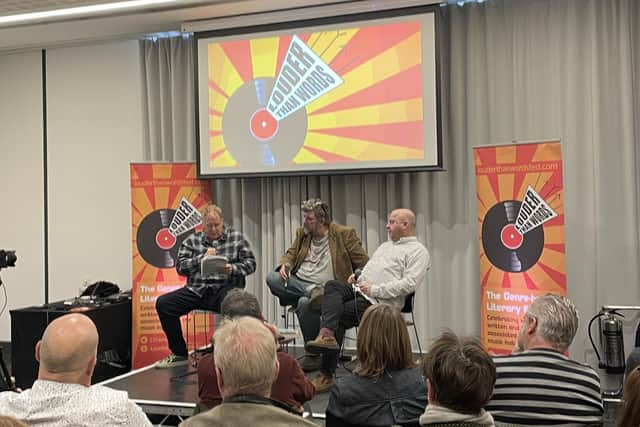
The first stirrings of the Sex Pistols and punk rock in London in 1975 helped transform Marco Pirroni from being a glam rock-loving suburban teenager “permanently dissatisfied with my life” into a guitarist with The Models and Rema-Rema before finding fame with Adam and the Ants. In a funny and insightful chat with John Robb about his memoir Your Money Or Your Life, he talked about his youthful visits to Vivienne Westwood and Malcolm McLaren’s shop Sex in the King’s Road, suggesting that for all her fashion nous, the designer “did not have a sense of humour at all”, and that Jordan, who he also met there, “was always the most sensible person in the shop”.
He found the early gigs by the Pistols inspirational, however, explaining: “What was really lucky was that something came along that meant you did not have to learn how to play.” Although the Pistols became a huge success, Pirroni compared their manager McLaren to Ed Wood, the ambitious but hapless director of 1950s B-movies such as Plan 9 From Outer Space, quipping: “He would just do everything wrong, but it just went right.”
The opportunity to create a new version of Adam and the Ants – after Malcolm McLaren took Adam’s original group to form Bow Wow Wow – would prove to be Pirroni’s golden ticket. “I think (Adam) had decided he wanted to be very famous and I wanted to be very rich,” he joked. The guitarist’s job would be to “distill” the singer’s mutiple but “confusing” ideas into something that would make sense to record buyers.
For 18 months they were the biggest band in Britain – “It was this unstoppable force, I did not have time to think about it,” Pirroni said – but by the start of 1982 he had had enough of “Adam’s paranoia” and band infighting. “I decided I’d done my bit,” the guitarist said, adding wryly: “When I die I will go to heaven because I spent my time in hell in the Ants.”
Steve Mason arrived at Louder Than Words buoyed by the success of reunion gigs by his old group The Beta Band. Talking to Daryl Easlea about his well-received memoir Failure Is Always An Option, he explained that he had begun writing it eight years ago when he moved from Fife to Brighton, and praised Pete Selby, MD of his publisher New Modern, for his encouragement.
With The Beta Band, he said, they used to “assemble songs rather than write them which was a lot easier when ProTools came along”, enabling them to edit all their separate ideas together. The most difficult chapter in the book to write had been the one concerning his depression, which initially ended the band – amid the weight of financial pressures – in 2004 before Maason embarked upon a solo career. “I suffered from depression for about 20 years. When you are lucky enough to put that to bed I’m the sort of person who likes to look forward,” he said.
Looking back at the founding ideas of The Beta Band, he said: “I just wanted to destroy Britpop, the flags and all that British stuff. We didn’t want to be coke-addled, wallabee wearing t***s who would just spill their guts to any journalist. We wanted to be artists.” Mason’s tastes, which ranged from rap to garage rock, rockabilly to reggae, were always too broad to be pigeonholed.
These days he finds himself in a happier place with a family of his own and The Beta Band have enjoyed toured tours of the UK, US and Australia. “When you take away the pressure from that situation, (I found) this can be amazing fun,” he said.
Our day ended with former Smash Hits, NME and The Face journalist Sylvia Patterson in conversation with Mark Hart of the Rock ’n’ Roll Book Club about her second book, I’m Not With The Man. A collection of 22 interviews with musical mavericks, its subjects include Liam Gallagher, Marianne Faithfull, Adam Ant, John Lydon and Sinead O’Connor.
Mavericks, she said, were “those who got their own way outside of convention”, adding that “in terms of pop culture, the foundations of rock ’n’ roll was built on the crazy person (for whom) there were no rules, ever”. However, she lamented that in music such “gigantic characters” had become few and far between since the 2000s.
She cited the example of Dermot Kennedy, the chart-topping singer-songwriter who she had been sent to profile when he was playing in Amsterdam in 2019. During their interview in the afternoon she said the singer had been “slagging off the (modern) surface level culture” yet onstage he was “entirely harmless”; backstage he practised yoga and travelled with a vocal instructor. “This was all so sensible and boring to me,” Pattenden said. “I thought, it’s done.”
The rock ’n’ roll spirit, she felt, was “a generations thing – in some ways it was a 20th century art form and a 20th century mindset”; today “the young think rock ’n’ roll is a bit of a loser’s game in some ways”.
It had been very different when Patterson was sent by the NME to interview the Wu Tang Clan in New York in 2000. By her own admission an unlikely candidate for the job – “I was no hip-hop guru, I was a vegetarian Smiths apostle” – she had waited three days in a swanky hotel before two members of the 10-man rap crew eventually turned up, yet Method Man and U-God proved “funny” and ”adorable” company who offered telling insights into their world. “They were talking about being a fatherless generation, they were saying this is a problem with Black America,” Patterson recalled. While several of the Clan had dealt drugs in their younger days, they had decided that hip-hop was a better way of life. ”They built a multi-million pound empire – that is genuinely inspirational,” she said.
What has been lost from music journalism in the last 40 years, she said, is jokes. In an image-driven environment, pop star Jess Glynne had told Patterson “it’s not much fun to be in pop, everyone is so self-conscious”. She added: “In the 2000s bands became brands. As time went on it was all about PRs, it was controlled. (Journalists) were seen as the enemy.”
Still providing an outlet for tales from rock ’n’ roll’s more adventurous past, Louder Than Words is a literature festival like no other, and this was arguably its best edition yet. Roll on Louder 2027.