
Sally Potter: 'Songs are not good as lectures'
One of British arthouse cinema’s most fêted directors and screenwriters, Sally Potter has also long had an interest in music. From her 1992 adaptation of Virgina Woolf’s Orlando onwards, her compositions have featured on the soundtracks to her films, and in 2023 she released her debut album, Pink Bikini.
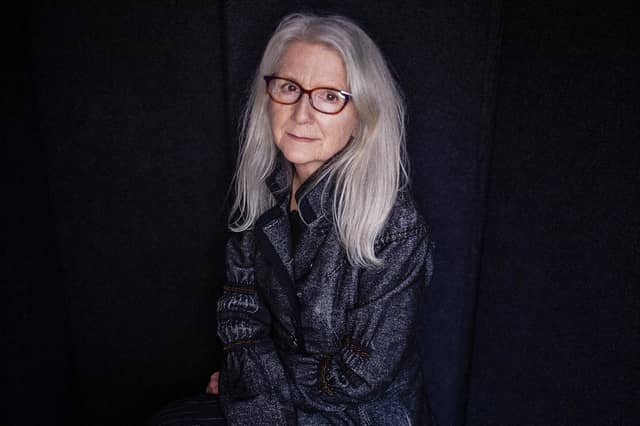


Now comes a follow-up, Anatomy, comprised of a dozen self-penned songs, which is out this week on the indie label Bella Union.
Flanked by a grand piano, keyboard and microphones as she talks to The Yorkshire Post via video, the 75-year-old explains that music was an integral part of family life while she was growing up. “My mum was a music teacher, my brother (Nic) was a bass guitarist in Van der Graaf Generator and various other groups, my grandmother was also a singer, so there is a kind of family line,” she says.
“As a child I learned the violin and then the piano, but it wasn’t so much about having lessons and what I learned in that way but rather the role that music played in my life, which essentially, as for so many others, is a kind of soul food and a way of meeting the mysterious parts of life that you can’t put into words and feelings that you can’t otherwise quite feel or articulate.
“So as well as being joyful and full of celebration, and a way to dance your way through life, it’s always been for me an absolutely core thread.”
Pink Bikini and Anatomy are, she says, a return to the kind of songwriting that she “did a lot of” in her twenties when she was a member of several bands including the Feminist Improvising Group. Although that ensemble’s ethos did “not always” chime with her own, she says it was “a great experience to be really on the road as a touring musician making music that was entirely improvised in that moment”.
“I think improvised music as a discipline is the most incredible ear training,” she adds, “because you’re composing in the moment, each individual, but you’re trying to compose together in the moment or argue with each other musically or destroy what you’re doing, whatever it may be. It’s a training to be truly in the present and truly listen to many other lines, melodically, harmonically, rhythmically and so on.”
In Pink Bikini, Potter chronicled her experiences as an artist and activist in 1960s London when there was “an awful lot” to protest against from the nuclear arms race to apartheid as well as women’s and gay rights. The focus “might have shifted a bit” since the days of the Cuban missile crisis but she clearly still believes in the power of protest. “I think every generation expresses its idealism in different ways,” she says. “I think the streams of idealism, if I can put it, that I was experiencing in my teenage years, which is really what that album was focusing on, was everybody’s survival – if they survived their teenage years they were doing well.
“It was the nuclear threat that I as a child dreamt of night after night after night, like a repetitive horror show. We really all felt the world might be about to be blown to pieces, so what could we do about it. One of the only things that was available to people to do – and to some extent still is – is to get out on the streets and march, to protest together.
“You never know whether the protest is having an effect on the decision makers at government level and so on or whether its function is just to remind you you’re not alone in what you are thinking and feeling about the world and in your desire for it to be a more just, humane and inclusive place.”
Today, as she reflects in some of the songs in Anatomy, there is still much to say. “Now what I see among young people is a feeling for the environment, the terrors of extinction of species, all the fires and floods that people see, and the fact that you see all those images now on social media – as well as the terrible wars, the injustices in Gaza and so on, so young people are flooded with the spectacle of disaster and destruction and enormous feelings of helplessness about what to do about it.
“I’m not sure there are such huge differences between the generations, but I think conditions and circumstances change but protest and resistance to what appear to be – and are – many, many destructive policies at government level worldwide have an enormous effect on people’s sense of what’s possible.”
The new album is not, however, about holding up a placard or trying to lecture people, she insists. Instead, it’s trying to say more nuanced things “about the Earth and our relationship to it”. She adds: “The title of the album, Anatomy, was because all of the songs are based around the idea that we are not separate from the Earth, we’re not just walking around on the surface of it, we are part of the Earth. The Earth is our body and we rely upon it, we’re dependent upon it, we exploit it at our peril, it’s basically self-sabotaging if we do that.
“The subtitle of the album is ‘love songs for the Earth’, so there’s a mixture of celebration and kind of intimacy, where I’m singing away to the Earth as if this was like a love affair, sometimes that’s breaking up or sometimes that’s together, sometimes playful, sometimes sad, and you can read it either way. You can read them as songs that might apply to any relationship like all love songs do or that could apply specifically to our perilous now relationship with the Earth.
“Songs are not good as lectures, lectures are good as lectures, placards are good as placards. Songs are probably the oldest artform that people started to make, pure sounds that you make without having to make any instruments or any materials at all, just our own bodies. So when you write a song it’s like you’re on just the very now-ish moment of this long thread, this incredible lineage of songs that goes way back to the beginning of humanity. So I’m trying to tap into that and feel what other songs have done to me and hope that I can write songs that might have that effect on others.”
Potter only has one concert planned to promote the album – at London’s Cafe OTO tonight – after that her focus will turn to her ninth feature film, Alma, which will star Pamela Anderson, Dakota Fanning and Lindsay Duncan. Filming, she says, is due to start in September but beyond that, she is reluctant to say more. “I have done it in the past and lived to regret it because I find that the film has turned into something entirely different,” she chuckles.
Nevertheless, she does believe that there are still important stories to be told in feature films. “It’s the streamers that have got the money so it’s not that often even the big feature films you don’t necessarily watch on the big screen – a lot of people watch big feature films on their laptops or even sometimes on their phones, so people have got used to watching on different scales, that is simply a reality that ones has to accept, but I think the form of the feature film hasn’t diminished its place,” she says.
“People may occasionally watch television series more than once, but mostly if you watch a series you watch it once, but lots of people watch a feature film, a really good one, more than once. It’s because it endures, it got a sort of shape and an identity somehow in culture that you hold, it’s not as ephemeral as a lot of stuff that comes and goes in general streaming.
“That may change, although I think that’s still the case, and there’s something about its length, although I think films have got far too long recently, but the hour-and-a-half length of experience feels like a good one – it’s like a double abum’s worth.”
Anatomy is out now on Bella Union Records.