
Sheffield violin maker Emma Hardy on going from corporate London to making a living by joining folk in Yorkshire
Emma Hardy grew tired of sitting in front of a screen all day and took up violin making as a hobby. She has now become an expert and wants to attract others to the genre. Julian Cole met her.
Violin maker Emma Hardy has fallen in with good folk in Sheffield, made what you might call a violin for the people, and been bewitched by a shapeshifting witch who takes the form of a hare.
In her workshop in the Portland Works building off Bramall Lane, Emma makes violins and violas for folk musicians.
Sheffield is famously folky, and being drawn into that world helped Emma find her feet in the city.
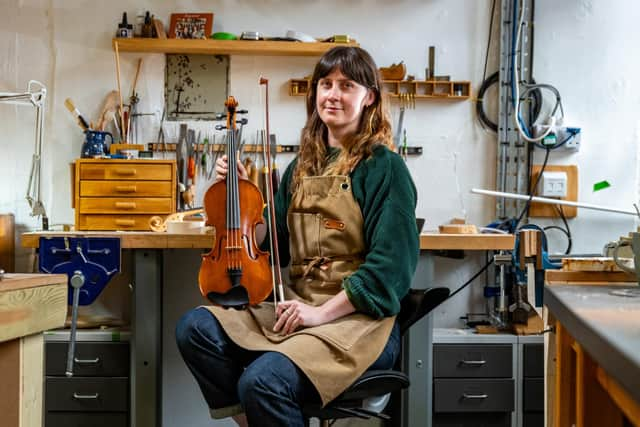

Built in 1879, the Portland Works has been called the birthplace of stainless steel cutlery manufacturing. After half a century of neglect, the building was bought in 2013 by a social enterprise and is now a centre for small manufacturing, independent artists and craftspeople.
The area is very different to where Emma, 34, grew up in rural Shropshire in the middle of nowhere, enjoying what she describes as a feral childhood.
She studied animation in Bristol, then moved to London to work as a graphic designer in academic publishing.
“After four or five years of that I didn’t love sitting in front of the computer all day or the corporate environment," says Emma.
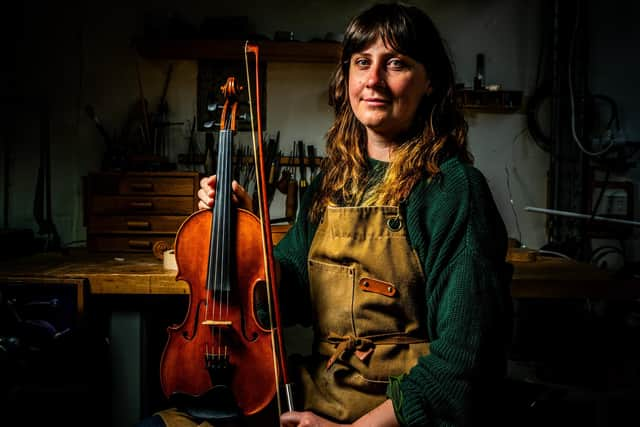
"So I was looking for something else.”
As a violinist herself, she knew about violin making, and found a hobby course in Cambridge.
“I started that on the weekends for fun and completely fell in love with it.”
She then studied violin making on an adult education course at Merton College in south London. After three years of training, she moved to Sheffield to be with friends.
Away from strings and things, Emma is a keen climber who spends her weekends grappling with ropes and rocks.
“Mostly sport climbing, a tiny bit of trad climbing. Sports climbing is when the bolts that you clip in are already in the wall, trad climbing is when you have this array of stuff you stick into gaps and hope it holds.
“As somebody who relies on my hands for my work, I am always nervous of that in case I have a fall.”
Her partner, Will Szott, is also a violin maker. He works in an outbuilding at the old property they are restoring in a village outside Sheffield.
“He’s much more the classical style. He’s also a good repairer and does some really high level repairs.”
Asked if it is unusual for one violin maker to hook up with another, Emma says: “It’s actually not in the violin world. It’s such an unusual job it’s almost like no-one understand it like another violin maker.”
Violins she has made sit in the airy and bright space where she spends her days.
A key instrument is the Folk Who Roam violin, part of a project filmed by Emma Crome and photographed by Cat Vinton for a documentary of the same name.
Emma was followed throughout the making of this special violin.
Rosie Butler-Hall, a local English-folk fiddle player, Morris dancer and textile artist, was on hand to play the instrument.
Moving between Emma’s workshop and the Peak District, the film reflects on how traditional music, like the countryside, belongs to everyone.
It was released in Sheffield last month and is now being shown at film festivals and folk festivals.
“The idea was that I would make a violin that would become a community instrument and travel round with different people, and that musicians would take out into the countryside and the Peak District and play outdoors,” says Emma.
“In the Peak District we have open access on the open moorlands, and I wanted it to be a celebration of what we do have, and at the same time draw attention to the bits that we don’t.”
The violin features decorative carving inspired by the area it celebrates, with gritstone at the top of the scroll.
“It’s a lovely instrument and it’s gathered a community around it. When I started that project I was still new to Sheffield and it became the conduit for meeting people.”
An unfinished violin on the bench is a collaboration with Emma Reith, an illustrator from Cornwall.
“I’m making the body and doing the initial varnish and then posting it to her. She’s going to illustrate all the way round the ribs.
"She’s a beautiful illustrator and does very nature-based illustrations. She’ll paint a story of a tree as it goes around.”
The finished violin will be put up for sale by violinist and luthier Libby Summers at her shop Stamford Strings.
At present the body and neck are separate.
Emma has used maple wood for the back and neck, with spruce for the top. She has also been experimenting with other woods from the UK, including ash, widely available thanks to the sad effects of ash dieback disease.
“A few years ago in a storm, a massive ash tree came down on the Chatsworth estate and through a local wood supplier I managed to get a load of this,” she says.
"I think I’ve got enough for about 15 violins. It’s beautiful, it’s really nicely flamed, it’s beautiful wood.”
Another of her violins was inspired by the folk song Lyddie Shears, as played by Rosie Hood.
“Rosie’s band performed the tale of this shapeshifting witch who would take the form of a hare to cause mischief, but who would also, in an act of pure joy, dart across the countryside with her fleet-footed kin, only to be struck down with a silver bullet of a disgruntled farmer.”
The violin has a scroll in the shape of a hare’s head, originally modelled and remodelled as a clay maquette, before being carved in lime wood, which Emma describes as “a woodcarver’s dream: your tools glide through the wood almost like butter”.
Emma’s violins take her three months to complete, and cost from £5,500.
If you fancy a go yourself, Emma has a book out in August, a step-by-step guide to fiddle making, published by the Crowood Press.
“It’s a practical guide aimed at keen amateur makers or violin makers who are wanting to experiment in decorative techniques,” she says.
Emma favours the creative style of the art rather than the traditional technical side, and her instruments are often embellished or decorated.
“I wouldn’t say it’s taboo, but it is definitely unusual in violin making to do decorative things,” she says.
"There’s been more history that if you say you’re a fiddle maker you’re throwing it together, you’re not a professional. I’m trying to bring the training I’ve got to those folk instruments because folk traditions deserve good instruments too.”
Emma also made for the book a pochette or a kit fiddle, a medieval dance instrument.
“It’s called a pochette because it will fit in your pocket and it’s the French for small pocket,” says Emma.
Another experiment for the book was a violin with a double-decker peg box and a box for sympathetic strings, allowing the lower strings to resonate. This was influenced by the Hardanger fiddle of Norway.
Next year Emma wants to move on up to a cello. “It’s basically just a big violin but I didn’t have a workshop that was big enough to make cellos,” says Emma.
She does now.
To view more of Emma’s work visit hardyviolins.co.uk