
The fascinating story of a Yorkshire artist saved from a Victorian textile mill by his talent
For an example of a local artist making good despite an impoverished and difficult childhood, look no further than Frederick (Fred) Stead, one of the finest Yorkshire painters of his generation.
Born in Saltaire in 1863, Fred was the youngest of ten children born to Samuel and Sarah Stead, textile workers at Salt's Mill, built alongside the village by industrialist, politician and philanthropist Sir Titus Salt (1803-1876).
Life was difficult, to say the least, governed by shifts at the mill, his mother's frequent pregnancies over 20 years, all endured in horribly overcrowded conditions in a house shared with another family.
Within six months of his birth, Sarah Stead was dead, worn out by her struggles, and Fred's care in the cramped, noisy home was shared by his four older sisters.

Fred's father Samuel was soon unable to work because of rheumatism but three sons and two daughters, including 10 year old Harriot, all worked at Salts Mill, the largest textile factory in Europe, featuring an enormous 600ft room known as The Shed, where miles of cloth were produced each day.
It seemed inevitable that Fred would end up there, too, after leaving school. But he had other ideas and, after attending Saltaire Art school, where his talent was recognised and nurtured, he won a scholarship to the National Art Training School, later the Royal College of Art.
His skills earned him a travelling scholarship and suddenly the working class Yorkshire lad found himself dealing with the complexities of etiquette and foreign languages while studying European art in Italy, Switzerland, Germany and France.
Back home, he taught at the art schools of Saltaire and Bradford and from 1888 exhibited regularly with the Yorkshire Union of Artists, of which he became chairman, staged exhibitions of oils and watercolours in Birmingham, Manchester and Liverpool and began his long run of more than 30 exhibits at the Royal Academy.

His commissioned portraits included Alderman Benjamin Septimus Brigg, first Mayor of Keighley, in 1882, and Sisters, depicting Hilda and Mabel Townend, 12 and 10, daughters of dentist Edmund Townend, who worked from home at Cliffe Villas, Manningham, Bradford.
The girls sat for hours in Fred's studio each Saturday for months, with Mabel having to hold a heavy Peter Pan book while he painted.
But the artist is perhaps best remembered for his landscapes, which show a love of his native Yorkshire and his exhibits at the RA include works such as Shades of Evening, The Magic Crystal and The Princess and the Frog.
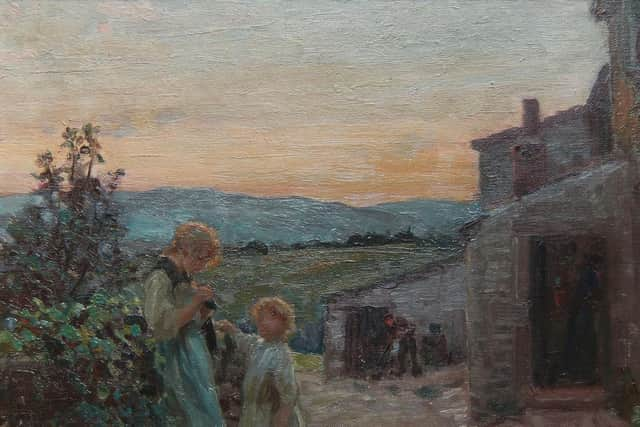
Now here's another: Fred's undated The Farm, Evening, which has surfaced at the Harrogate gallery of Yorkshire picture specialist Paul McTague and is priced at £2,550.
The figurative oil, typical in featuring idealised childhood scenes, depicts sisters talking outside their farmstead at sunset, while father works in the background.
To complete Fred Stead story, he was appointed head of the Saltaire Art School in 1896 and married local teacher and artist May Greening.
They lived in Ivy Road, Shipley, and in 1898 the first of their three children, Samuel, was born. In Fred's 1923 painting Mother and Two Children with a Picnic, she is pictured with their daughter and younger son.
Their eldest, Samuel, had been killed on the Somme in 1916. Fred died in January, 1940 and is buried in Nab Wood Cemetery. His widow died in 1958.
Paul McTague, who opened his Harrogate gallery in 1981, specialises in traditional oil and watercolour paintings and rare prints, particularly of Yorkshire and the North East.
His current offerings include work by Fred Lawson, Williams Greaves, Tom Dudley, Owen Bowen, Herbert Royle, Ernest Higgins Rigg, John Ward Knowles, Nora Munro Summers and Thomas Bowman Garvie.
Pictured here, alongside Stead's The Farm, Evening, are The Plough at Hinderwell, an oil by Bradford-born Rigg (1868-1947), priced at £1250, and Easby Abbey, Richmond, Yorkshire, a watercolour by York-born Dudley (1857-1931), priced at £150.
Easby Abbey, or the Abbey of St Agatha, was founded in 1152 by Roald, Constable of Richmond Castle, and the inhabitants were canons rather than monks. They wore white habits, followed a code of austerity similar to that of Cistercian monks, undertook preaching and pastoral work in the region and raised sheep.
Like most Northern monasteries, Easby suffered from frequent Scottish raids during the Middle Ages. In the late 1530s, Henry VIII dissolved the monasteries, the abbey was abandoned and left to fall into ruins.
**At Dreweatts of Newbury, Berkshire, two oils by Bradford-born Richard Eurich (1903-1992) each fetched £16,380. Shells on a Beach with Figures, a Fishing Boat and Lighthouse and The Hammock had both belonged to the same family.