
I visited the Castle Howard Arboretum - with autumn foliage and a red squirrel named after David Attenborough

Yorkshire is erupting in autumn leaves, so last weekend, I visited Castle Howard Arboretum: a 120-acre botanical garden dedicated to trees.
Located in North Yorkshire, the arboretum has over 7,000 trees, from Japanese maples to English oaks.
On Tuesdays and Saturdays, it runs red squirrel talks, introducing visitors to “David Attenborough” – aka Castle Howard’s resident squirrel.
Opened in 2023, Castle Howard Arboretum’s Red Squirrel project was funded through the King Charles III Charitable Fund. The project has bred 15 kits, all relocated to conservation sites across the UK, including North Wales.
As I drove towards Castle Howard Estate, the grandeur was mind-blowing. Passing crenellated walls and stone archways, I reached a roundabout marked by a gigantic obelisk.
Between February and November, Castle Howard Arboretum opens from 10am until 5pm, with tickets available from £12.75 and last entrance at 4pm.
Pulling into the car park at 10.20am on a Saturday, it wasn’t quite busy enough for overflow parking, but spots were filling up.
First on my itinerary was the 10.30am Squirrel Talk. Only a few hundred metres from the entrance, the open-topped squirrel enclosure has a double-gated system and an accessible wooden boardwalk.
Turning to my mum, I just about whispered, “I wonder whether we’ll see him,” when a flash of red fur bolted across the path.
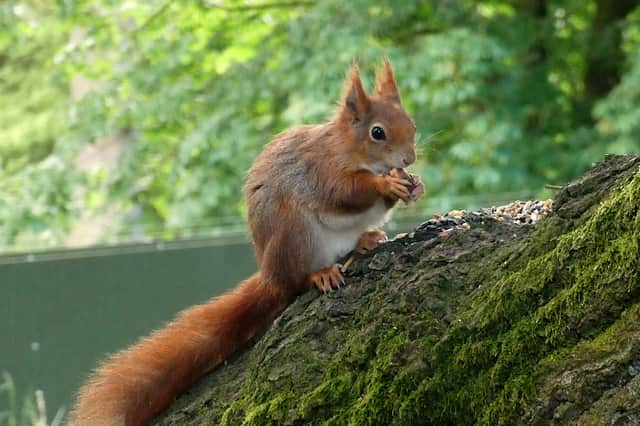

Grabbing a nut, the squirrel paused for a moment, deftly removing its shell before hurtling off again – presumably in search of another diamond in the rough.
“David Attenborough is our male squirrel,” said Ben Paterson, Castle Howard’s arborist and red squirrel officer, “so named because he arrived here on David Attenborough's 100th birthday.”
The tiny squirrel had attracted quite the crowd; approximately 15 to 20 onlookers had gathered along the boardwalk, from parents with toddlers to photographers poised with expensive lenses.
Everyone was transfixed as David bounced across the native woodland. Still, for all his character, David is here to serve a greater purpose.
In the 19th century, the introduction of grey squirrels as an ornamental species began spreading a fatal parapoxvirus to the native red squirrel population. As of 2026, red squirrels are currently classed as endangered in the UK.
“The current estimations are between 120,000 and 287,000 red squirrels left in the UK, but there are fewer than 38,000 in England, and that number is struggling,” said Ben. This project runs a small breeding colony, aiming to grow the UK’s surviving red squirrel population.
On October 5, David met the project’s newest addition: a young female called Cinnamon.
Autumn is when squirrels are most active, spending most of their time scavenging to build a food store of hazelnuts, seeds, berries, and fungi.
“During this time of year, they are extremely food-motivated,” Ben said. “They are governed entirely by their stomach.
“But since his future girlfriend has arrived, he is spending maybe 10 minutes feeding, then he's running back to check on his friend,” Ben said.
“He seems fairly smitten already with his new partner,” he added.
For an hour, I stood on the boardwalk, surrounded by rustling leaves and mesmerised by David’s antics. He must have been exhausted; I was just watching him. At one point, he clambered onto the railing and ran towards me, stopping about 30cm away – unpeeling a nut and casually looking me up and down.
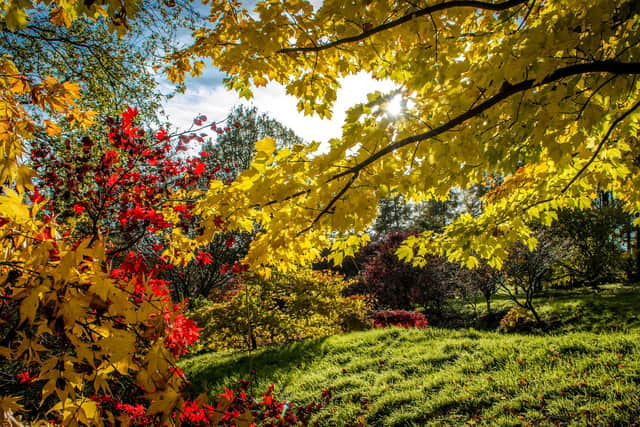
Afterwards, I walked through the arboretum. Given that I was visiting in early October, I had been unsure how much autumn foliage there would be.
However, I was pleasantly surprised to see plenty of bright colours.
Japanese maples were already blazing red, and some of the oaks were yellowing. In the coming weeks, these treetops will transform into waves of bronze, red, orange, and yellow.
The arboretum has a serene combination of grassy tracks and gravel walkways. I walked along the shore of Arboretum Lake, with its swishing bullrushes, and looped through Tercentenary Wood, towards Ganthorpe Gate.
The experience felt incredibly peaceful, and I’d like to return in a few weeks, when the autumnal colours are even brighter.
Before leaving, though, I couldn’t resist taking another peek at the squirrel enclosure – just to see whether David was still foraging.
A few visitors were patiently sitting on wooden benches, but the boardwalk was quiet. They might be waiting a while, as Ben had warned me that 12pm to 2pm was David’s “siesta time.”
He might be a budding Yorkshire celebrity, but David has certainly nailed his work-life balance.