
Clare Phelan: Meet the printmaker giving new life to obsolete technology
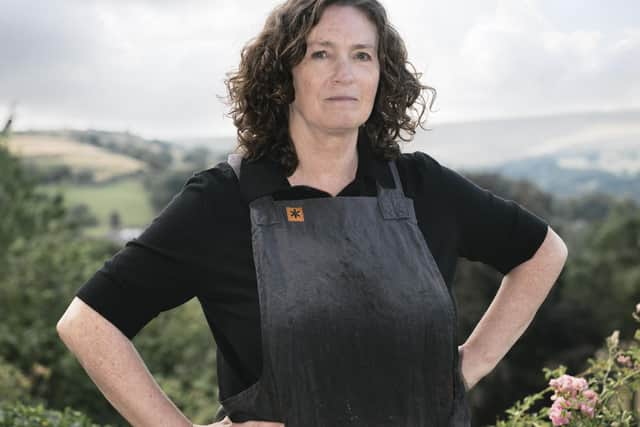
Working primarily as a printmaker, Holmfirth-based Clare Phelan has developed an interest in mass-produced objects most people would throw away.

Influenced by the post-industrial landscapes of Northern England, where she has lived all her life, her current practice utilises obsolete nineteenth and twentieth century coding technology artefacts, such as textile jacquards, music box discs and IBM punch cards.
It may sound very technical but it is the stories behind these lost technologies that really inspire her and bring the past into the present day.
"People take inspiration from all sorts of things,” says Phelan. “I grew up in Doncaster, I’ve lived in Manchester, Halifax, Bradford and now in Holmfirth – there’s something about industry and in particular declining industry that has been part and parcel of my adult life.”

She says coming from a working class immigrant background work and gender issues were always around her growing up.
"I moved from Doncaster to Bradford in the mid eighties to do my art degree which was a really broad degree and I was just blown away the stone compared the red brick of south Yorkshire. I fell in love with the vast mills and the back to back terraces.
"Since moving to Bradford I have had a bit of an obsession with the industrial revolution and how it changed the North."
After her art degree she trained to become an art therapist working in the NHS in Bradford for 20 years.
“When I graduated it seemed really difficult to even think of making a living as an artist and even now people still have to take part-time job to be able to pursue the kind of art they want to do.”
But her children started secondary school she decided the time was right to go back to creating her own work. She went back to Bradford and did a part time MA in printmaking.
"I took as my inspiration a technical drawing from the machine made lace industry in Nottingham. It’s all about time and touch. It has pin marks in it, it looks like someone has pricked their fingers and it his notations. And I took that as my starting point and I researched all about the early coding technology they used in particular in the jacquard textile cards which very much links with where are to day with computer coding.”
Through her work, the binary language of the machine unfolds in rhythmic patterns, bridging the physical past with the digital present. She also has also worked with IBM punch cards and is even looking at other people’s telegrams and morse code messages.
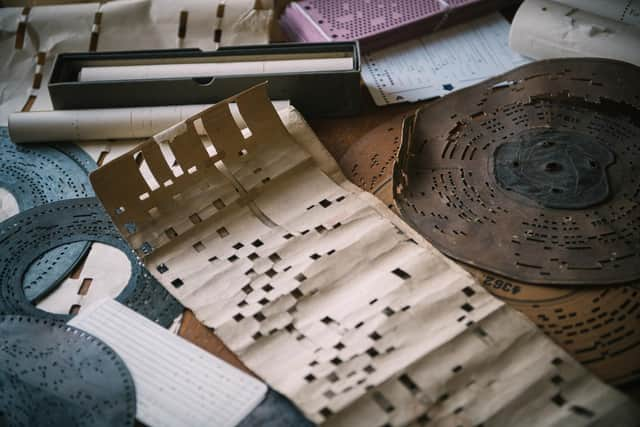
"There’s a lovely phrase ‘Do Not Fold Spindle or Mutilate’ which was printed on the wrapping of the blocks of cards which I have used for the title of my exhibition at the Hepworth. Students in the US used that phrase in the sixties to say they were people not machines.”
While doing her MA she also became fascinated with the cylinders found inside children’s music boxes.
"I wanted to make something that moved and so I bought a lot of these music boxes off ebay and through that I discovered that you could also get music box discs which really tied in with that punchcard technology that interests me and I could use those as etching plates.”
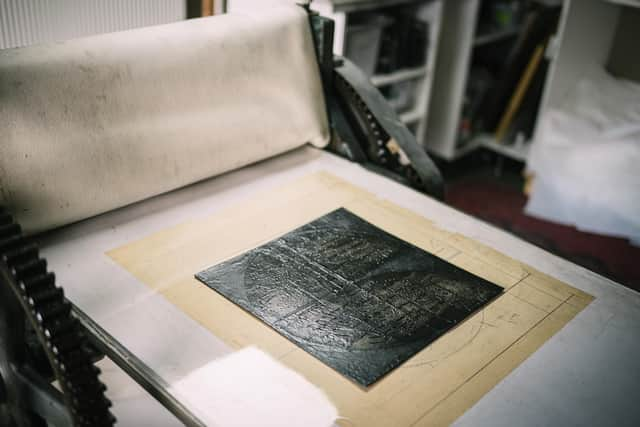
Phelan employs traditional analogue printmaking processes that mirror the labour embedded in these found materials, many of which she sources from ebay.
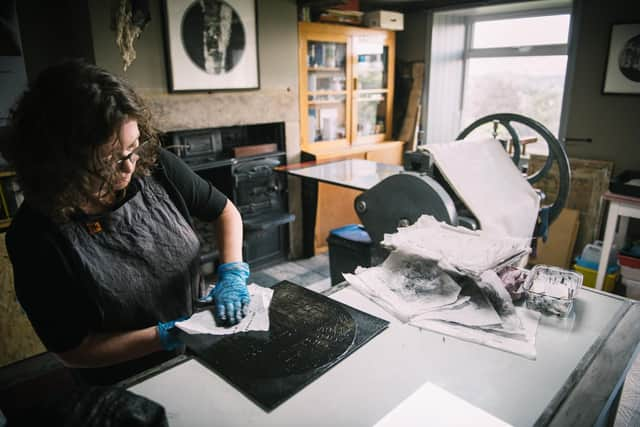
"I have a 50 year old etching press in my studio at home and I also print from Hot Bed Press in Salford. I mostly use etchings and collargraphs.
“I have spent a lot of time collecting different artefacts which are all low value, redundant and scrap,” says Phelan, “And through that I met a man who is the authority on the mechanical discs including pianola rolls and he would keep them for me, in particular the damaged and tatty ones as for me they have a bit more interest and history about them.”
It was through him that Phelan acquired two 70 feet rolls from a organetta which had much bigger holes that the pianola rolls and she used these as the basis for a huge installation in the south transcept of Wells cathedral.
The Print Fair Prize, open to all artists and collectives participating in The Hepworth Wakefield’s 2025 Print Fair, was devised as part of the gallery’s work to support artists at all stages of their career. The Print Fair Prize is now in its 7th year and previous recipients include James Bywood, Daisy Jacobs, Tall Paul Kelly and Babs Pease.
“It’s a great honour to be the recipient of this year’s Print Fair Prize and I’m looking forward, as part of this exhibition, to launch a new series of six prints inspired by Barbara Hepworth’s The Family of Man sculptures,” says Phelan. “It gave me an opportunity to introduce a bit of colour and also a hook tp put these pieces together.”
Visitors to the Hepworth from November 22 will see around 15 pieces of Phelan’s work in the cafe.

Clare Bridge, Retail Buyer and Product Developer at The Hepworth Wakefield, said: “Clare’s print complement The Hepworth Wakefield’s post-industrial setting on Wakefield’s waterfront. Visitors can experience Phelan’s work in the informal setting of The Hepworth Wakefield café, that encourages close, thoughtful engagement, and envision how these beautiful prints might look on their own walls at home.’
Clare Phelan: Do Not Fold Spindle or Mutilate will be on view in The Hepworth Wakefield café from Saturday 22 November 2025, opening to coincide with the gallery’s Festive Market weekend. Visitors can preview the exhibition on Friday 21 November, 7-10pm, at a free opening event celebrating the gallery’s autumn/winter programme of exhibitions and events.
Phelan’s prints will be available to purchase from The Hepworth Wakefield’s shop and online at hepworthwakefield.org/shop from late-November.