
Colin Campbell on what 30 years in crime gave him as a writer
Colin Campbell doesn’t hesitate when asked what 30 years in the police gave him as a crime writer that no amount of research ever could. “The smell,” he says. As a scene-of-crime officer with West Yorkshire Police, he once attended the flat of a man who had died alone and lain undiscovered for weeks during the summer. The curtains were closed, the fire was still on, and the room was thick with flies.
Campbell had to keep stepping outside while he photographed the scene.
“You had to go home and change your clothes because the smell was in everything. You had to wash your hair. You were just covered in it. You don’t get that in research.” It is the sort of experience that might appear to explain why Campbell became a crime writer. Except, as with most good stories, the truth is rather less straightforward.
Long before the police, the Army or the crime scenes, there was a boy growing up on a council estate in Tinshill, north Leeds, who loved putting words together but never imagined that people like him became authors.

“Kids from council estates didn’t write books,” says Campbell, now 71. “Books seemed to be something really intelligent people wrote. People who were educated, who’d gone to university. It didn’t seem like something that somebody who had to get the school bus would write.”
His father was a lorry driver and his mother a seamstress who worked in a factory. At Moor Grange County Secondary School, the emphasis was on learning the things you needed to earn a living. Yet two teachers saw something in him. His English teacher, Mr Radler, encouraged his writing, while art teacher Brian Gaunt had the gift of making an enthusiastic pupil feel “like the most special person in the class”.
Campbell remembers writing an elaborate scene about a gunfight on a pristine ski slope. “It was really over the top,” he laughs. “But I just really enjoyed that process of putting pictures in my head into words on the page.”
He also wanted to paint the vast illustrated film posters that once hung outside cinemas. His father dismissed the idea as impractical. Books, however, were one thing they shared.

His father kept shelves of paperbacks and steered him towards CS Forester’s Hornblower novels. Campbell devoured them, followed by books including Ray Rigby’s The Hill and eventually Ian Fleming.
“I like the flow of the words and the flow of the words translated into pictures in my head.”
Writing remained an ambition rather than a career. Campbell left school, embarked on an electrician’s apprenticeship, and then joined the Army for three years before moving into the police. It seemed a natural progression and, more importantly, offered the secure job expected of his generation.
What followed was a three-decade career with West Yorkshire Police, beginning in Leeds and later moving to Bradford. Fifteen of those years were spent in scenes of crime. He loved it.
The job exposed him to stabbings, petrol bombings, sudden deaths and murder scenes, yet he is wary of the familiar fictional trope of the traumatised detective carrying every case home.
“I wasn’t writing to clear away my skeletons,” he says. “I just really loved telling the story.” Indeed, Campbell didn’t initially write crime at all. Influenced by Stephen King, his first novels were horror. Four manuscripts were rejected before Darkwater Towers was published. Police officers nevertheless kept finding their way into his stories. Eventually the obvious occurred to him.
“I thought: ‘I’m a police officer. Why am I not writing that?’” His police background now gives him a particularly acute ear for authenticity. Fiction, he says, does not have to be literally true, but it has to feel true.
“The thing that is missing in a lot of fiction is the dialogue. It needs to sound like you can believe somebody would say that. People don’t speak in full, flowing terms. It’s short and punchy.”
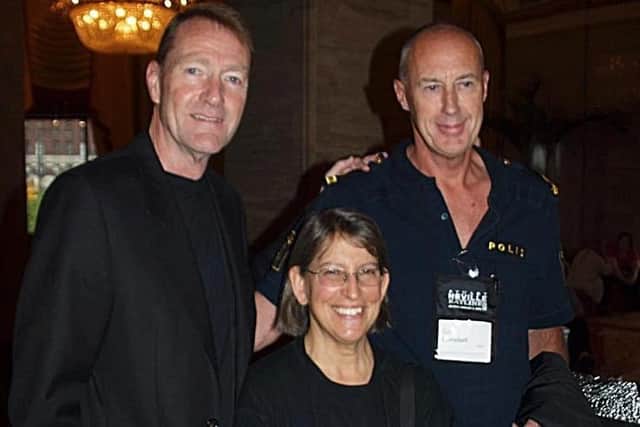
Campbell’s breakthrough came with Through the Ruins of Midnight, a novel rooted in the realities of uniform policing. At a crime festival, he handed a copy to Lee Child. Some time later, an email arrived. Child had read it and loved its authenticity.
“He was the person who got me off the bottom of the seesaw,” says Campbell. Child supplied a cover quote: “Very real. And very good,” and later helped connect him with a literary agent. That relationship would eventually lead Campbell towards writing American-set crime fiction, albeit with British police protagonists.
It also led, indirectly, to his best-known character. Campbell discovered that Lee Child’s real name was Jim Grant and thought it had exactly the plain, solid quality he wanted for his own Yorkshire-born police officer.
Only after writing the story did he wonder whether he might have overstepped the mark, but when he checked with Child, he gave his blessing.
The series has taken Campbell far from West Yorkshire, but the emotional landscape remains familiar. Writing police scenes, he says, reconnects him to the job he left behind. “When I’m writing those things, I feel connected to being in the police again.”
It informed his identity. It’s perhaps why retirement from writing is unlikely for Campbell. His next Jim Grant novel, Dark Sugar Bay, is published on December 1, while he is already two-thirds of the way through his 50th book.
Dark Sugar Bay, a Jim Grant novel, is out December 1, published by Level Best Books.