
Inside Doncaster Sheffield Airport: Bosses' high hopes of attracting four million passengers a year
Officials leading public sector efforts to reopen Doncaster Sheffield Airport say they believe it can eventually serve four million passengers a year – almost three times more than was ever achieved under private ownership. Chris Burn reports.
The check-in desks are empty, the shop frontages have been stripped bare and the escalator which once carried countless passengers on their way to their holidays has long been at a standstill - more than three years after its closure, entering the terminal at Doncaster Sheffield Airport is a curious experience.
But the presence of a couple of workmen inside the terminal highlights that DSA is far from being abandoned, as efforts continue to bring a site previously voted the best airport in the UK four years in a row back to life.
And while the airport’s main car park still sits empty and looking in need of a clean-up, the couple of dozen vehicles parked outside the neighbouring Heyford House office building indicates the growing activity levels as Doncaster Council looks to deliver on bold - and by its own auditor’s assessment “high risk” - ambitions to reopen the site itself via a council-owned company called FlyDoncaster.
Despite the project team now numbering around 40 people and intentions to build up staffing levels to 200 in the coming months, there is still plenty of uncertainty surrounding the route forward for the project - with a renegotiation of the lease needed before £160m of funding will be released; more than a year to wait for a decision on restoring airspace; the prospect of a potential legal challenge from rival airports and growing public cynicism about reopening dates after previous claims the site could be reopened by spring 2026 had to be shelved.
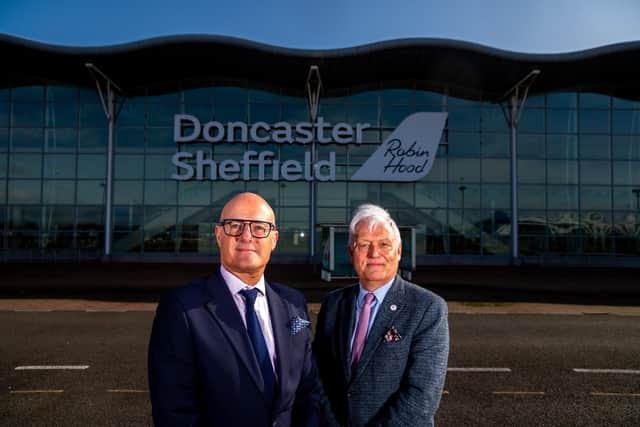
With the political fallout to this newspaper’s recent reports on the leaked contents of the 125-year lease between the council and landowner Peel still ongoing and an extraordinary council meeting to discuss it scheduled next week, The Yorkshire Post was invited to the airport to meet Doncaster Council chief executive Damian Allen and FlyDoncaster director Christian Foster and tour the site.
In the circumstances, the first question to the pair is a simple one - what message do they have to the people of Doncaster and beyond?
Mr Allen says: “The key thing is this isn’t a programme waiting to happen. It has been business as usual for us for two years. For some of us, we’ve been doing it for nearly four on top of the day job. You can see that when you walk through, every day there’s more layers, there’s more staff.”
Work on refitting and modernising the site’s fire station has already taken place, with similar plans in the offing for the air control tower and the terminal building itself.
Mr Foster adds: “We’ve got a serious, fantastic opportunity here to do something which could be a huge economic driver.”
He says that in contrast with local controversy that typically surrounds airport expansion projects, 130,000 people signed petitions calling for DSA to remain open. He says he believes that is partly down to the airport’s previous economic importance in an area where skilled jobs in fields like manufacturing and mining have disappeared over the generations.
“That doesn’t normally happen with UK airports. Part of that might be because it was voted as one of the best passenger experiences in the country,” he reflects.
“The fact you had 30 acres of car park directly in front of the airport for you to get to the terminal, through security and the baggage check and into the departure lounge in 10 to 15 minutes is unheard of.
“There’s probably part of it from that, there’s also about the holiday destinations people were accessing but there’s also something I think from the residents in and around South Yorkshire that this is a gamechanger for the next generation.”
He says there is huge interest in working at DSA with “over 100 applicants per job” when roles are advertised.

As a site that began life all the way back in 1915 as a military airfield defending Britain from German Zeppelin bombing raids, the former RAF Finningley first became a commercial airport in 2005.
But despite winning awards for being the best UK airport and generating more than £100m a year for the local economy, the airport was closed in late 2022 by operator and landowner Peel following years of running at a loss.
The shock plan was announced that summer after Wizz Air announced it was withdrawing from the airport - leaving Tui as the only remaining operator.
It came at a point when the aviation industry was still recovering from the hammer blow of Covid lockdowns, but Peel said at the time that the airport had “never achieved the critical mass required to become profitable”.
Efforts to get Peel to change their mind about the closure - including tens of thousands signing a public petition - failed, while hopes of either buying the site from the company or securing an alternative private operator subsequently fell by the wayside.
It led to the plan for Doncaster Council to attempt to reopen the site itself via arms-length company FlyDoncaster.
The plan is far from without risk - it is expected to cost the council £193m including the use of all of its devolution funding up to 2050.
The local authority’s own estimates suggest the airport will lose more than £80m in its first nine years of operation before being able to turn a profit. Auditor Grant Thornton has described the project as “high risk” and raised concerns about the council’s potential financial exposure.
But those behind the scheme argue the opportunity is too big to miss out on.
It is intended that the reopened DSA will be at the heart of a wider ‘South Yorkshire Airport City’ development plan which would see the neighbouring Gateway East logistics park become a world-leading home for companies specialising in aviation-related industries and technologies.
This would potentially generate substantial income from business rates while council papers have suggested future potential private investment in the airport could allow for public spending on the reopening “to be recouped in full or in part”.
As well as the broader regeneration ambitions, Mr Foster says the airport itself can be more of a success than was achieved by Peel.
He says he believes that in around 30 years time, the airport could be handling four million passengers a year, as well as substantial freight volumes. He says the two-mile long runway makes the site attractive for long-haul flights while the airport is well located to handle increased amounts of freight.
Mr Foster says: “East Midlands Airport has got the same road and rail links as Doncaster. This was a site that was doing 23,000 tonnes of freight.
“East Midlands is doing 400,000 tonnes of freight and wants to do 800,000. We have existing infrastructure that we deem we can do 100,000 and we’re keen to make sure we can grow on that to be at those capacities at East Midlands.
“Passenger-wise, that is a terminal that was built to accommodate up to four million passengers and in its prime in 2019 was doing 1.4m passengers and obviously had two airlines in Wizz and Tui.
“This is an airport that will have more than two airlines and it will be maxing its capacity for that terminal.”
Those passenger number ambitions go beyond what has previously been set out. A ‘high case’ traffic forecast published in September put passenger numbers by 2051 at 2.6m, with a ‘base case’ estimate of two million.
It has previously been revealed that the current business case requires high traffic volumes to be achieved for the plan to be achievable.
That lies in the future but for now, Mr Allen says the project has reached an “inflection point” with non-executive directors now recruited for the FlyDoncaster board and preparations to move into the next phase of the project with the company taking on the development and establishment of the airport.
Plenty of hurdles undoubtedly remain but Mr Allen says: “This is the end of the beginning.”
Redesign of terminal ‘to increase food and drink revenue’
A multi-million pound redevelopment of Doncaster Sheffield Airport’s terminal is in the works as part of reopening plans.
The position of security gates are to be moved to allow more food and drink outlets to operate from the site - with projections that the move could result in a 30 per cent increase in turnover compared to what they previously generated.
New e-gates are planned to modernise security processes while the redesign will include artwork to better reflect the site’s location in Doncaster and South Yorkshire.
Christian Foster, director of FlyDoncaster, said it is planned that the redevelopment work will be completed by April next year, with an announcement on the food and drink companies coming into the airport around this autumn.
“It is a really exciting time in regards to the development of DSA. There’s a fantastic opportunity to re-energise the main terminal.”