
Rami Baitiéh - everything you need to know about Morrisons chief executive including future plans

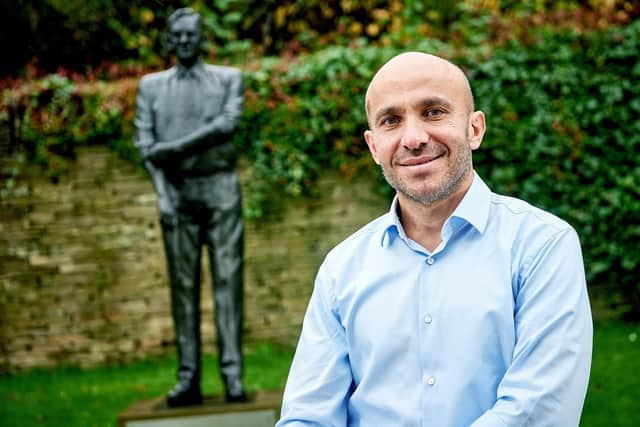
As you walk towards the entrance at Hilmore House, the head office of Morrisons, it’s impossible to escape the gaze of the man who transformed a tiny family business into the UK’s fourth largest food retailer. The statue of the late Sir Ken Morrison stands like a sentry near the front door of the business he led for more than 50 years. Appropriately, Sir Ken’s statue is rolling up its sleeve; reflecting a work ethic which is also the defining characteristic of Morrisons’ latest CEO, the former French Air Force Colonel, Rami Baitiéh.
Appropriately, Sir Ken’s statue is rolling up its sleeve; reflecting a work ethic which is also the defining characteristic of Morrisons’ latest CEO, the former French Air Force Colonel, Rami Baitiéh.
“I get very happy when the customers say to me,’ I used to shop with my parents when I was a kid at Morrisons,’’ said Mr Baitiéh, the former chief executive of Carrefour France, the multinational retail and wholesaling business, who took charge of Morrisons in November last year.
Sitting in the Morrisons’ boardroom, where Sir Ken’s photograph looms large on the wall, Mr Baitiéh is keen to highlight his profound respect for Sir Ken’s tenacity and vision. There’s a good reason that Morrisons is still going strong, 125 years after it was founded on a Bradford market stall. Mr Baitiéh aims to use data to drive the next phase of Morrisons’ growth, while honouring Sir Ken’s legacy.

“For me, it’s all about how robust this company is,’’ said Mr Baitiéh. “Today, our elderly customers say, ‘When we were kids we went shopping with our parents’. You don’t see this sort of relationship anywhere else in the country. The Morrisons’ name means the promise and guarantee of good quality. Today, we have 18 factories, we have our abattoirs, we work directly with 3,000 farmers, this is all the result of 125 years of experience. You can’t build it overnight.
“I admired Sir Ken at a personal level and at a professional level,’’ he added. “At a professional level, I believe he was a genius. He was also very brave because when you open 18 factories you take on a lot of risk. He was wealthy but his lifestyle was very humble.
“Sir Ken visited all the stores, everywhere. I will be the same,’’ he added. “He believed like me in entrepreneurship, accountability, the importance of details and training. He took time to train people. When I visit a store I will speak to the cashier, the butcher and the fishmonger and every time I try to give them some information and training. This is th e kind of mission I’ve given myself which is part of my personality.”
Which brings us to Mr Baitiéh’s vison for the future of Morrisons. Over the last eight months, he’s listened to customers, staff and suppliers and the insights from this exercise are helping to refine the pillars of his strategy: commercial excellence, operations optimisation and new value creation.
The US private equity firm Clayton, Dubilier & Rice snapped up Morrisons for around £7bn in 2022. Morrisons has seen its share of the UK grocery market decline in recent years as shoppers have increasingly moved towards discounter rivals during the cost of living crisis, with Aldi overtaking Morrisons as the UK’s fourth biggest grocer as a result.
Mr Baitiéh said it was clear that availability and the Morrisons’ loyalty scheme are two areas customers talk about the most and he is focusing on these areas. With the recent acquisition of 38 stores in the Channel Islands, there are now 1,600 Morrisons Daily convenience stores across the country, about two thirds of which are wholly owned by the business. With this “strong growth trajectory” Morrisons aims to have a total of 2,000 convenience stores in 2025. Mr Baitiéh said he was pleased with the overall performance of the business in the second quarter with supermarkets, convenience, wholesale and online all delivering growth and contributing to a 4.1 per cent increase in like-for-like sales.
“Commercial excellence for me is based on listening to customers,’’ he said. “I am ready to put all my knowledge and my time and my energy to achieve customer satisfaction. Operational optimisation is all about getting the best process in our stores and head office. It’s more about how you make the organisation lean, how to improve availability. Availability is criteria number one for British consumers.
“I have worked in seven different markets,’’ he said. “This is the first market where I have seen availability as the most important. That’s why I have executive level meetings about availability.”
“We asked all our cashiers to tell us what the customers tell them,’’ he added. “They are the colleagues who spend most time with the customers.
“So every week, on Monday, I’ve got a list of the five most frequent comments made by customers to our cashiers. In just one week, the cashiers recorded 1,500 comments from customers,’’ he added.
“So when, for example, customers complain about lack of availability, we ask the cashiers to ask the customer where these problems are exactly.”
This means that if, for example, a customer complains about the lack of availability of pet food, the cashiers are encouraged to ask them if this applies to specific pets.
“It’s granular, so we know exactly where we need to act,’’ he said. “This listening helps me as well. Rather than spreading my energy everywhere I know exactly where work needs to be done. The eyes are everywhere. I have ambassadors in the cashiers. And the cashiers don’t have any political reason not to tell me the truth. So they tell me. Sometimes, within companies the managers will not tell you everything. The CEO will only know 5 percent of the truth. That’s why I talk about the inverted pyramid which ensures more information from customers gets to senior management.
“We have had a roundtable and talked to 340,000 customers over the last few months and then you have 1,500 cashiers who provide you every week with the comments from customers. So my five percent of knowledge which comes from the official pipeline will become bigger.”
He said the data and feedback from customers and cashiers was helping to formulate strategy.
Mr Baitieh said his previous experience in the French air force also reflected his leadership philosophy. He added: “We say in the forces, for example, ‘Officers eat last’. First we think about our team. There’s this sense of being a giver. People who have been in the forces are givers; they have been willing to give their life in order to protect people. These values are based around respect and loving others. Courage is also very important.”
Above all, he loves to use data creatively while focusing on improving the shopper experience.
“I call it Ocado; O is observe, C is compare, A is analyse, D is diagnose, O is operate. I told that to the team at Ocado and they were very happy!” he joked.
“I look at the customers when I go to the store before I look at anything else. So when I see for example, an elderly person, struggling with the items in their basket, I say, ‘I need to bring them a trolley with wheels.’ If we see a customer holding two items or more in their hands, somebody will approach them politely and say, ‘May I offer you a basket?’
“The idea is driven by ease of shopping. It’s not to drive sales. We all know that ease of shopping indirectly drives sales. But that’s not the idea behind this.”
He also believes in tackling customer complaints head on.
“One unhappy customer leads to at least 10 unhappy customers,’’ he added. “We spend our first meeting of the week on Monday from 8am on the complaints.”
He’s also proud of the contribution from the manufacturing business which is spread across 18 sites. He is also aiming for a share of the online grocery market of 11 per cent, which is in line with Morrisons’ share of the high street grocery market.
“The manufacturing sites are our DNA,’’ he said. “I am not changing the DNA, I am shifting the culture. I need to shift the culture of the company towards more ownership and more accountability and to be a more data driven company.
“My role is to shift the culture but keep the DNA, that’s why, when we sold our petrol stations I asked to keep Morrisons name on the top of the petrol station forever. It’s a shift of culture without touching the DNA. That’s why I talk about the legacy of Sir Ken because it is vital to remind everyone that the DNA will not change. We are Morrisons, we are food makers, we provide good food that is affordable for everyone.
“This is the purpose and by doing our jobs well we are helping 3,000 farmers, supporting 110,000 jobs, we are helping 7m customers a week.
“We are being environmentally friendly and we are paying our taxes and helping charities and communities around the stores. We are training our team. This reflects Sir Ken’s commitment to Bradford. We are committed to the UK where the customers trust us.
“At the end of the day if you are a good retailer, the customer will give back to you and you can build a healthy and wealthy company. In our stores, my dream is to work on the macro space management, to make them easier places to shop and to drive more sales and more customer satisfaction.
“We also need to export our brands and products. We have started to sell our products in Spain and Asia and Dubai. Many British communities which have settled outside the UK trust these products. People in Gibraltar, for example, who shop at Morrisons there feel like they are shopping in the UK. We want to export goods and products to the world.”
He said Sir Terry Leahy, the former CEO of Tesco who is now chairman of Morrisons, had been acting as his mentor for the UK market.
He added: “Retail is not a straight line and sometimes you can feel a failure. He’s very supportive and a great mentor. Terry convinced me to take on the role. Terry will be the first mentor in our leadership school. That’s going to be a real game changer for our team. I have always been a disrupter; in crises there are opportunities. The more crises you face the more resilient you will become. When you see a very big problem you need to break it down step by step.”
A philosophy which would have probably found favour with Sir Ken, arguably the greatest corporate disrupter of them all.