
'Barking mad' to build solar farms on good agricultural land says North Yorkshire councillor

Government policy which encourages solar schemes on fertile agricultural land has been described as “barking mad” by a North Yorkshire councillor during talks on plans for a huge green energy development near Selby.
Councillor John McCartney went on to brand Energy Secretary Ed Miliband an “idiot” as North Yorkshire Council’s strategic planning committee met to discuss the authority’s response to the 500MW Light Valley Solar scheme.
Island Green Power UK Ltd is preparing a planning application for a network of seven solar farms on 1,020 hectares of land between the villages of Escrick, Monk Fryston, Hambleton, Chapel Haddlesey and South Milford.
Speaking about the plans, Councillor John McCartney, independent councillor for the Osgoldcross division, said: “My comment is that this entire policy is barking mad.
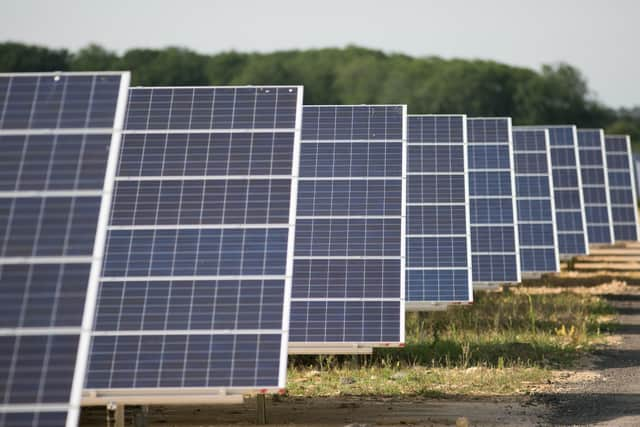

“We’re covering good agricultural land and yet in the Selby district we have Kellingley Colliery which is a huge site and they’re now putting storage and haulage on, huge, huge warehouses, but guess what, they don’t have any solar panels on the roofs — it’s insane.
“We should be putting solar panels on roofs. At this rate, we’re going to have a cultural crisis — the farmers will be stinking rich, but we’re not going to be able to grow our own food.
“This is in the Vale of York, which is meant to be very fertile, lots of vegetables, lots of stuff growing, but all we’re going to be growing is solar panels. Miliband is an idiot.”
The councillor said green energy schemes were being “dumped” on the Selby district rather than being spread across the county, with the area previously including Drax, Eggborough and Ferrybridge power stations.
“Basically, we’re becoming another power station made up of lots of solar panels,” he added.
Councillor Andy Brown, Green Party councillor for Aire Valley division, said there were some gains in the scheme.
But he added: “There are also some very significant losses that shouldn’t be underestimated.
“The gains are obviously 500kw of energy generation, but we’re losing a very large area of prime agricultural land and the cumulative impact on our rural community and rural landscape looks very significant.”
He added: “I’m not yet convinced that we’re going through out there the losses of the solar panels parts of the scheme.”
Cllr Brown also raised concerns that the land used for the solar scheme would be sprayed with glyphosate weedkiller.
The meeting also heard a call for sheep to be grazed amid the solar panels, if the scheme was approved.
The committee today (TUESDAY) gave officers the authority to submit a local impact report on the scheme and make other representations on behalf of the council.
In its response to the Preliminary Environmental Information Report (PEIR) prepared by the developer, the authority has already noted that a clear assessment of the impact on human health of aspects of the scheme had not been produced, as had been requested by the planning inspector, who will advise the Secretary of State on whether to give the go-ahead for the scheme.
If granted approval, Light Valley would be larger than the biggest solar scheme currently operational — Cleave Hill in Kent.
The developer says the scheme would provide enough power for 115,000 homes a year.