
Hundreds of Yorkshire patients cared for in hospital corridors every day
The NHS is publishing details of corridor care for the first time, with one expert saying they “confirm the scale of something that should never have been normalised”.

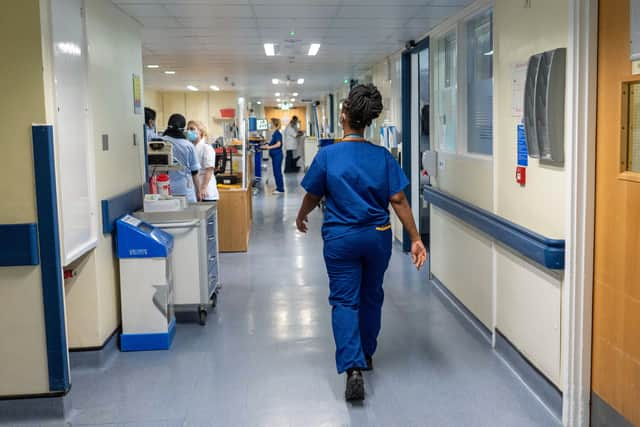
More than 300 patients every day were cared for in hospital corridors or makeshift treatment areas in Yorkshire and the North East last month, according to official data.
NHS England published figures for the first time on “corridor care”, with one expert saying they “confirm the scale of something that should never have been normalised in the NHS”.
A patient is classed as receiving corridor care if their treatment does not take place in a clinically appropriate and safe setting.
The criteria used for defining an appropriate setting includes things such as patients having privacy, access to food, water and toilets, and whether lights can be turned off and noise levels minimised to allow sleep.
Overall, there were an average of 275 instances each day in May of a patient receiving corridor care for more than 45 minutes at hospital A&E departments in Yorkshire and the North East.
This includes patients receiving treatment, or waiting for assessment, admission or transfer, but not delays involving ambulances handing over patients to A&E staff.

While not all NHS trusts submitted figures, in Yorkshire, Leeds Teaching Hospitals trust had the number of emergency patients being cared for in corridors at 51 - or 2.3 per cent of the national total - each day in May.
Mid Yorkshire Hospitals trust was slightly lower with 46 patients, which was 2.1 per cent of overall daily total.
There were a further 54 instances on average each day last month of patients receiving corridor care for more than 45 minutes inside hospital wards in the region.
This figure covers patients who are being treated within a ward but not in a designated bed space. It is based on a snapshot of patient numbers at 8am each morning.
Siva Anandaciva, director of policy, events and partnerships at the King’s Fund, said: “These figures confirm the scale of something that should never have been normalised in the NHS.
“Patients are routinely being treated in hospital corridors, without privacy or dignity. Pressure across the whole health and care system is spilling into A&E.
“The sheer scale of corridor care in the NHS is deeply concerning, equating to three in every 100 who attended an accident and emergency department every day.
“Despite the extraordinary efforts of staff, corridor care is one of the most visible signs of how patient safety and experience are being compromised in the NHS.
“It is distressing for staff when they cannot deliver the care they want for their patients and it is equally unacceptable when patients are left feeling forgotten and vulnerable at the time they most need to feel safe and cared for.”
Harrogate and Knaresborough MP Tom Gordon said: “The figures for Yorkshire and the North East make for grim reading - 1,682 incidents of corridor care in May alone, with an average of 54 patients a day receiving treatment in corridors.
“Behind every one of those numbers is a person who deserved proper care in a proper bed. This is the direct consequence of ministers failing to grip the social care crisis and invest in NHS capacity.
“The Lib Dems have set out a fully costed plan to end 12-hour waits and eliminate corridor care. It’s time the government stopped ignoring this scandal and started acting.”
It comes as the NHS waiting list for planned hospital treatment in England rose for the first time in six months.
An estimated 7.22m treatments were waiting to be carried out at the end of April, relating to 6.11 million patients.
This is up from 7.11m treatments and 6.02m patients at the end of March.
Health Secretary James Murray said: “Corridor care is unacceptable, undignified and has no place in our NHS.
“That is why, for the first time, we are publishing this data to shine a spotlight on where the problems are greatest and ensure trusts get the support they need, with the vast majority of corridor care concentrated in a small number of organisations.
“We have already deployed expert teams to help struggling trusts turn performance around.
“Ending corridor care for good will take time and different areas will need different solutions, but we are determined to eradicate this practice.”
Tim Hiles, chief operating officer at Leeds Teaching Hospitals NHS Trust, said: “We know that providing patient care in additional spaces is not acceptable, and we must continue working hard to make sure our patients receive care in the right environment. The safety, wellbeing, privacy and comfort of our patients remain our top priority.
“We use ‘corridor care’ when we have more patients needing hospital care than we have beds. These additional spaces include consultation rooms, day rooms and additional beds on wards.
“While waiting for a bed, we do put in place safety measures including a risk assessment of a patient’s condition, increasing wellbeing checks, providing call bells and setting up dignity screens. Any patient needing extra interventions or monitoring will not be placed in one of these areas.
Talib Yaseen, chief nursing officer at the Mid Yorkshire Teaching NHS Trust, added: “We fully acknowledge that too many of our patients are experiencing care in corridors and temporary escalation spaces in our emergency departments and medical wards.
“The reasons this happens are well known by now to most people using NHS services across the country: unprecedented demand and being unable to discharge patients quickly enough. But this is not an excuse: we are sorry to anyone who has experienced corridor care at Mid Yorkshire.
“We also know that explanations and apologies are not enough. Patients rightly expect action, which is why we are publicly committing to eradicating corridor care across Mid Yorkshire.
“While there are no quick fixes, we are already taking steps to improve discharge processes, reconfigure emergency department spaces at Pinderfields and introduce new models of care for frail and elderly patients.
“We are also expanding our Hospital at Home service, introducing real-time digital bed management systems, and investing £9m in a new acute receiving unit at Pinderfields Hospital, due to open in December.”