
'I suffered a life-changing spinal injury and created the Cool Crutches business with my mum - Victoria Beckham has used our products'
It has been nearly 20 years now but Amelia Peckham has never forgotten the words that doctors used to describe her injuries after a life-changing quad bike accident.

“They said when they’d done an MRI (scan) that it looked like someone had taken a hammer to a meringue,” the now 38-year-old says. “So that was a bit of a shock.”
They were referring to her spine. “The idea was to stick the vertebrae back together and when they said about the meringue, (I remember thinking) that doesn’t sound like something that’s fixable.”
Amelia had lost all feeling and movement from her waist down and at first it was uncertain whether or not she would walk again. What followed, in that first year in particular, was an arduous journey, with her heartbroken mother Clare Braddell by her side.
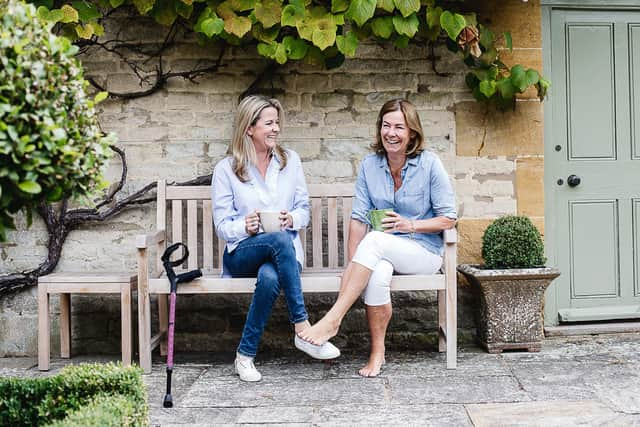

Inspired by Amelia’s experiences, the mum and daughter duo set off on a path to creating “comfortable, silent and safe mobility aids”.
Now, two decades on from the accident, their business Cool Crutches and Walking Sticks has amassed a community of tens of thousands of people - the majority of whom are living with long-term conditions and disabilities.
“Everything we’ve solved has been as a result of a problem I’ve faced,” reflects Amelia, who lives in Ripley, North Yorkshire. “I think we’re also the only walking aid company where the founder uses a walking aid…and that’s where unintentionally we’ve differentiated ourselves from everyone in the market.”
Amelia was 19 and in her second year of study at the University of Edinburgh when she embarked on a weekend getaway with friends that would change the course of her life forever.
Confident, outgoing and embracing adventure, she was exploring a remote area of Scotland by quad bike when tragedy struck.
Amelia hit a pothole causing the quad to flip and slide towards the edge of a cliff. She jumped off and began rolling, but her hips became wedged on a rock.
Looking back to that day in 2005, Amelia says: “I knew I’d done something bad but I thought I’d broken both of my feet…I asked my friend to take my boots off and she said ‘you’re not wearing any boots’ and at that point I was like I can’t feel my legs.”
Amelia was taken by air ambulance to the emergency department of Dumfries hospital and then transferred to a spinal unit in Glasgow.
Her parents travelled up from their home in the Cotswolds. “I remember a doctor saying she will walk but she will need aid forever,” Clare says, recalling the shock. “It had never crossed our minds that she wouldn’t walk. We hadn’t even considered a wheelchair or anything like that.”
It was unclear at this point what the long-term impact would be. It took several weeks for the swelling to reduce enough for Amelia to undergo spinal surgery at Stoke Mandeville Hospital. Then it was slow and painful progress towards getting back on her feet - and she remained in hospital for nearing five months.
“The whole thing is a time bomb,” Amelia says. “They say in the first three months you’ll have a pretty good indication of what you’re going to get back and by the end of the first six months, that’s pretty much it I think.”
“I thought I’d have my operation, have maybe a week in bed, get out, get into a wheelchair and that would be the beginning of go go go,” she adds.
The reality, however, was that Amelia had been laid flat and immobile in bed for weeks, completely reliant on those around her.
“I always tried to keep a brave face during the day but sobbed most nights,” she shares. She was fearful for her independence, and the pressure that would put on her parents
“The idea of not being able to look after myself or do anything alone safely haunted me. For the first six months, it was a case of trying not to focus on the future but just the minute, hour, or day in front of me.
“The truth is it was terrifying not knowing whether I would be able to go to the bathroom on my own let alone move, live, travel, work - everything about the future was by no means guaranteed, and that in itself was terrifying.”
It took time to get Amelia upright again, with standing frames and walking bars, before even attempting crutches.
“I was so knackered by that point (of getting crutches). I just wanted to get moving because the minute I was out of bed, upright and mobile was when it would become clear whether or not I’d be able to be independent.”
She says she had no power or strength in her legs, just numbness and pins and needles. But Amelia was keen on using crutches rather than a wheelchair for any distance that she could manage.
Sadly, the crutches led to pain and infected blistering on her hands and it was suggested to Amelia that she used a wheelchair until she was further along in her recovery.
“It kind of broke me,” she says. “And that was when mum was like no, we are not giving up. You can’t be told you’re not going to walk because your hands are a problem…We just need to find crutches that aren’t going to hurt your hands and we’re back on. I was just like I can’t, I have nothing left. Mum was like I can.”
The seed was sown for what would later grow into the pair’s walking aid business. Clare attended medical exhibitions and trade shows in the UK and overseas to see what was available. She wanted her daughter, and others in a similar position, to have more choice when it came to walking aids and equipment.
Clare says: “The problem with the NHS crutches is they are really clunky, they make a noise, they are grey and they are not yielding on your hands, they’re quite hard. Also they click. I think the worst thing about having an accident like this or a long-term disability is that you lose your privacy because you can’t do stuff yourself. And if someone is coming along the corridor needing the loo badly and is click clicking, it’s horrid. You don’t want people to know what you’re doing all the time.”
“You should be given something that fits with you and your personality,” Amelia adds. “I did not want to be seen, I didn’t want to be heard, I didn’t want to talk about my accident or have people ask me what had happened to my legs. I just wanted to get on with it quietly.”
She met others on her journey who spoke about walking aids being “like shoes”. They wanted choice - and personality.
In September 2006, Clare and Amelia registered the company, just shy of a year after the accident. It would be another couple of years before they were ready to market their first products but they had a clear vision now for customisable coloured and patterned but medical crutches. So they began working with a factory in Europe to bring that vision to life.
“There was nothing on the market that ticked all the boxes,” Clare claims. “Either (the crutches) were designed brilliantly but enormous and hideous or they were trying to be pretty but medically basic in functionality.”
During this time, the pair were inundated with phone calls and messages checking in on Amelia’s recovery. “Could I feel my feet, legs, knees? Could I sit up? Stand up? Walk? Would I be able to live on my own again? Go back to uni? Get a boyfriend? Have kids? It was a relentless reminder of the negative: what we didn’t have and what we may never get back,” Amelia shares.
Clare realised that starting a business would give them a focus and a distraction. It would also help her daughter to ease back into day-to-day life. From attending in-person meetings with website designers to driving with an adapted car and applying for a blue badge, Amelia started to gain back some independence. She left hospital and went back to live with her parents.
“Had we not had this (to focus on), there would have been very little light at the end of the tunnel,” Amelia reflects. “We made what would have been a really hideous year productive.”
“There was always that pressure of the future,” continues Amelia, who had wanted to work in advertising. “This meant mum had created something that I could do, I could earn a living from, we hoped. It was an opportunity as much as it was a product.”
They set up the company how an e-commerce business would be set up today. “The way it was set up in hindsight, was for success, but it wasn’t intentional,” Amelia says. “We didn’t know the online world would explode and that social media was going to be the next big thing. We had created a business that was accessible for the people running it and that happened to be beneficial for everybody.”
After finishing university and then working in several jobs in London for ten years, Amelia began to focus on the business full-time in 2021. She can now walk with just one crutch and on some days, can use a walking stick for shorter distances.
In 2019, she and Clare launched walking sticks in the business and they now also do children’s crutches, as well as a range of accessories including rubber tips, soft grips and extra-wide cuffs. Clare focuses primarily on bespoke designs.
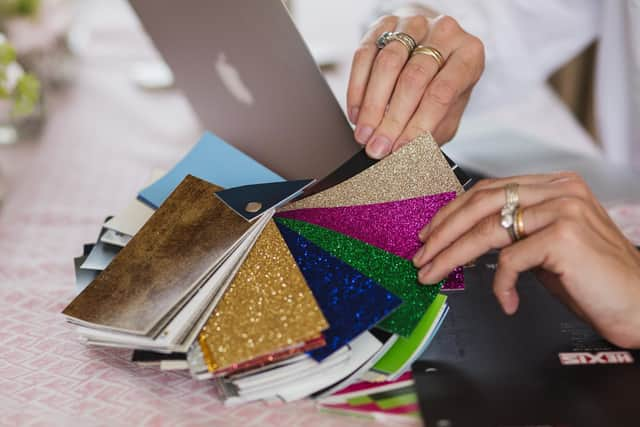
“It’s an amazing part of the business that’s probably the biggest USP that you can literally have anything on your crutches or walking stick,” she says.
Their products have caught the eyes of celebrities including Prue Leith, Amanda Holden, Olly Murs and Eamonn Holmes, who have all used Cool Crutches.
“Then Victoria Beckham was the first one who just ordered,” Amelia says. “No PR, no me messaging on Instagram, she just ordered them, wanted them and wore them. That has to be the most ‘you’ve done it’ moment.
The mum-and-daughter duo have now built a thriving business, that’s for sure, but more than that they are passionate about what they do, understanding first-hand the impact that disability and serious injuries can have on both physical and mental health.
“The whole ethos of the business is that you should never be about looking at what you’ve lost, what you can’t do, everything that’s negative, which was the default when it came to disability in 2005,” Amelia says. “We have flipped that entire narrative to being here’s what you can have, here are your options, here’s what you can do with them. Go, live your life...That whole flip in mentality has totally transformed my life and in being able to communicate that has transformed hundreds of other people’s lives too.”
Visit www.coolcrutches.com