
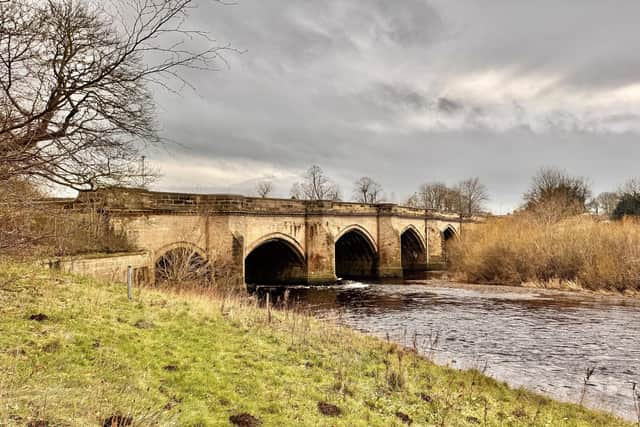
Croft Bridge: The historic bridge which is the traditional boundary between Yorkshire and Durham
The boundary between Yorkshire and County Durham was first established by the Vikings, who divided their Kingdom of York into the three ancient Ridings.
The 85-mile-long River Tees, flowing from its source in wild Pennine hill country eastwards to the North Sea, formed a natural dividing line and in some areas remains the border between today’s administrative areas of North Yorkshire and County Durham.
At one such location Croft Bridge fords the river just a few miles south of Darlington.
Built around 1356, for centuries it served as the main north-south crossing on the River Tees until Blackwell Bridge was built further upstream in 1832.

Before the construction of the A1(M) motorway it was a branch of the Great North Road, the historic medieval highway carrying mail coaches between London and Edinburgh.
In December 1569 Croft Bridge was the scene of a major incident during the Rising of the North, an unsuccessful attempt by Catholic nobles in Northern England to depose Elizabeth I and replace her with Mary Queen of Scots.
Two southern noblemen loyal to Elizabeth led forces over the bridge and forced the rebels to retreat.
Flooding has caused much damage over the years, the most serious being in 1822 when it became submerged.
As a result the maintenance of the 330-foot-long bridge was a bone of contention between those living on either bank.
In recent times this divide was shown by the North Riding registering the Yorkshire side as a Grade I listed structure in 1951, and Co. Durham not listing its portion until 1967.
Today the bridge is setting for an ancient ceremony.
When a new Bishop of Durham is elevated it is customary for he or she to be greeted at the bridge by the Mayor Darlington and, as a symbol of loyalty, presented with a curved sword known as a falchion.