
Graham Ibbeson goes back to his coal mining roots with new sculpture trail
Renowned sculptor Graham Ibbeson is returning to his roots with a new sculpture trail at the National Coal Mining Museum. “My mining history goes back 170 years,” he says. “I am the son of a Barnsley miner and the grandson of a Barnsley miner and right the way back. To me the museum is the ideal place for my sculptures – it is part of my heritage. It’s like coming home.”

From Coal Queens to Comedy Kings: The Sculptures of Graham Ibbeson, runs until Sunday, 7 September at the Wakefield museum and is a unique trail that spans the museums indoor and outdoor spaces. It offers a fascinating journey through important moments in mining history while celebrating beloved performers all through the work of world Ibbeson.
“My maternal grandfather came down from the North East to Grimethorpe near Barnsley as a miner. I was brought up in a council house in Shafton over the hill from where my old man worked. I grew up in the heart of the coal mining community,” says Ibbeson.
“I’ve done monuments to my comic heroes, but also memorials to my personal heroes.”
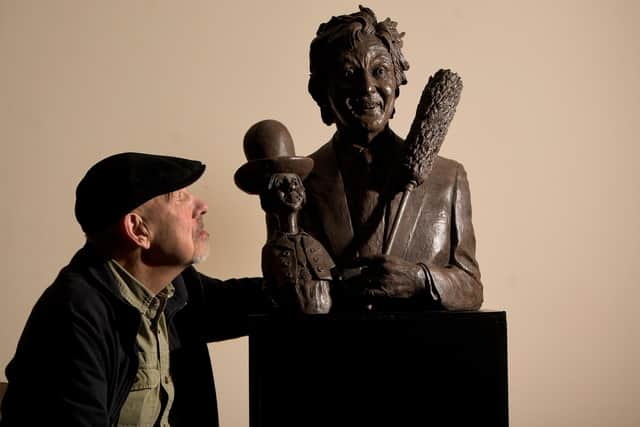

Ibbeson may be best known for his comedic sculptures such as Eric Morecambe, Laurel & Hardy, and Ken Dodd, all of which have connections to coal mining and form part of the trail – but he has also done 11 coal mining monuments around the country.
Laurel and Hardy did a film called the Miner, Eric Morecambe was Bevan Boy, Ken Dodd's father was a coal merchant and he helped him out, Benny Hill’s first job was working for a coal company – they all have links to the coal industry. It is the first time that Ibbeson’s comedic sculptures and memorials have been seen together.
It is this juxtaposition between his comic heroes and memorials to disasters that really make the visitors stop and think.
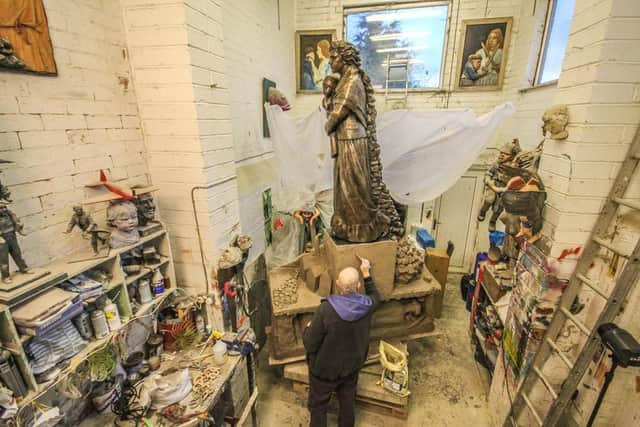
While exploring the trail, which is free to enter, visitors will see the poignant Coal Widow, the Oaks Disaster, 1866, Memorial, on loan from the National Union of Mineworkers and other memorials linked to the coal industry.

Deeply personal to Ibbeson the sculpture is dedicated to the 361 miners and rescuers killed in the Oaks Colliery disaster of 1866. It was England’s worst mining disaster and Ibbeson’s great-uncle George Ibbeson was among the victims – although he didn't know that until he was approached by the NUM to create the memorial which was unveiled in 2017.
“The model for the widow featured in the Oaks Memorial is a cross between my daughter and my wife,” he says. “My wife often had to model for me – she even modelled for Eric Morecambe doing the ‘Sunshine’ dance and Benny Hill.”
"It’s never been linked together and is part if my character - I like to use humour to reflect the hardships of life but also to draw people in.”
Ibbeson is one of Yorkshire’s best-loved sculptors and artists, whose work can be found not only in the county, but around the world. Not that being an artist was a likely job option for a lad growing up in Barnsley in the ‘60s.
“I became an electrical apprentice for the National Coal Board when I left school, but then I started recognising girls and so I thought I’d go to art college where there would be more girls – it worked for John Lennon.” It must have worked as he was marred at 17 and has been married to Carol for more than 50 years and they have three grown up children.
He then thought he better get a ‘proper’ job for a couple of years, although he returned to art school in 1970 getting a degree in Fine Art and a MA in Sculpture from the Royal College of Art after a Polish lecturer recognised that all his drawings were leading to him making sculpture. “I just tried it and I found I could express myself. I was expressing in something real, I was working in 3D and then I started scaling things up to lifesize."
Depending on what he makes his sculptures out of they can take months to make.
"If it’s in bronze it can take up to nine months,” he says. “Fibre glass is a couple of months, in plaster I can put a lifesize figure up in a day. If it’s lifesize it immediately gets the attention. I am also a narrative sculptor – you can’t tell a human story without human in it.”
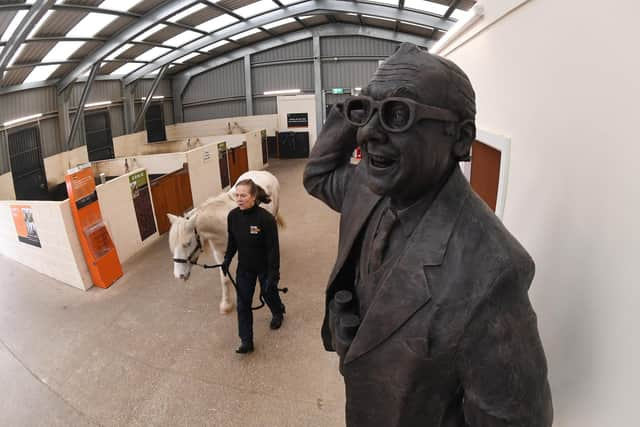
Ibbeson says he doesn’t really like his work to be called statues as that implies something static whereas he tried to breath life into his sculptures and give them movement – like the one of Eric Morecambe.
He returned north and took up teaching roles in Leeds and Manchester, international exhibitions and acclaim, and back to a studio in Barnsley.
His work was soon being promoted in some of London’s best galleries and at European art fairs and then he started to get commissioned to create public works of art. “I’ve been paid to make sculptures of my heroes.”
But it isn’t just famous people, he says. “I’ve also put a lot of ordinary people who have done extraordinary things on pedestals.” He did the Covid memorial in Barnsley.
Having moved to the capital, he returned to Barnsley in 1978 where he and his wife have been ever since.
His home town also has two of his best known statues. One is of his friend Dickie Bird, another of Barnsley’s famous sons. It depicts Dickie in familiar pose with a finger raised to give a batsman out. The second is Hoyland-born author Barry Hines. It isn’t a sculpture of him but arguably his most famous character, Billy Casper, the schoolboy from his novel A Kestrel For a Knave.

But his passion is to make art accessible.
"It’s great having it here,” says Ibbeson. “This is a National Museum – a national museum to my heritage. I have fought all my life to make art accessible. This is a great way of taking art to the people art rather than them having to go to a gallery which they might not think is for them.”
The trail has come together to coincide with the closure of the deep mine to the public.
Alison Cooper the museum’s Collections Engagement Manager explains: “Between January and March the underground deep mine will be closed because we are having the winding machinery dismantled and replaced with some new more efficient machinery. While this unique experience is closed we wanted to bring another unique experience to visitors and Graham’s mining related sculptures are a wonderful way to do that.” There will also be a programme of events to coincide with the sculpture trails which runs throughout the museum's internal and external areas. "We want people to see that there is so much more here than just the underground experience.”
As well as being able to look at the sculptures visitors will be able to hear Ibbeson talking about them in his own words with an audio guide that people can access via a free app on their own phones.
Sculptures will be found across the Museum including gallery spaces, buildings, café and even the pony stables. Visitors are encouraged to get involved by striking the famous poses of some of the iconic characters and sharing their experiences on social media using the hashtag #CoalQueensComedyKings
Visit www.ncm.org.uk for more details.