
"How I turned sharpening my kitchen knives into a successful business," says Gareth Heaton of Community Cutlery
Gareth Heaton is on a mission – to get the country sharpening their knives and garden tools rather than throwing them away. The professional knife sharpener and man behind Ilkley shop Community Cutlery has written a book, which he will talk about at the town’s literature festival today.
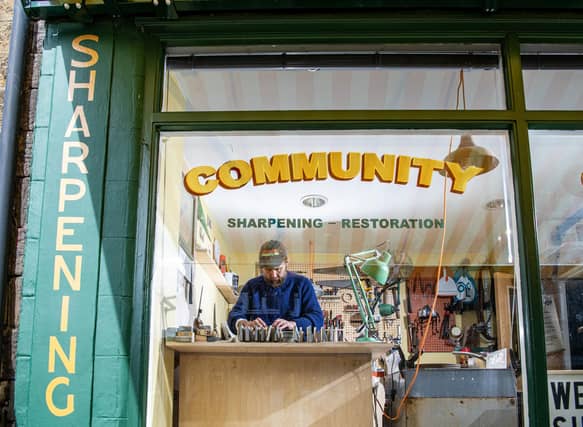


It was while working as a gardener that Gareth, known as Gaz, had something of an epiphany.
“I always used to maintain my own knives, but now I know I wasn’t doing a very good job of it,” says Gaz. Then one day while mowing someone’s lawn and listening to a podcast, he had a lightbulb moment.
“The podcast was called the Side Hustle Project, and the guest was a bloke from America who had just left the military and started a knife-sharpening business. It just struck a chord with me. I thought there must be a lot of knives out there that need sharpening. And I was right.”
Gav did a lot of research into how to sharpen knives – and admits there was a bit of trial and error. “There is a lot of information out there on the likes of YouTube, but not all of it is good.”
It coincided with Gav giving up drinking. “I used to spend Friday nights out drinking and then Saturdays recovering. When I decided to give up drinking, I suddenly had all this time on my hands, and so I used that time to learn this new skill.”
Initially, he just sharpened his own knives and then for friends and family for free.
The lockdown happened, and Gaz saw an opportunity.

“People were at home more, cooking more, and therefore using their knives more. I had some flyers printed and put them through people’s doors, and people took to it really quickly.” When someone got in touch with him, Gaz gave them a combination code to a padlock on his out-house and instructions on how to drop them off.
“I’d then sharpen their knife at home before placing it back in the box for collection. It worked perfectly and I gradually began to build up my customer base.”
It became so popular that he started to reduce the days he spent gardening. He also decided to buy some quality knives to sell and posted them on social media.
“We had socially distanced queues down the back alley coming into the garden one at a time, buying knives from a little table by our back door, and we pretty much sold out on the first day.”

As demand grew, Gaz and his partner Georgina bought more stock and held a number of pop-ups and markets as lockdown rules eased.
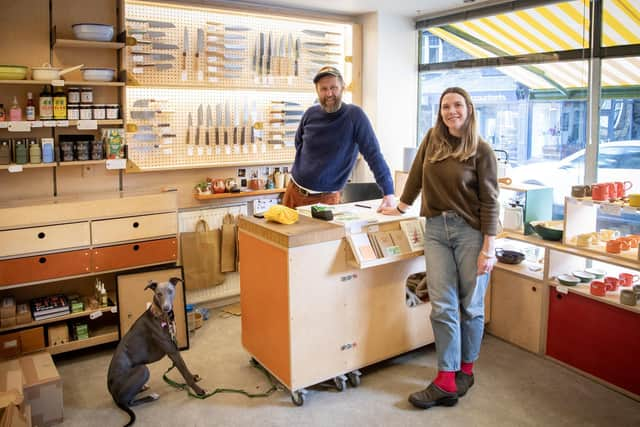
Then in 2021, they decided to take the plunge and bought a shop in Ilkley... and Community Cutlery was born.
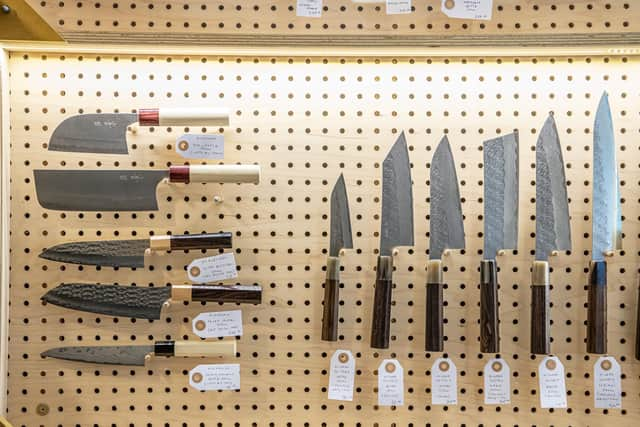
“To start with, we just had one side of the shop where we did the knife sharpening and sold the kitchenware from a handful of suppliers in the UK, Japan, Germany, Spain and France,” says Gaz.
Five years on, they now have the shop next door, which is entirely retail – full of kitchenware and knives which are all aesthetically pleasing but also entirely functional. Across the small entrance, there is Gaz’s knife-sharpening workshop.
Gaz has spent a lot of time working out why people don’t get their knives sharpened and has come up with three explanations.
“There are those who simply don’t know about knife sharpening – it has never crossed their minds that you can even sharpen a knife. They buy them for £3 online, including shipping and throw them away when they go blunt; they just buy a new one,” says Gaz.
“Then there are those who are aware but financially it just isn’t a priority, and there are those who are aware of knife sharpening, can afford it, but they just forget to do it.”
In a bid to pass on his knowledge to others, Gaz holds regular knife-sharpening workshops and has now published a book ‘Do/Maintain/How to sharpen knives, scissors and garden tools’ where he gives step-by-step instructions on how to correctly sharpen your knives and tools.
“I believe it’s something we should all learn to do, and I am passionate about getting as many people as possible sharpening and properly looking after their tools and utensils. It makes such a difference – it makes cooking easier, quicker and more enjoyable.
“But people need a constant reminder. There used to be a time when a man would go around in a van with a grinding wheel in the back and stop and sharpen people’s knives. That doesn’t happen any more, and so people need to be constantly reminded or they will forget.”
Although Gaz says he can sharpen the cheap knives from China, he admits they don’t stay sharp long.
“The better the quality of the steel, the longer it is likely to stay sharp,” he says. “But it doesn’t matter what you paid for it. If it’s the knife you use, no matter what you paid for it, then it is worth getting it sharpened.”
Also, the chopping board you use is a factor in how long your knives will stay sharp.
“If you’ve got a cheap knife and you use it every day on a glass chopping board, it will lose its edge very quickly. If you have a good quality knife on an end grain board (he sells them – made in Harrogate), then it will last a lot longer – there are a lot of factors that influence how long a knife stays sharp.”
But it isn’t just knives that can be sharpened.
“Scissors are worth sharpening,” says Gaz. “People replace scissors more often than knives. We also sharpen a lot of garden tools – secateurs, loppers, but not saws or cylinder lawn mower blades, but we do sharpen almost everything else.”
And he believes there is a real appetite for people wanting to learn the skill themselves.
“Ever since we opened the shop, we’ve had a steady stream of people coming in wanting to learn how to sharpen their own knives. It’s a skill that people know isn’t complicated, and they want to do and feel they should be able to do. And whilst they’ve tried, they’ve not got the results they want, but by breaking it down in a few simple steps, you make it almost impossible not to get your knife sharpened.”
Gaz says his weekly classes are always sold out, but he is not worried about doing himself out of business. “To be honest, the people who come to my workshops and are keen to learn are probably not the people who would bring their knives to me to sharpen, as they want to do it themselves.”
And he says you really don’t need a lot of equipment to sharpen your own knives.
“You need a combination wet stone, a strop – used to maintain your knife after you’ve sharpened it, and that’s it, and a way to keep your stone flat.”
Gaz says there is something very mindful about learning to sharpen.
“I advise people to put their phone away and do it without any distractions and focus their attention, and the result is that it can be very relaxing.”
Gareth Heaton is at Ilkley Literature Festival today www.ilkleyliteraturefestival.org.uk
Do/Maintain/How to sharpen knives, scissors and garden tools by Gareth Heaton, published by the Do Book Company £11.99