
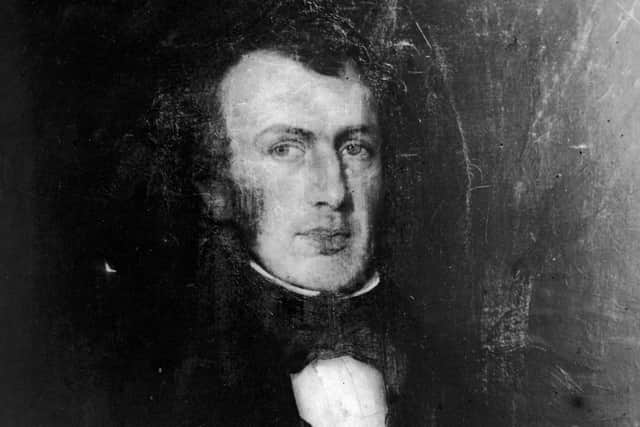
Joseph Hansom: The Yorkshire architect who invented the Hansom cab in 1843 - a horse-drawn vehicle that was commonly used in cities worldwide during the Victorian era including the US

Joseph Hansom was an architect from Yorkshire who invented the Hansom cab in 1843 which was an early transportation vehicle in the form of a two-wheeled horse-drawn carriage.
The architect was born in Micklegate, York, and was the son of a builder.
He worked predominantly in the Gothic Revival style and founded the architectural journal The Builder in 1843 - the same year he invented the two-wheeled horse-drawn carriage.
The vehicle was created and tested in Hinckley and it was originally called the Hansom safety cab.

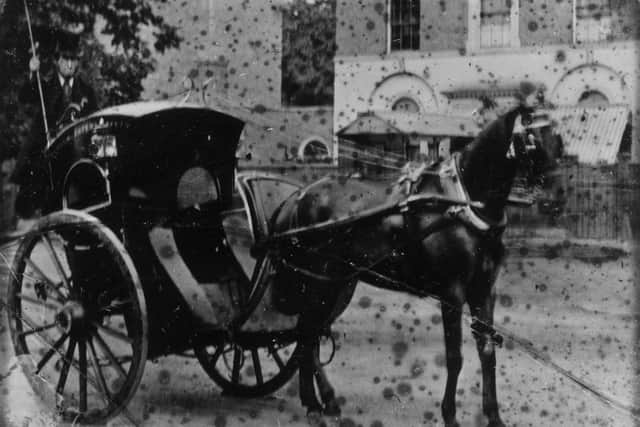
It was designed by Joseph to combine speed with safety, with a low centre of gravity for safe cornering. In the original design, the driver sat on the front centre of the roof, the wheels were 7ft 6in tall, the same height as the roof, and there were two stub axles.
It became a popular mode of transport during the Victorian era worldwide including in US cities such as New York City and Chicago.
Career of Joseph Aloysius Hansom
Joseph was born in the parish of St Martin’s in York, to a large Roman Catholic family and was the brother of the architect Charles Francis Hansom and the uncle of Edward J. Hansom.
His first apprenticeship was with his father, Henry, as a joiner, but he exhibited an early aptitude for draughtmanship and construction.
Joseph’s apprenticeship was transferred to a York architect named Matthew Philips, without informing the City of York.
By around 1823 he had completed his apprenticeship and became a clerk in Philips’ office.
In 1825, he moved to Halifax, where he married Hannah Glover, the elder sister of the architect George Glover, at St Michael le Belfrey in York.
He took a job as assistant to John Oates and there befriended the brothers John and Edward Welch, who he formed his first architectural partnership with (Hansom and Welch) in 1828.
Together they designed several churches in Yorkshire and Liverpool as well as working on the renovation of Bodelwyddan Castle in Denbighshire and King William’s College in the Isle of Man.
Their designs for Birmingham Town Hall in 1831 were accepted, however, the contract resulted in their bankruptcy, as they had stood up for the builders. This led to the dissolution of the partnership.
Joseph supported the views of social reformers Robert Owen and Thomas Attwood, and the Operative Builders Union, which was formed in 1831/1833, which led to some seeing him as a socialist.
Joseph Hansom’s invention of the Hansom safety cab
He registered the design of a ‘Patent Safety Cab’ in December 1834, following a suggestion from his employer.
Safety feature characteristics included a suspended axle, while the larger wheels of the cab resulted in less damage and fewer accidents.
He sold the patent to a company for £10,000, however, as a result of the purchaser’s financial challenges, the sum was never paid.
The first Hansom Cab was driven down Hinckley’s Coventry Road in 1835 and the cab was approved by subsequent modifications and exported worldwide to become a ubiquitous feature of the 19th century street scene.
In 1843 Hansom founded a new architectural journal known as The Builder, another venture which continues to run to this day and was renamed Building in 1966. Due to not profiting from the venture, neither he nor his partner Alfred Bartholomew were compelled to retire.
From 1854 to 1879, Hansom dedicated himself to architecture, designing and erecting a number of significant buildings, private and public, including numerous churches, schools and convents for the Roman Catholic Church.
His building designs are found all over the UK, as well as Australia and South America.