
Mystery over five names missing from Yorkshire memorial

Why five names were left off Hovingham’s war memorial is a question perplexing the local branch of the Royal British Legion.
The reason why the names of the soldiers who were killed in the First World War were omitted is unknown.
It seems that the village, despite being a close-knit community of around 600, did not act in unison when the original memorial was established in 1920.
“Not all families agreed with what they saw as glorification of personal tragedy,” said Stuart Dean, chairman of Hovingham Royal British Legion.
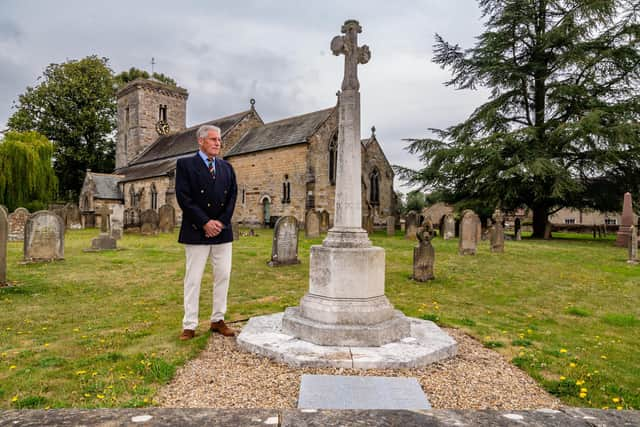

“So we are appealing for any surviving relatives to let us know their feelings before proceeding with plans to add the missing names.”
War memorials were not universally popular as it was felt they glossed over the horrors of the conflict and served to justify nationalistic sacrifices that many grieving families questioned.
Cash-strapped towns argued over whether to spend scarce funds on statues or living memorials such as community halls, hospitals, or homes for disabled veterans.
The missing names came to light when a parish councillor started researching records online.
Since the name of one of them – Cyril Judson – was added to a new stone, which was made in 2016 to go in front of the memorial, some of whose inscriptions had become illegible, after villagers raised £1,800.
His niece laid a wreath for him on that Remembrance Sunday. Cyril’s death in 1919 from illness was believed to have been too late to be included on the original memorial.
Frank Parker, a Private in the West Yorkshire Regiment, died on September 27, 1915, and is listed at the Loos Memorial, in northern France, which commemorates over 20,000 men, with no known grave.
William Sadler, was a Corporal of Horse in the Household Battalion who died on April 19, 1917, aged 24.
Arthur Sanderson, who died on September 22, 1917, is commemorated at Tyne Cott, one of four memorials to the missing in Belgian Flanders, which cover the area known as the Ypres Salient. John Carruthers, 18, a Private in the Sherwood Foresters, died on April 15, 1918.
Nearly 30 per cent of the men – there were 75 in total – who went off to war did not make it home.
Mr Dean recalls Harry Patch, the last surviving soldier to have fought in the trenches, who famously declared war as “a licence to go out and murder”.
He said: “We had the 110th anniversary of the Battle of the Somme in July. Fifty-five thousand died on the first day – that’s the equivalent of the population of Ilkley.
“I think after the war people didn’t want to recognise it or remember it.
“We want to ask if relatives are happy for the names to go on the memorial. If not it’s fine.”
Mr Dean can be contacted at [email protected].