
Humanist celebrants in Yorkshire share hopes as wedding law reform consultation winds up

Humanist celebrants have shared their hope that they could soon be presiding over legally-binding marriages across Yorkshire.
The Government’s proposals on wedding reforms – for which a public consultation closes on Thursday this week – would give Humanist ceremonies in England and Wales legal recognition, a status they already have in Scotland and Northern Ireland
A humanist wedding is a non-religious ceremony conducted by a professionally trained, accredited celebrant who shares the couple’s values. Every ceremony is written from scratch with the couple and can happen anywhere meaningful to them.
Humanist Ceremonies, part of the charity Humanists UK, have been conducted for more than 130 years, and thousands a year already choose one in England and Wales. But those couples also have to go to the registry office for a civil ceremony too, whereas a Church of England wedding, for example, is legally recognised during the ceremony itself.
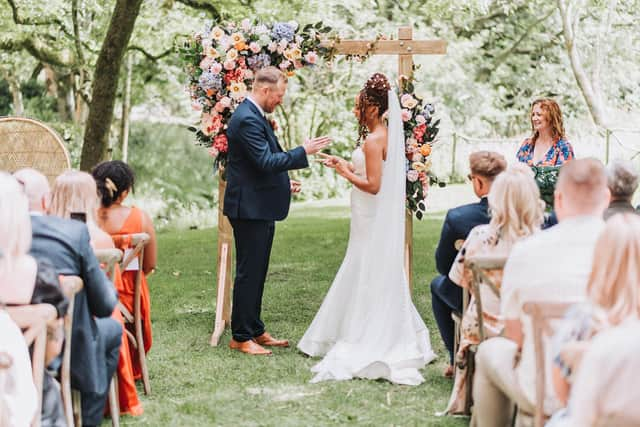

Leeds-based humanist celebrant Helen Phillips recently conducted her 100th ceremony, “a wonderful Lithuanian-British wedding and I loved that we were able to incorporate rituals and traditions from both cultures into something that was special and significant. Every single one of my ceremonies is different and created with that specific couple in mind. Crafting completely unique ceremonies that are meaningful and memorable for each couple is what I love the most about my role as a humanist celebrant.”
“With legal recognition for humanist ceremonies, couples that are looking for something that is more personal and reflective of who they are will be able to have access to a non-religious ceremony that is aligned to their values, conducted by someone who shares these values, without all the extra inconvenience and expense of having to register their legal marriage separately.”
That, she says, also “creates this awkward division between that legal marriage ceremony and their wedding day”.
She says: “Sometimes people can get a little bit upset if they're not invited to that legal ceremony, even though they might be only having the statutory two witnesses. You might just be choosing one set of parents, but then you choose one set of parents over the other, or you're choosing your siblings over your friends, and it can create a bit of division and a bit of friction.
"It also then creates this thing where some people might refer to the wedding day – which the couple themselves feel is the most important moment, it’s the most meaningful to them, it's their humanist ceremony, it's aligned with their values, it's conducted by someone who's aligned in those same values – and then their guests, their relatives, might be saying, ‘Oh, this is the fake wedding’ or the ‘fake ceremony’.”
That is unfair, says Helen, because it “deflects from you know the joy that that couple are feeling on the day. So if they can just do everything together, then it puts them on the same footing as religious couples who can go and marry.”
Humanist weddings became legally recognised in Scotland in 2005, and Northern Ireland followed in 2018 after a court case.
Celia Hickson, humanist celebrant in Shipley, West Yorkshire said: “The recognition of humanist marriage would mean that couples can be truly themselves during their wedding ceremony and not have to conform to the constrictions of the current legal process to becoming married. They can have a truly meaningful and personal wedding ceremony that honours them, their families, their cultures and traditions whilst representing who they are and what they want their marriage to be.”
Rachael Bowers, humanist celebrant in York, added: “In my six years as a humanist wedding celebrant, I have stood by couples' sides during the most joyful, intimate and important moments of their lives. When I tell their story on their wedding day and explain what love and marriage mean to the couple, I can see them radiating with love and pride!
“Sadly, many of them experience friction with more traditional family members who feel 'left out' of their 'real' ceremony, i.e. when they signed a piece of paper. Being able to bring together the legal ceremony with a meaningful, humanist ceremony would remove this friction.”
The Government says it wants to make it easier for couples to get married, making the law “clearer and fairer with the same kinds of rules for different religions and types of weddings” and to “give people more choice in how they get married, no matter what religion or belief they follow.”
It follows the Law Commission’s 2022 report on weddings law and the government’s announcement in October 2025 of its intention to modernise wedding law.
Current weddings law is still built on rules dating back to the 18th and 19th centuries.
And while the Anglican, Jewish and Quaker faiths each have their own legal framework, every other religious group must fit within a single set of rules, which “often fail to reflect their traditions,” says the Government’s consultation foreword.
Civil weddings are governed by another set of rules altogether and non-religious belief organisations, including Humanists, cannot conduct legally -binding weddings at all.
Andrew Copson, Chief Executive of Humanists UK, said: “Humanist weddings have transformed how people marry in Scotland and Northern Ireland, by allowing non-religious couples to have meaningful ceremonies true to their beliefs. Couples in Yorkshire have waited long enough for the same right. Recognition is now within touching distance, and when it comes, celebrants like Helen, Celia, and Rachel will be ready.”
The Government’s consultation on wedding law reform closes on Thursday, September 24.
To share your views, visit: https://www.gov.uk/government/consultations/tying-the-knot-reforming-weddings-law-in-england-and-wales