
Fresh ideas on how brownfield funding could save Yorkshire's green fields
The Labour government has committed to delivering 1.5m homes over the next five years, which will include significantly boosting the number of social and affordable housing.

That new, more energy efficient homes are needed is indisputable but the construction commitment has sparked fears that green belt land will be gobbled up in order to meet mandatory house building targets, which is why the Prime Minister has stressed that local authorities must have a brownfield first planning policy.
A brownfield site refers to previously developed land that is poor quality and no longer in use. Old industrial estates, factories and smaller disused sites in towns and inner cities are examples.
Those who have been in the residential property business for many years have heard various versions of a commitment to brownfield development many times before from all political parties but delivering new homes this way is not one favoured by many developers who fear the costs and time involved.

Now, in a bid to boost the number of brownfield sites eligible for remediation funding and make them more appealing to developers, the Northern Housing Consortium, NHC, has published a report with 15 recommendations on how the government can progress and fund brownfield development effectively.
Its research found there is capacity for up to 104,000 new homes on brownfield land in the Yorkshire and Humber region alone and it is calling for a new £4.2 billion funding package from Government over ten years to prepare the brownfield land in the North for new homes.
On the new “to do” list, the NHC says that to deliver as many homes as possible on brownfield land over ten years, the Government funding must be devolved not delegated as this will allow combined authorities the control to use funding in line with local priorities.
It adds that it must also be more flexible with value for money requirements so that sites in areas with lower land values are eligible for funding.
It is also urging the government to increase planning department capacity so combined authorities and local governments can plan a strategic pipeline of brownfield projects.
Patrick Murray, Executive Director of Policy and Public Affairs at the NHC, says: “It’s great we have a brownfield first commitment from the government but our report shows how to make it a reality and make the investment work.
He adds: “Brownfield land doesn’t have to be large sites, it could be small infill plots like disused garage sites.”
Northern Housing Consortium Chief Executive Tracy Harrison says: “There is a massive opportunity in Yorkshire and the Humber to unlock land for over 100,000 homes, helping provide much needed homes, regenerate communities and rebalance the economy away from London and the South East.
“But the current funding rules don’t work. Central government requirements mean some of the most deprived areas in need of regeneration are not being developed to provide much needed homes.
“Brownfield funding should be further devolved to give local government and combined authorities the flexibility to use it where it’s needed most.
She adds: “The Ministry for Housing, Communities and Local Government has started to review brownfield funding and the value-for-money appraisal process for housing and land investment. We are keen to work with the Government to deliver changes which will help our members regenerate communities and unleash the benefits of brownfield-first development.”
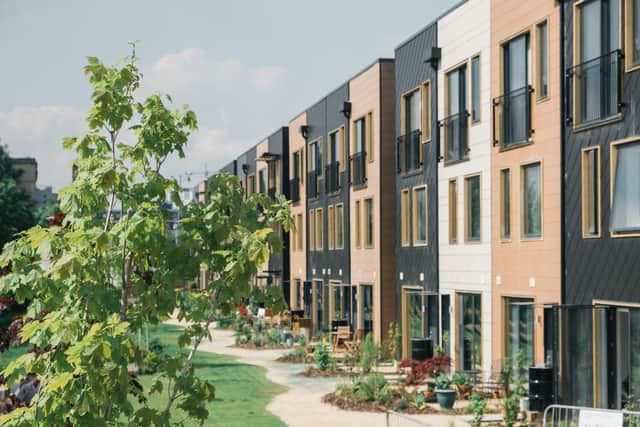
Yorkshire based sustainable developer CITU is an exemplar on how to use brownfield land for homes. Since it launched in 2004 its environment conscious principles dictate that it will only build on brownfield land and the team there proved that is works in terms of profit and for the planet.
Jonathan Wilson, CITU MD, says: “The point of building on brownfield is that the alternative is building on green belt and if you build on green fields you destroy habitat and you build in places that are disconnected from amenities, which means you have to drive everywhere and transport is the biggest emitter of greenhouse gas.”
He agrees whole-heartedly with the Northern Housing Consortium’s proposals and says “If the government is committed to combating the climate emergency, developers must build on brownfield. It’s the right thing to do but it’s not the easiest thing to do because it is technically more challenging.”
He adds that to ensure uptake on the brownfield first requires investment from the government to help remediate land to make it appealing to developers and it needs to be done quickly and with more focus.
“CITU has shown that building on brownfield works as a business model and we are proud of that.
“One of the challenges is that there is more cost upfront initially but the benefit comes at the end when you get amazing buildings and they are close to amenities.
“Look at what CITU does, as a business we have proved the point.”
*Visit www.northern-consortium.org.uk/brownfield-first/