
From hedgehog highways to net-zero schools: How new homes are being designed for wildlife
New housing developments are no longer just about bricks and mortar, they are increasingly being designed as places where people and wildlife can live side by side.

Ecology consultancy Arbtech, a member of the Home Builders Federation (HBF), says modern housebuilding is showing how demand for new homes can be met while also protecting and enhancing nature, by building biodiversity into schemes from the outset rather than adding it later.
Developers are already adopting ecology-led design. Barratt Redrow, the UK’s largest housebuilder, has committed to delivering at least 10 per cent Biodiversity Net Gain (BNG) across new developments and works with the RSPB to integrate wildlife measures from the earliest stages.
Vistry’s Beaulieu development in Chelmsford, inset, demonstrates the scale of ambition. The 3,600-home project combines low-carbon homes with extensive green infrastructure, including 176 acres of parkland, new woodland, meadows and preserved hedgerows.
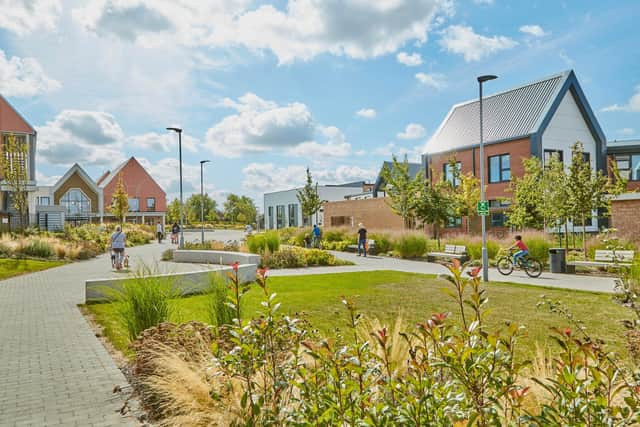

Wildlife such as barn owls, skylarks, bats and badgers are thriving, while deer and hares have returned to restored parkland.
Elsewhere, Gleeson Homes and Taylor Wimpey have partnered with conservation charity Buglife to improve habitats for invertebrates, while Taylor Wimpey is also working with Hedgehog Street to introduce hedgehog highways into developments.
Nicole Gullan, associate director at Arbtech, said early ecological planning is key. She said: “When ecology is considered at the earliest stages of design, new developments can actively enhance biodiversity, rather than simply mitigate harm.
“We’re seeing more housebuilders take a proactive approach, using smart site planning to protect existing habitats, while creating new opportunities for wildlife and people to thrive side by side.”
Modern developments often include native planting, wildlife corridors, bird and bat boxes, green spaces and sustainable drainage systems, all of which help create more resilient communities.
Arbtech says early ecological input can also smooth the planning process by identifying environmental constraints upfront.
Nicole added: “Retrofitting biodiversity into older housing can be challenging and costly. New homes, by contrast, offer a unique opportunity to get it right from the outset; designing places where nature is part of everyday life, not an afterthought.”
The campaign also highlights the energy efficiency of new builds, with Arbtech arguing ecological design complements lower energy use and reduced carbon emissions.
“Lower energy costs and reduced carbon emissions often sit alongside wider ecological benefits,” Nicole said.
“Thoughtful design choices can reduce pressure on natural resources, support biodiversity and create developments that are better for both residents and the environment.”
For buyers, this means more than an energy-efficient home. New neighbourhoods increasingly offer access to green space, better air quality and closer contact with nature.
Nicole said: “Buyers aren’t just moving house. They’re moving into healthier, green environments where ecology-led design helps communities thrive alongside nature. That’s the real power of modern new homes.”