
This innovation from Leeds-based Wrapt could solve the challenge of insulating older homes
Making Britain's ageing housing stock warmer and more energy efficient is one of the biggest challenges facing the drive to cut carbon emissions.

But for owners of older properties, particularly those built before 1919, improving insulation without creating damp and condensation problems can be a difficult balancing act.
Leeds-based retrofit specialist Wrapt Homes believes it has found a way to make the process simpler.
The company has just completed the second installation of its new Breatheasy internal wall insulation system, which is currently patent pending, at a detached four-bedroom house near Harrogate. Designed specifically for older solid-wall homes, the system uses breathable materials that allow moisture to move naturally through walls rather than becoming trapped within them.
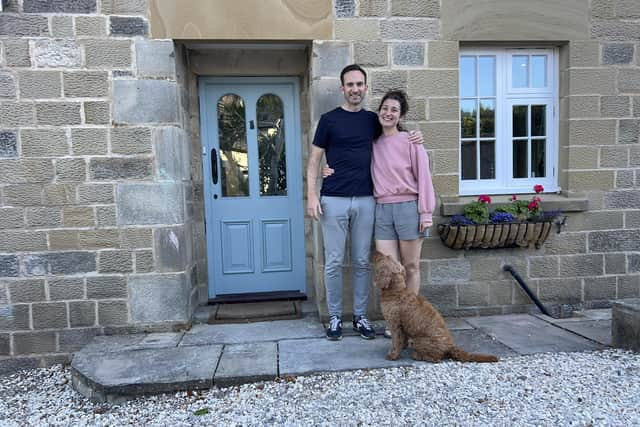

The project belongs to Pete Dyer, who lives with his wife Emily and their two young children in a house dating from 1906, with a more modern extension added in 2008.
After moving from Headingley to the village of Birstwith in April this year, the family quickly realised the original part of the property was noticeably colder than the extension. "It’s quite a windy plot and we noticed there was a lot of wind rushing through the window and door joints," says Pete, head of UK commercial at a construction materials company.
“The plan is to make the building as airtight as possible so we can go to an air source heat pump and remove any need for gas."
Wrapt Homes first carried out a Home Energy Action Plan, including an airtightness survey, to identify where heat was escaping and which improvements would have the biggest impact.

The first stage focused on one of the children's bedrooms, where the survey revealed there was no insulation within the original walls and ceiling.
"It was noticeably colder than the extension side of the house," says Pete. "When the ceiling came down we saw there was no insulation there. Because it's not a cavity wall from when it was built, there was nothing there at all.
"The thing with working with somebody like Wrapt is they can advise on the right materials because old buildings need to breathe."
The installation, which included insulating the ceiling and external walls and improving airtightness around windows and floor junctions, took around six working days.
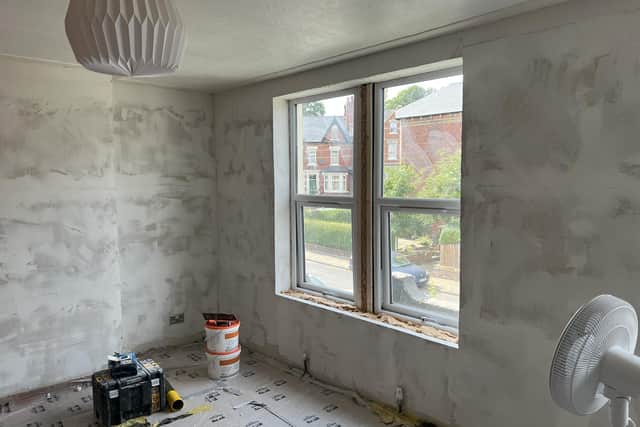
Although the room is only just being completed, Pete says the experience has convinced the family to continue improving the rest of the house over the coming years. "Watching how the guys have been working, you can see there's that commitment to that quality level," he says.
Wrapt director Jamie Keats, inset, says that philosophy of tackling homes gradually has shaped the development of the new system.
"The idea of the wall system is a quick install. It can be done one room at a time," he says. "It was just a really good fit for Pete because he wanted to do his son's bedroom before the more major works happened."
The latest version of the wall system uses hemp insulation grown in East Yorkshire and processed in Scotland. Wrapt previously used wood fibre but switched to hemp because it offers greater flexibility when working with the uneven walls commonly found in older properties.
"You've often got issues with older properties of bending walls and the hemp's really good at being flexible," says Jamie.
The company has also refined the plaster finish to speed up installation, removing the need for a separate plastering stage.
While the recent project took around six days, Jamie believes future installations could eventually be completed by a two-person team in as little as two or three days.
Performance in increasingly hot summers was also a consideration during development. "The hemp has a very high density so it can slow the heat getting through," he says. "It basically levels out the temperature from day to night. At night you can open your windows, get good ventilation and bring the temperature down naturally, but during the day it buffers you from the heat."
The system has been developed in partnership with Energy Systems Catapult and the University of Birmingham and earlier this year won the Big Retrofit Challenge at Futurebuild.
Wrapt says 50mm of breathable wood fibre insulation can reduce heat loss through a typical solid brick wall by around 75 per cent while allowing the building fabric to continue managing moisture naturally.
According to Jamie, one of the biggest challenges is persuading homeowners that retrofit does not have to mean a whole-house renovation costing tens of thousands of pounds.
"We're trying to get people to think about it on a room-by-room basis to manage the disruption,” he says. “Do one room, feel the benefit and then decide if you want to do the next one. It's manageable and you can see the benefit over time."