
New app launched in bid to study effects of Peak District fires on air quality
A new project is aiming to further study the link between upland fires in the Peak District and the region’s air quality, with the public asked to help collect data which could aid researchers.

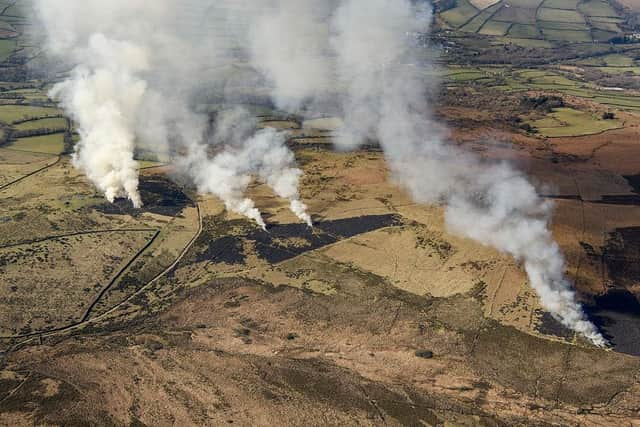
A group of researchers working across four Northern universities have launched an online tool to gather data around fires in the region. The Peak Fire Reporter app asks members of the public to report the location and time of any upland fires that they see in the Peak District, as well as asking them to send in photos and videos of the events.
Information collected from the app will then be compared to data from air quality monitors located around the Peak District, with researchers able to study the link between fires in the region and drops in air quality.
Researchers also hope to eventually use information from the tool to look at the impacts of fires on public health, as well as aiding the enforcement of regulation around prescribed burning.

The project is being delivered by researchers from Sheffield Hallam University, the University of Sheffield, University of Manchester and University of Nottingham, with help from software firm ESRI UK.
Dr Joe Glentworth, a lecturer in nature recovery and rewilding at the University of Manchester, who is working on the project, said: “Often with burning, the debates are around biodiversity, particularly around nesting birds, and also around water quality and carbon.
“Those three things are relatively well studied, whereas the air quality impacts are often the ones that are talked about a lot in the news, but there's very limited work on that. The only studies that have really been done are usually around wildfires and not actually around prescribed burning, so there's a kind of obvious academic gap.”
Prescribed burning describes the managed and rotational burning of moorland vegetation, most often used for grouse management, livestock grazing and wildfire prevention. The season for prescribed burning generally runs from around October to April.
Under new rules brought into place last year, burning is banned on land with peat which is over 30cm deep. The change built on previous regulation which banned burning on specific sections of land with peat over 40cm.
Researchers hope the new Peak Fire Reporter tool could help regulators to further enforce these rules, as well as allowing for further study around the air quality impacts of both prescribed burning and wild fires.
Dr Glentworth added: “Some prescribed burns actually occur outside regulation. In our earlier work we showed that even the 40cm rules still weren’t being well regulated, because of the resources it requires to actually monitor fires in these areas.
“So the more we've been doing this, the more we’re thinking that actually the combination of satellite imagery, sensors, and citizen science can help us regulate the current restrictions on burning in a way that hasn't been done before.”
As well as inputting location, timing and photos to the app, researchers are also asking the public to put in how the fires made them feel emotionally, in a bid to study wider responses to climate change.
To study the public health aspect of fires, researchers plan to look into shifts to hospital admission numbers which take place around the same time.
They will also monitor air quality using a string of sensors which are located around the region.
Dr Rebecca Brownlow, a lecturer in environmental science at Sheffield Hallam University, said: “We have around 12 particulate matter sensors out at the moment across the Peak District.
“Particulate matter comes with burning, and a lot of the health impact comes from these fine particles. But, although we know combustion is a source, it's really difficult to tell what the source is when you get these peaks in these different sensors in the network.
“So this is why the app will really help to narrow down what the source was, and we can really look into what the air quality is like when that fire is occurring and relate these to each other.”
Other accademics working on the project include Dr Anna Hawkins, from Sheffield Hallam University, and Dr Maria Val Martin from the University of Sheffield. Researchers warned that no one should approach a fire if it is not safe to do so, and that any fire should be reported to 999 first, before being logged on the app.